

Headquartered in Mountain View, California, Alphabet Inc. (GOOG) has grown far beyond being just the company behind Google. Today, it sits at the center of the digital economy, with businesses spanning online search, digital advertising, YouTube, cloud computing, and a growing portfolio of artificial intelligence (AI) initiatives. From AI-powered Search features to expanding cloud services and ambitious bets in areas like healthcare and autonomous technology, Alphabet continues to shape how billions of people interact with technology every day.
That reach helps explain why investors have placed Alphabet firmly in the “mega-cap” club. With a massive market capitalization of $4.3 trillion, the company stands among the most valuable businesses. Wall Street’s confidence has been fueled by strong execution across its core businesses, rapid growth in Google Cloud, and the belief that Alphabet is well-positioned to capitalize on the AI boom for years to come.
More Top Stocks Daily: Go behind Wall Street’s hottest headlines with Barchart’s Active Investor newsletter.
Still, even market giants hit bumps along the way. Alphabet's shares climbed to a 52-week high of $404.47 on May 18, but have since pulled back about 12.1%. Some investors have grown cautious about the company’s rising spending levels, particularly as Alphabet pours billions into AI infrastructure. Broader market swings have also added pressure.
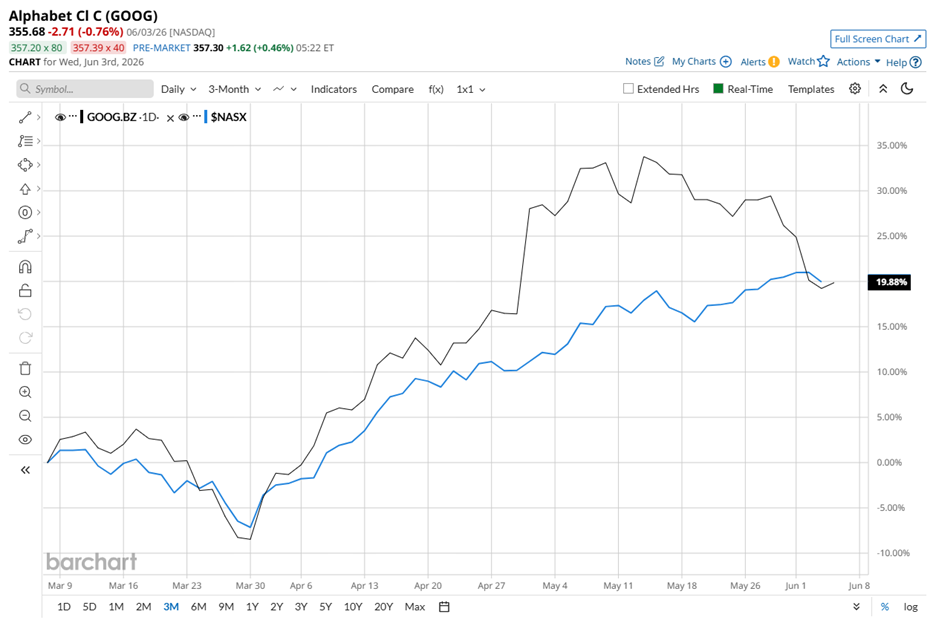
Yet, over the past three months, GOOG stock has gained 17.2%, although it has slightly trailed the Nasdaq Composite’s ($NASX) 19.3% surge during the same period.
 www.barchart.com
 In 2026 so far, GOOG is up 13.4%, respectable, but still behind the Nasdaq’s 15.5% return on a year-to-date (YTD) basis as investors weigh Alphabet’s AI opportunities against the hefty price tag required to pursue them. Zoom out further, and the story changes dramatically. Over the past 52 weeks, Alphabet’s shares have soared 112.1%, crushing the Nasdaq’s 38.4% gain as investors cheered AI-driven product upgrades and the impressive momentum coming from Google Cloud.
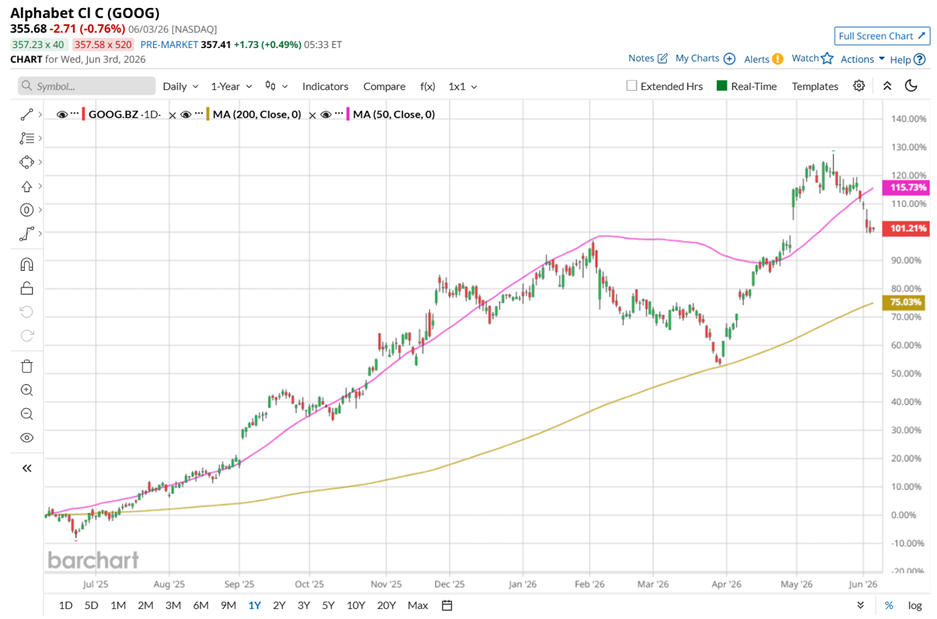
The chart also suggests that Alphabet’s longer-term uptrend remains on solid footing. GOOG has traded above its 200-day moving average for most of the past year, reflecting sustained investor confidence. However, the recent pullback has pushed the stock below its 50-day moving average, signaling that some near-term momentum has faded as investors digest rising AI-related spending.
 www.barchart.com
 For most of the past year, Alphabet looked like one of Wall Street’s favorite AI stories. While investors poured money into anything connected to AI, Google kept its core business growing while building for the future. GOOG stock delivered stellar rally over the past year as investors cheered a series of AI-powered Search upgrades and strong momentum at Google Cloud. Search advertising remained a cash-generating machine, while Cloud emerged as one of the company’s fastest-growing businesses. Together, those businesses gave investors confidence on Alphabet.
But lately, the story has hit a speed bump. Shares slipped after Alphabet unveiled plans to raise over $80 billion through equity offerings to help fund its expanding AI infrastructure ambitions. The market’s reaction was not necessarily about doubts over AI demand. Instead, it reflected growing concerns about the cost of competing in the AI race.
After all, Alphabet is one of the greatest cash-flow generators corporate America has ever produced. Investors are accustomed to seeing Google fund its projects internally. So, when a company with a fortress balance sheet turns to the equity market, it naturally raises eyebrows. The immediate concern is dilution. More shares outstanding means existing shareholders own a slightly smaller piece of the company. But the bigger issue is what the capital raise says about the scale of AI spending. Building massive data centers, securing advanced chips, and creating enough computing power to compete at the cutting edge of AI now requires staggering amounts of money – even for companies as large as Alphabet.
That leaves investors debating two very different interpretations. Bulls see a company making an aggressive move to seize a generational opportunity. Bears see a warning sign that the AI infrastructure bill is growing faster than expected and may take years to generate acceptable returns. For now, that debate is creating uncertainty around the stock. Alphabet’s long-term AI opportunity remains intact, but Wall Street is beginning to realize that winning the AI race is not just about having the best technology. It is also about how much companies are willing and able to spend to stay ahead.
Putting next to another Silicon Valley heavyweight Apple Inc. (AAPL) highlights just how strong GOOG’s run has been. Over the past 52 weeks, Alphabet has comfortably outpaced Apple’s 52.6% gain. However, the script has flipped in 2026, with AAPL advancing 14.1% YTD and GOOG has lagging behind it.
Despite the recent underperformance, Wall Street analysts are strongly bullish on GOOG stock. The stock has a consensus rating of “Strong Buy” from the 53 analysts covering it. The mean price target of $431.08 implies a 21.2% upside from current levels, while the Street-high price target of $515 indicates GOOG stock could rise as much as 45%.
On the date of publication, Sristi Jayaswal did not have (either directly or indirectly) positions in any of the securities mentioned in this article. All information and data in this article is solely for informational purposes. For more information please view the Barchart Disclosure Policy here.
More news from Barchart
These 2 AI Stocks Dominated Headlines in May. How to Play Them in June. 3 Bear Put Spread Trade Ideas For This Tuesday Nasdaq Futures Plunge as Broadcom Sinks on Disappointing AI Chip Sales Forecast Dear Dividend Investors, Mark Your Calendars for June 23