

Eli Lilly and Company’s LLY stock has risen 14% in the past month, backed by several positive developments. Robust first-quarter 2026 results and a guidance raise were the biggest catalysts. Also last month, Lilly announced that CVS Caremark, a large U.S. pharmacy benefit manager (PBM), expanded insurance coverage for Lilly’s obesity drugs. CVS Caremark announced it will cover Foundayo beginning June 1 and restore broader Zepbound coverage starting in October.
Moreover, in a pivotal phase III obesity study, data showed that Lilly’s next-generation triple-agonist obesity candidate, retatrutide, achieved weight loss of about 28% over 80 weeks. Lilly also announced three acquisitions to build its infectious disease portfolio.
However, though the stock’s bull run will impress investors, those with a long-term investment horizon should make a decision based on the company’s fundamentals after carefully analyzing its strengths and weaknesses.
Strong Growth of LLY’s GLP-1 Drugs Mounjaro and Zepbound
Lilly boasts a robust portfolio of treatments for diabetes and other cardiometabolic conditions, with its cardiometabolic division emerging as the company’s strongest segment. This success is largely attributed to blockbuster demand for its GLP-1 therapies, Mounjaro and Zepbound. Despite a short time on the market, Mounjaro and Zepbound have become key top-line drivers for Lilly, with demand rising rapidly. These therapies account for more than 60% of the company’s total revenues.
Mounjaro is the market leader in new prescriptions within type II diabetes incretin analogs in both the United States and ex-U.S. markets. Zepbound also holds a leading market share in the branded obesity market with nearly 70% share of new prescriptions.
In the first quarter, Mounjaro recorded sales of $8.66 billion, up 125% year over year, while Zepbound’s sales were $4.16 billion, up 80% year over year, driven by increased demand, which offset the impact of lower pricing. The positive trend is expected to continue in 2026.
New Drugs Also Contributing to LLY’s Growth
In addition to Mounjaro and Zepbound, Lilly has secured approvals for several other new therapies over the past few years. These include Omvoh for treating ulcerative colitis and Crohn’s disease, BTK inhibitor Jaypirca for mantle cell lymphoma and chronic lymphocytic leukemia, Ebglyss for moderate-to-severe atopic dermatitis, Kisunla (donanemab) for early symptomatic Alzheimer’s disease and Inluriyo (imlunestrant) for metastatic breast cancer. These newly approved drugs are also contributing to Lilly’s revenue growth, with the positive trend expected to continue.
Lilly’s Broad Obesity Pipeline
Lilly is developing several next-generation, more powerful and more convenient GLP-1–based treatments, including oral options and multi-acting candidates.
In early April 2026, Lilly gained FDA approval for its once-daily oral GLP-1 pill Foundayo (orforglipron) for treating obesity. Foundayo, which offers the benefits of GLP-1 therapy in a pill form, can prove to be a commercial game-changer for Lilly. Early launch data for Foundayo has been encouraging, and insurance coverage for the pill is expanding rapidly through major PBMs. Lilly expects to launch Foundayo in most international markets during 2027.
Oral pills will be a more convenient alternative to the currently available once-weekly injectable obesity treatments like Zepbound and Novo Nordisk’s NVO Wegovy. Oral pills may significantly lower the treatment burden and potentially broaden patient adoption versus injections. Oral pills can also be manufactured at scale to meet global demand, which, in turn, can drive billions in additional sales. In addition to obesity and diabetes, Lilly is evaluating Foundayo in six phase III studies for other diabetes and obesity-related diseases.
For the type II diabetes indication, Lilly has filed regulatory applications in several countries, while it expects to file the same in the United States in late second-quarter 2026.
In its GLP pipeline, retatrutide is one of Lilly’s most important late-stage candidates, as it targets three biological pathways — GLP-1, GIP and glucagon — potentially offering greater weight-loss and metabolic benefits than current therapies. Phase III studies have shown strong results in obesity, type II diabetes and knee osteoarthritis pain, positioning the drug as a potential next-generation growth driver. Lilly plans to seek approval for retatrutide in obesity and knee osteoarthritis pain in 2026.
Efforts to Diversify Beyond Obesity & Diabetes
In the past couple of years, Lilly has upped its efforts to diversify beyond GLP-1 drugs by expanding into cardiovascular, oncology and neuroscience areas. In 2026 so far, Lilly has announced six proposed acquisitions — Centessa Pharmaceuticals, Ajax Therapeutics, Kelonia Therapeutics, Orna Therapeutics, CrossBridge Bio and Ventyx Biosciences — to diversify beyond its GLP-1 franchise and strengthen its pipeline in oncology, neuroscience, RNA and cell therapies. It also agreed to acquire three private vaccine developers in May 2026, adding programs targeting shingles, bacterial infections and Epstein-Barr virus. In 2025, it also announced several M&A deals.
Race to Make Oral Obesity Pill Intensifies
The global obesity drug market is projected to grow dramatically, reaching nearly $95 billion by 2030 and potentially $125 billion by 2035, according to Goldman Sachs estimates.
Nordisk had gained approval for an oral version of its obesity drug, Wegovy, in December 2025 and launched the pill in January 2026, which gave it a first-mover advantage over Foundayo. However, Lilly may be able to close the gap quickly now that it has launched Foundayo. Also, Foundayo offers better patient convenience as it can be taken at any time of day, with or without food. In contrast, NVO’s Wegovy pill has to be taken on an empty stomach, followed by a waiting period of 30 minutes before eating. However, in terms of side effects, Wegovy has a slight edge as it seems to have a more stable safety and tolerability profile than Foundayo, whose use is associated with some gastrointestinal side effects.
While Lilly and Novo Nordisk currently dominate this space, smaller biotechs like Structure Therapeutics GPCR and Viking Therapeutics VKTX are also developing oral GLP-1 drugs for treating obesity.
Viking Therapeutics’ dual GIPR/GLP-1 receptor agonist, VK2735, is being developed both as oral and subcutaneous formulations for the treatment of obesity. Viking plans to advance oral VK2735 into phase III development for obesity in the fourth quarter of 2026.
Structure Therapeutics’ phase II ACCESS study on its orally administered GLP-1 RA, aleniglipron, demonstrated significant weight loss across all doses. Structure Therapeutics expects to initiate the late-stage program of aleniglipron in obesity in the second half of 2026.
LLY’s Stock Price, Valuation and Estimates
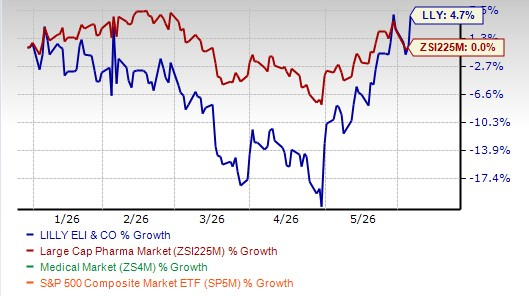
Lilly’s stock has risen 4.7% so far this year compared with no change for the industry.
LLY Stock Outperforms Industry
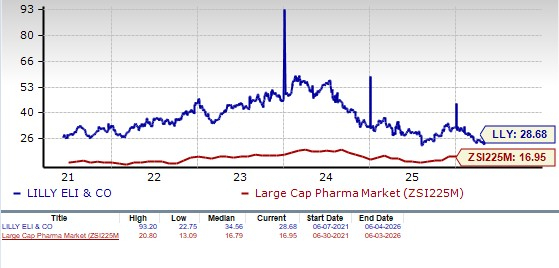
From a valuation standpoint, Lilly’s stock is expensive. Going by the price/earnings ratio, the company’s shares currently trade at 28.68 forward earnings, higher than 16.95 for the industry. However, the stock is trading below its 5-year mean of 34.56.
LLY Stock Valuation
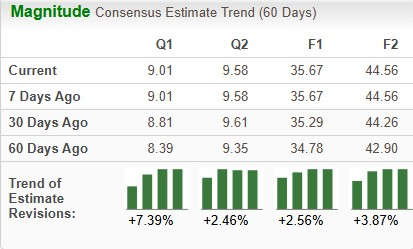
The Zacks Consensus Estimate for 2026 earnings has risen from $35.29 to $35.67 per share over the past 30 days, while that for 2027 has risen from $44.26 to $44.56 per share over the same timeframe.
LLY Estimate Movement
Stay Invested in LLY Stock
Lilly has its share of problems. Prices of most of Lilly’s products are declining in the United States. Price is expected to continue to be a drag on top-line growth in the low to mid-teens percentage in 2026. Rising competition in the GLP-1 diabetes/obesity market is a key headwind. Also, sales of late-life cycle products like Trulicity, Taltz and Verzenio are expected to be flat to down in 2026.
However, Lilly is the only drug company with a market value above $1 trillion. Though the stock is not cheap, Lilly is a great stock to have in one’s portfolio, given its significant price appreciation, dominant obesity franchise, strong earnings growth, deep pipeline and bullish analyst sentiment. One should stay invested in this Zacks Rank #3 (Hold) stock. You can see the complete list of today’s Zacks #1 Rank (Strong Buy) stocks here.
Radical New Technology Could Hand Investors Huge Gains
Quantum Computing is the next technological revolution, and it could be even more advanced than AI.
While some believed the technology was years away, it is already present and moving fast. Large hyperscalers, such as Microsoft, Google, Amazon, Oracle, and even Meta and Tesla, are scrambling to integrate quantum computing into their infrastructure.
Senior Stock Strategist Kevin Cook reveals 7 carefully selected stocks poised to dominate the quantum computing landscape in his report, Beyond AI: The Quantum Leap in Computing Power .
Kevin was among the early experts who recognized NVIDIA's enormous potential back in 2016. Now, he has keyed in on what could be "the next big thing" in quantum computing supremacy. Today, you have a rare chance to position your portfolio at the forefront of this opportunity.
See Top Quantum Stocks Now >>Want the latest recommendations from Zacks Investment Research? Today, you can download 7 Best Stocks for the Next 30 Days. Click to get this free report
Novo Nordisk A/S (NVO): Free Stock Analysis Report
Eli Lilly and Company (LLY): Free Stock Analysis Report
Viking Therapeutics, Inc. (VKTX): Free Stock Analysis Report
Structure Therapeutics Inc. Sponsored ADR (GPCR): Free Stock Analysis Report
This article originally published on Zacks Investment Research (zacks.com).