


Study after study suggests that consistently beating the market through stock picking is exceptionally difficult. Yet in 2026, retail investors are putting that assumption to the test—and, so far, they are winning. Recent research from JPMorgan indicates that everyday investors have outperformed several widely followed benchmark strategies, helped by a simple but powerful approach: concentrate on the biggest beneficiaries of the AI boom rather than spreading capital across broad index exposure.
That outperformance has not been driven by obscure names or lucky one-off trades. Instead, retail investors have leaned heavily into a handful of core AI winners—particularly semiconductors and AI infrastructure plays like Micron (MU) and Nvidia (NVDA)—where fundamentals have remained strong, and earnings expectations have continued to rise. In numerous instances, retail traders have also shown unusual conviction, holding onto positions through volatility instead of rushing to take profits, suggesting they believe the AI rally still has room to run.
More Top Stocks Daily: Go behind Wall Street’s hottest headlines with Barchart’s Active Investor newsletter.
So, can retail investors keep beating Wall Street benchmarks by sticking with AI leaders—or is the easy money already made? Let’s take a closer look.
 www.barchart.com
 AI Stocks Help Retail Investors Outperform Wall Street Benchmarks
Study after study has shown that stock picking is extraordinarily difficult, with the vast majority of active fund managers historically failing to consistently outperform the S&P 500 ($SPX). According to data from S&P Dow Jones Indices, 79% of U.S. large-cap equity fund managers underperformed the S&P 500 in 2025. To that, retail investors respond, “What, like it’s hard?” And for good reason.
A JPMorgan team led by Head of U.S. Equity Quant Strategy Arun Jain found that most of the stocks purchased by retail investors this year have been semiconductor and AI-related names. Moreover, Jain found that everyday investors are actually superb at picking stocks. They compared those purchases with a dollar-cost averaging (DCA) strategy, in which investors invest the same amount at regular intervals.
Jain said retail investors’ individual stock picks have outperformed returns generated by dollar-cost averaging strategies tied to the tech-heavy Nasdaq 100 Index, as well as several of the top-performing segments of the AI trade in 2026. The outperformance has been driven largely by concentrated positions in companies such as Micron Technology, Advanced Micro Devices (AMD), and Nvidia, all of which have delivered strong year-to-date (YTD) returns, with the first two posting triple-digit gains. “In single stocks, retail has unsurprisingly outperformed benchmarks over the past month or so, consistent with a concentrated tilt toward MU, AMD, and NVDA,” the strategist wrote.
Meanwhile, performance within exchange-traded fund (ETF) holdings has been relatively more balanced. Retail investors have outperformed the broader S&P 500 on a YTD basis. However, retail portfolios relying on broader ETF holdings trailed the Nasdaq 100 DCA strategy, highlighting a distinction between successful single-stock picking and lagging diversified fund investments.
Can Retail Investors’ Favorite AI Stocks Keep Rallying?
JPMorgan’s research showed that despite the strong performance of retail investors’ favorite stocks, they have not rushed to take profits, suggesting they expect the rally to continue. With that, let’s take a closer look at whether the stocks that have helped investors outperform the broader market so far this year still have room to run.
Memory stocks are clearly top of mind for retail investors. JPMorgan said Micron and Sandisk (SNDK) have ranked among retail investors’ top picks since February, with both stocks posting outsized gains this year. And the key point here is that the rally in memory stocks is far from over. Recent quarterly updates from companies such as Dell (DELL) and Hewlett Packard Enterprise (HPE) highlighted booming demand for AI servers. Notably, AI servers require high-bandwidth memory (HBM) to handle the processing of massive volumes of data. Demand for HBM currently significantly outpaces supply, and industry capacity is limited by complex manufacturing and packaging bottlenecks. This structural shortfall gives suppliers immense pricing power, resulting in premium margins. With that, companies in the sector are expected to continue delivering explosive profit growth, which should support further gains in their stocks.
Moving on to another retail investor favorite: chipmaker Advanced Micro Devices. The company has closed the gap with Intel in CPU chips and is now positioning itself to challenge Nvidia in the GPU market. The company is already generating billions in GPU sales and has secured two major deals with Meta and OpenAI that are expected to fuel future revenue growth. Moreover, AMD has a massive opportunity in the data center CPU market. Furthermore, AMD has a massive opportunity in the data center CPU market. I recently estimated that the company could generate $50 billion in annual server CPU revenue by 2030 under a conservative scenario—roughly three times what its entire data center segment generated in 2025. With that, AMD stock looks well-positioned for further gains.
Finally, there’s Nvidia, the largest player in the AI chip market. Nvidia has already secured the lead in training, with its GPUs remaining the absolute gold standard for training and executing large language models (LLMs). Moreover, the company is well prepared for the next phase of the AI boom—inference, which involves running trained models continuously, efficiently, and closer to the end user. Nvidia’s Vera Rubin platform broadens its footprint across data center CPUs, GPUs, networking, and rack-scale AI systems. As long as AI spending continues to rise, Nvidia should remain a major beneficiary, which should also support its stock price.
S&P 500 Rally Could Get a Boost From Retail Investors
A team led by another JPMorgan strategist, Nikolaos Panigirtzoglou, expects retail investors’ share of U.S. equity trading to rebound after dropping to a four-year low at the end of the first quarter. The strategists argue that this could provide a new tailwind for U.S. equities.
“While the share of retail investors in U.S. equity trading declined further in the first quarter to 17%, we expect a rebound in the second quarter, echoing the second quarter of 2025,” according to the team led by Nikolaos Panigirtzoglou. “This would be consistent with the retail impulse we see in the options space, where the call option buying by small option traders subsided between October 2025 and March 2026 but rose sharply in April/May 2026.”
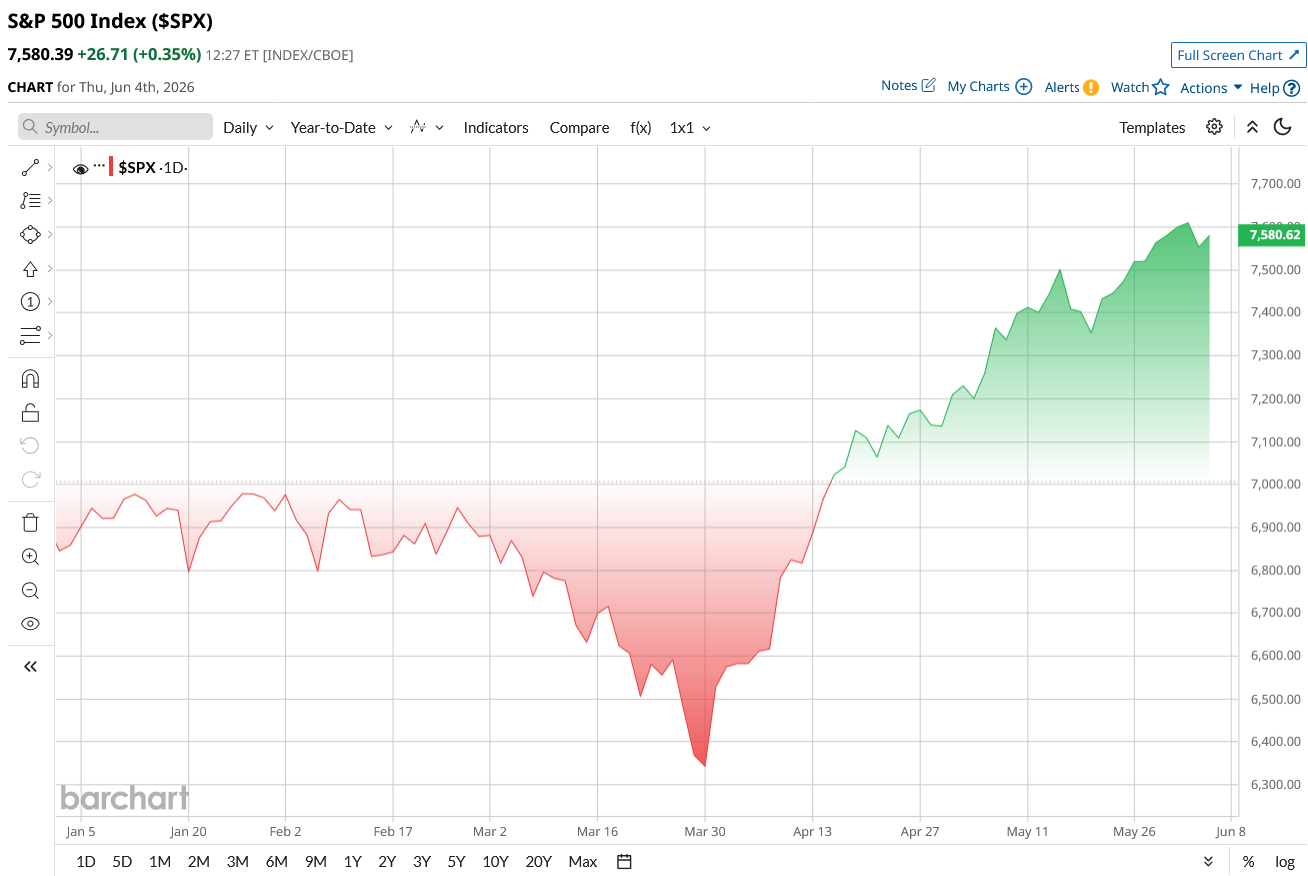
The S&P 500 Index has exhibited a similar performance pattern in 2025 and 2026, with muted returns in the first quarter, followed by a sharp rally in the second quarter. The team noted that a resurgence in retail trading could provide fresh momentum for the broader market.
On the date of publication, Oleksandr Pylypenko had a position in: NVDA . All information and data in this article is solely for informational purposes. For more information please view the Barchart Disclosure Policy here.
More news from Barchart
Greg Abel is Writing Checks for Berkshire Hathaway in a Hurry. You Should Write One for BRK.B Stock. Retail Investors Are Beating Wall Street Benchmarks With AI Stocks. Why That Could Change Soon. Hunting for the Next Nvidia Is No Easy Feat. Small-Cap Tech Stocks Promise Riches but Really Are Just Rags. Dear Adobe Stock Fans, Mark Your Calendars for June 11