

Few would have expected Space Exploration Technologies (SPCX) to end up in a value-stock ETF. Yet that is exactly what happened when the newly public space and satellite giant was added to the Schwab U.S. Large-Cap Value ETF (SCHV), a fund traditionally associated with mature, cash-generating companies rather than high-profile growth stories. SCHV tracks an index of large-cap U.S. stocks exhibiting value characteristics and manages more than $15 billion in assets, making SpaceX’s inclusion a notable milestone for both the company and investors.
SCHV has added a small position in SpaceX, with the stock representing just 0.012% of the fund’s portfolio. While the allocation is too small to materially affect performance, it gives value-focused investors exposure to the newly public aerospace and satellite company and highlights SpaceX’s growing inclusion.
More Top Stocks Daily: Go behind Wall Street’s hottest headlines with Barchart’s Active Investor newsletter.
With the company generating substantial cash flows from its rapidly expanding Starlink business, dominating the global launch market, and trading at valuation metrics that index providers apparently deem attractive relative to its fundamentals, SpaceX is beginning to blur the line between growth and value.
Is SPCX the value stock you have been looking to add to your portfolio?
About SpaceX Stock
SpaceX is a leading aerospace, satellite communications, and space technology company founded by Elon Musk. The company designs and launches reusable rockets, operates the rapidly expanding Starlink satellite internet network, and provides launch services for commercial, government, and defense customers worldwide.
Headquartered in Hawthorne, California, SpaceX has emerged as a dominant force in the global space industry and recently became one of the world’s most valuable publicly traded companies following its historic IPO. SpaceX’s market cap is around $2.2 trillion, placing it among the largest companies by market value.
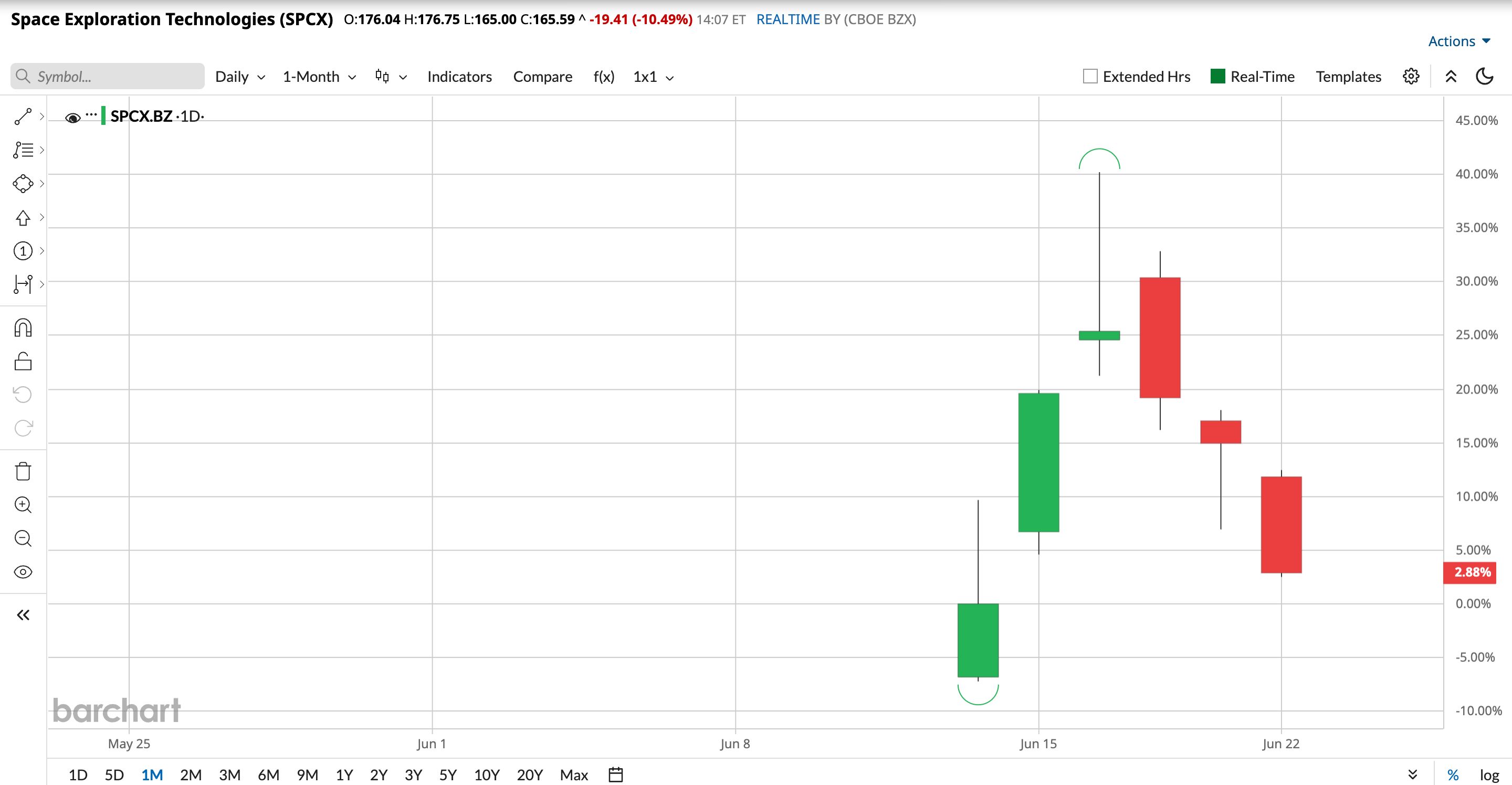
SpaceX has delivered one of the most explosive public market debuts in recent history. The company completed the largest IPO ever on June 11, 2026, pricing 555.6 million shares at $135 apiece. Shares began trading on the Nasdaq on June 12 under the ticker SPCX and immediately attracted intense investor demand.
On its first day of trading, SpaceX opened at $150 and closed at $160.95, representing a 19.2% gain from the IPO price. During the session, the stock climbed as high as $176.52, briefly valuing the company at more than $2 trillion.
The momentum continued over the following days as retail investors piled into the stock. Within its first three trading sessions, SpaceX shares have witnessed a meteoric rise from its debut levels, making it one of the strongest large-cap IPO performances on record.
Even after experiencing its first post-IPO pullback in the previous session, SpaceX remained well above its $135 offering price, closing the session at $191.82 on June 17. The stock’s past trading days were marked by exceptional volatility, heavy trading volumes, and unprecedented retail investor interest, underscoring Wall Street’s enthusiasm for the company’s leadership in space launch services, satellite connectivity through Starlink, and emerging AI infrastructure opportunities.
 www.barchart.com
 SpaceX’s inclusion in the SCHV has raised eyebrows because the stock hardly fits the traditional definition of a value investment. Despite being added to a fund focused on undervalued large-cap companies, SpaceX trades at an eye-catching 125.33 times sales, a valuation multiple that far exceeds the sector median.
Steady Top-Line Positioning, but Bottom Line in the Red
SpaceX delivered strong top-line growth but remained unprofitable as the company continued investing aggressively in artificial intelligence infrastructure, Starlink expansion, and its next-generation Starship program.
According to its filing, SpaceX generated first-quarter 2026 revenue of $4.7 billion, while reporting an operating loss of $1.9 billion and adjusted EBITDA of $1.1 billion. The company posted a Q1 2026 loss of $1.27 per share, compared with a loss of $0.18 per share in the prior-year period.
On an annual basis, the company generated $18.7 billion in revenue during 2025, up roughly 33% from $14 billion in 2024, while adjusted EBITDA increased to $6.6 billion. However, SpaceX posted a 2025 operating loss of $2.6 billion. Its net loss came in at $4.94 billion, or $1.69 per share, compared with net income of $791 million, or $0.01 per share, in 2024.
The company’s financial performance was driven primarily by its Connectivity segment, which includes Starlink. In 2025, the segment generated $11.4 billion in revenue, representing 49.8% year-over-year (YOY) growth, while operating income surged 120.4% to $4.4 billion and adjusted EBITDA climbed 86.2% to $7.2 billion. During the first quarter of 2026, the Connectivity business delivered $3.3 billion in revenue.
The Space segment, which includes launch services and Starship development, generated $4.1 billion of revenue in 2025. In the first quarter of 2026, segment revenue totaled $619 million, with an operating loss of $662 million.
Meanwhile, SpaceX’s newly consolidated AI segment generated $3.2 billion of revenue in 2025 but posted an operating loss of $6.4 billion. In the first quarter of 2026, AI revenue was $818 million while the operating loss widened to $2.5 billion. Capital expenditures in the AI segment totaled $12.7 billion in 2025 and an additional $7.7 billion in Q1 2026, reflecting massive investments in AI compute infrastructure and model development.
Analysts expect the company to post a loss per share of $0.89 for 2026, which is a decline of 100.1% but improve 73.1% to -$0.24 in 2027.
What Do Analysts Expect for SpaceX Stock?
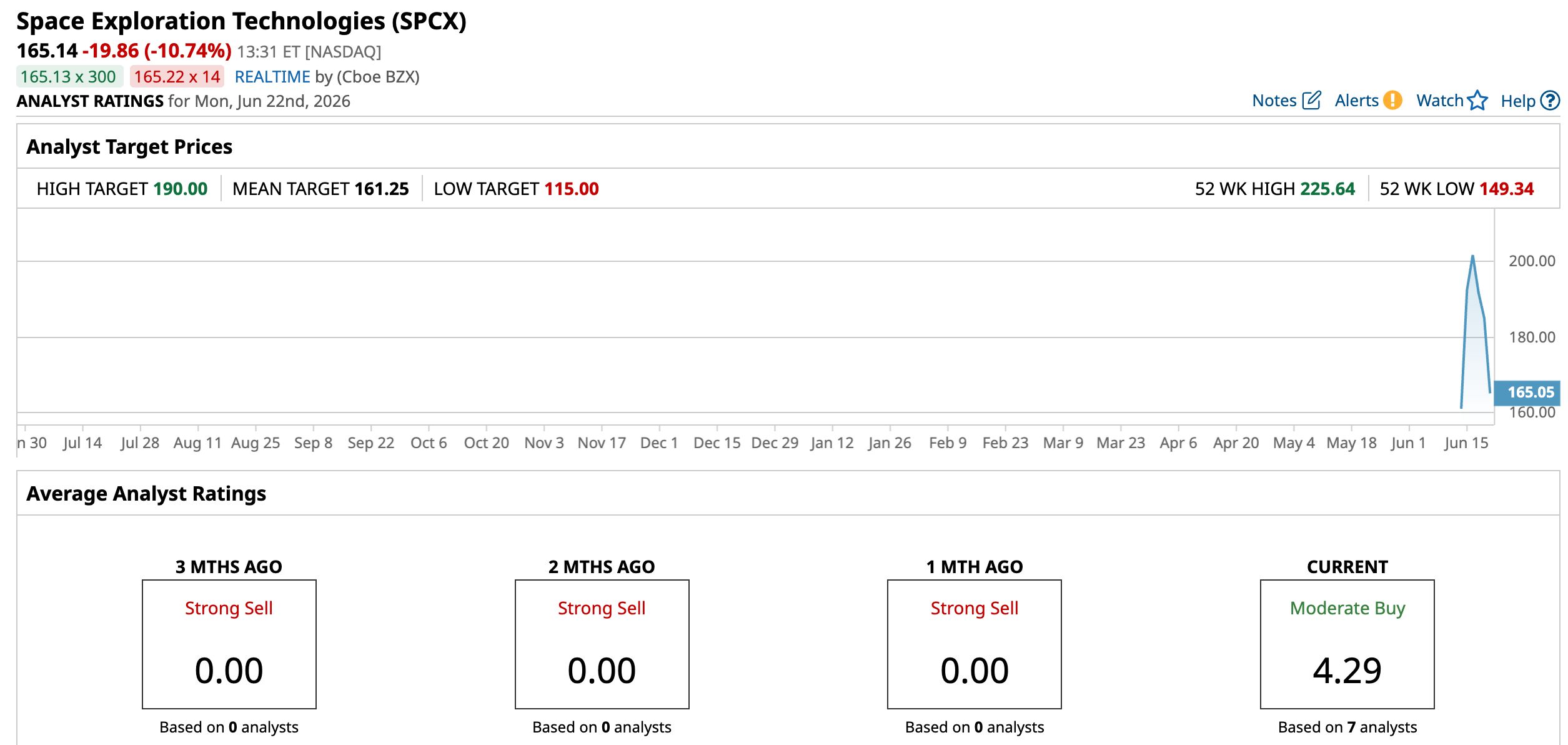
Recently, CFRA initiated coverage of SpaceX with a “Sell” rating and a $115 price target, arguing that the stock’s valuation already assumes the successful execution of several ambitious growth initiatives.
However, on the other hand, Oppenheimer initiated coverage of SpaceX with an “Outperform” rating and a $190 price target, citing the company’s unique strategy of combining satellite communications, cloud computing, and artificial intelligence through space-based infrastructure.
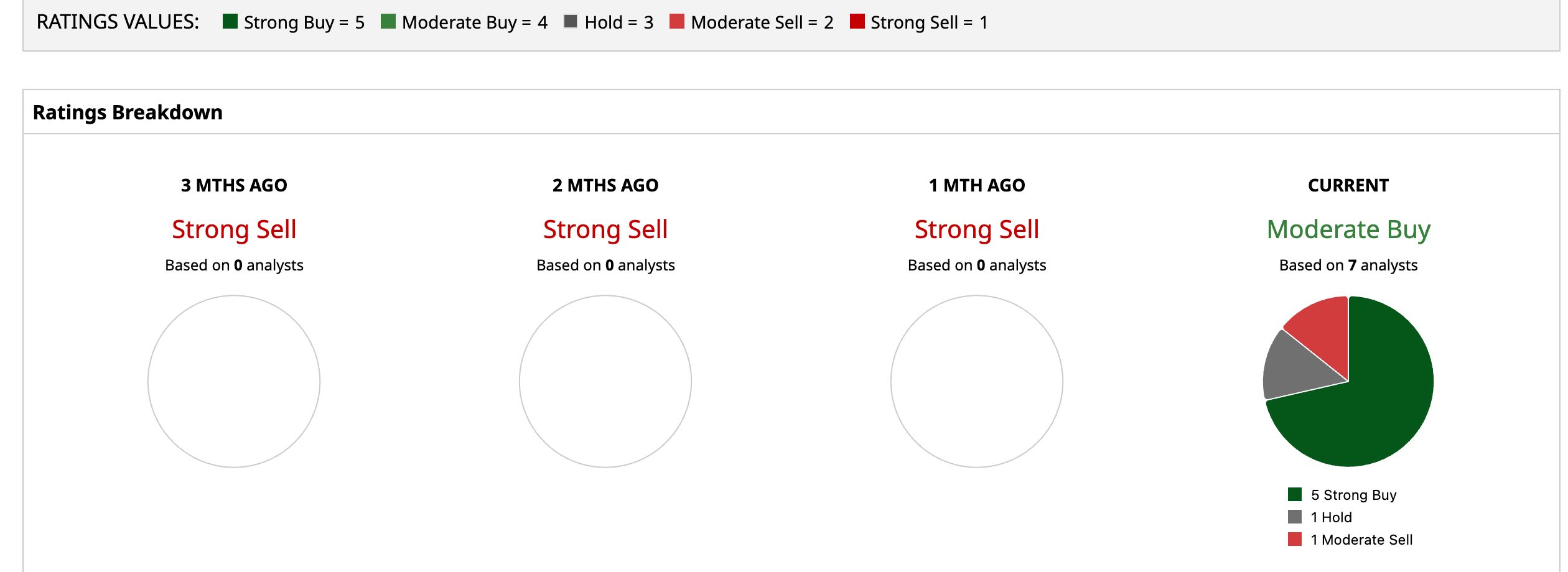
Overall, SpaceX has a consensus “Moderate Buy” rating. Of the seven analysts covering the stock, five advise a “Strong Buy,” one suggests a “Hold,” and one gives a “Moderate Sell” rating.
The stock is currently trading at a premium to the average analyst price target of $161.25, while slightly below Oppenheimer’s Street-high target price of $190.
 www.barchart.com
  www.barchart.com
 On the date of publication, Subhasree Kar did not have (either directly or indirectly) positions in any of the securities mentioned in this article. All information and data in this article is solely for informational purposes. For more information please view the Barchart Disclosure Policy here.
More news from Barchart
SpaceX Is Apparently a Value Stock as Schwab Adds SPCX to Its Popular SCHV ETF Jabil Shares Jumped on Earnings as AI Demand Boosts Its Business. JBL Stock Is No Longer Cheap. These 2 Veteran Wall Street Firms Just Revamped Their Micron Stock Price Targets Ahead of Earnings D-Wave Just Unveiled a Major Quantum Breakthrough. QBTS Stock Looks Ready for Another Surge.