

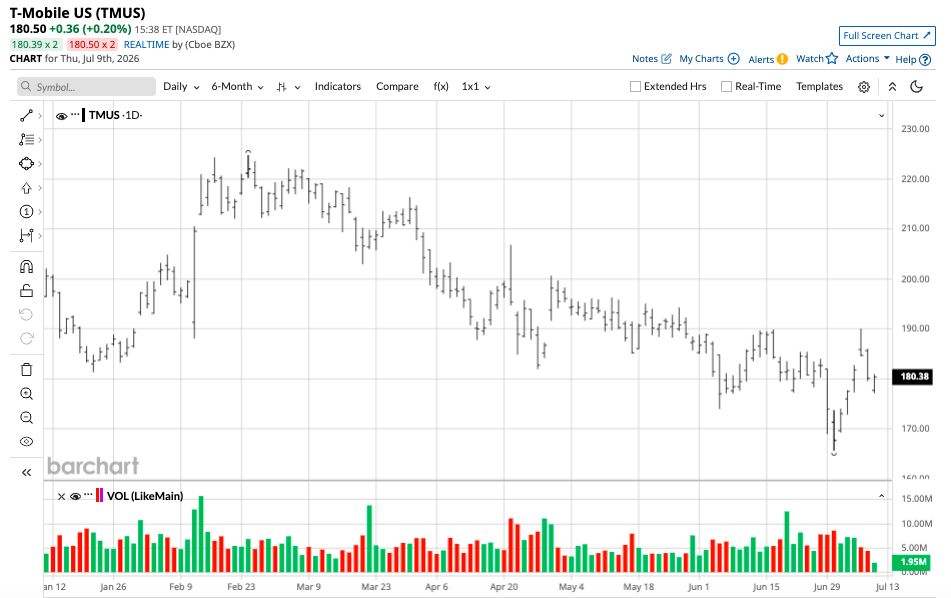
T-Mobile (TMUS) stock has tumbled 22% over the past 52 weeks and fallen 11% since the beginning of 2026. One of the reasons for this struggle is concern over the competition that T-Mobile could face from satellite companies. Specifically, the satellites of these firms enable them to provide direct-to-device (D2D) voice and data services to unmodified smartphones.
However, many of these D2D providers are actually looking to partner with carriers rather than replace them — and for important logistical reasons, that strategy is unlikely to change for the foreseeable future. Meanwhile, T-Mobile aims to have 18 million to 19 million customers for its broadband services by 2030. That said, the company had more than 130 million total customers in the U.S. in mid-2025, meaning mobile services revenue likely makes up the vast majority of its total sales.
More Top Stocks Daily: Go behind Wall Street’s hottest headlines with Barchart’s Active Investor newsletter.
Given these points, coupled with an upgrade from one analyst and solid valuation multiples, TMUS stock looks like an attractive name for value investors despite satellite competition concerns.
 www.barchart.com
 Satellite Companies Are Likely to Keep Partnering With Carriers
Three companies that are providing (or looking to provide) D2D services — SpaceX (SPCX), AST SpaceMobile (ASTS), and Amazon (AMZN) — have all signed partnership deals with carriers for their services. In fact, T-Mobile has specifically partnered with SpaceX's Starlink, with the former already offering some D2D services through this alliance.
Because it would be tremendously costly and time-consuming for D2D companies to acquire and maintain stores, hire salespeople, and obtain customers on their own, in my view these firms are likely to keep partnering with mobile carriers like T-Mobile for the foreseeable future. Additionally, Amazon is planning to directly offer broadband internet services to consumers and businesses, which does not require stores or as many salespeople, while SpaceX is already offering broadband internet and seeking to expand that business. With that in mind, Amazon and SpaceX will likely focus on growing their broadband businesses before they jump into competing with T-Mobile and other players in the mobile sector.
Bank of America Upgrades TMUS Stock
Bank of America agrees that the concerns over competition from satellite companies are overdone. On July 6, BofA upgraded TMUS stock to a “Buy” rating from “Neutral" and provided a $220 price target. According to analyst Michael Funk, TMUS stock is “trading at trough valuation and […] more than reflects the competitive threat.”
On the valuation front, shares of TMUS are also relatively cheap at 17.2 times forward earnings and 2.2 times sales, considering T-Mobile's bottom line is growing significantly and that it has a 2.21% forward dividend yield. Given that analysts on average expect EPS to climb 5% in fiscal 2026 and jump 23% in fiscal 2027, that's an attractive valuation.
Overall, TMUS stock has a consensus “Strong Buy” rating on Wall Street, while Bank of America's $220 price target suggests potential upside of 21% from current levels.
On the date of publication, Larry Ramer had a position in: AMZN , AMZU , ASTS . All information and data in this article is solely for informational purposes. For more information please view the Barchart Disclosure Policy here.
More news from Barchart
Mizuho Just Upgraded Five Below Stock. Here's Why. Worries About T-Mobile’s Competition From Satellite Companies Look Overdone Virax Biolabs Stock Skyrockets 100% on Exclusive Distribution Agreement iShares’ New Nasdaq-100 ETF May Be Cheap. But IQQ Is a Giant Red Flag That the AI Bubble Is Getting Ready to Burst.