

Nvidia (NVDA) gets most of the attention when it comes to data centers and artificial intelligence-capable computing capacity. That’s only natural, as it’s the biggest company in the world by market cap and built fortunes on its powerful GPUs.
But savvy investors shouldn’t ignore the other players on the field, and Nvidia’s biggest competitor just made a move. Advanced Micro Devices (AMD) announced a collaboration with 5C, an AI digital infrastructure provider, to build the next generation of gigascale AI campuses.
More Top Stocks Daily: Go behind Wall Street’s hottest headlines with Barchart’s Active Investor newsletter.
The agreement pairs AMD’s experience in AI compute and rack-scale architecture with 5C's track record of designing, building, and operating the high-performance infrastructure required for AI at gigascale.
“The AI industry has reached a point where performance at scale requires deeply integrated partnerships across all areas of the AI factory,” said Andrew Dieckmann, an AMD vice president and general manager of its data center GPU business. “Frontier AI workloads span compute, software, rack-scale architecture and infrastructure design. The AMD Helios rack-scale solution embodies that approach, and our collaboration with 5C shows how AMD's technology roadmap, paired with leading infrastructure partners, delivers leadership performance and (total cost of ownership) for the next generation of agentic AI.”
Here’s why the announcement is significant—and what it could mean for AMD stock.
 www.barchart.com
 AMD Is Following in Nvidia’s Footsteps
Nvidia isn’t the industry leader for nothing. Jensen Huang and his team had already figured out that there are plenty of customers who don’t simply want chips—they want the entire ecosystem, which Nvidia offers through its Blackwell GPUs, its Vera Rubin architecture, NVLink networking, and more.
With its collaboration with 5C, AMD is potentially working toward a world where it can also offer entire integrated solutions for companies seeking AI computing solutions.
“The next generation of AI factories won't be enabled by chips or data centers in isolation,” said 5C CEO Jonathan Ahdoot. “They will be tightly integrated ecosystems where compute, power, cooling, networking, and operations are planned together around validated, repeatable rack-scale reference designs.”
While the companies’ announcement doesn’t specify any contract values, it could position AMD’s technology to be the default platform when 5C builds its next generation of AI campuses.
AMD and 5C are also working on what they call “a broader roadmap” to develop more infrastructure capacity optimized for AMD technologies. Deployments are already underway in Memphis and Ohio, supporting different neocloud customers.
What Does It Mean for AMD Stock?
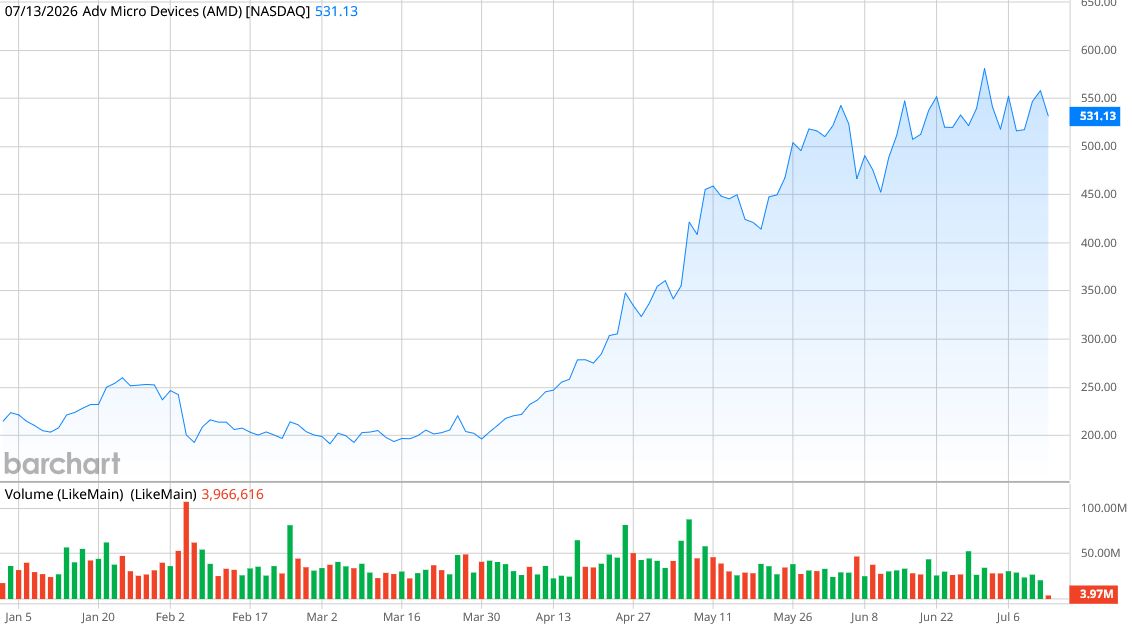
If you’re comparing AMD and NVDA stock, AMD is the much better performer right now. Shares are up 300% in the last year, versus Nvidia’s 29% gain and the S&P 500’s ($SPX) 21% return. AMD’s run has pushed its market cap to more than $900 billion, setting the stage for it to eventually join the trillion-dollar stock club.
Shares have climbed as AMD announced a series of large infrastructure supply contracts with companies, including OpenAI and Meta Platforms (META). The OpenAI deal provides for the deployment of up to 6 gigawatts of GPUs over several generations of chips and also gives OpenAI performance-based warrants to acquire up to 10% of AMD stock. AMD and Meta have agreed to a five-year deal valued at up to $100 billion for Meta to deploy up to 6 gigawatts of AI computing power using AMD GPUs and CPUs.
In May, AMD also announced it started ramping up production of its next-generation 2-nanometer CPUs and announced a $10 billion investment in Taiwan’s AI supply chain. The chips are being built by Taiwan Semiconductor Manufacturing (TSM), the globe’s leading foundry for AI chips.
However, as the stock climbed, AMD’s valuation has soared, with the forward price-to-earnings ratio climbing from around 25 in April to more than 75 today.
AMD’s first-quarter revenue was $10.25 billion, up 38% from a year ago, with net income of $1.38 billion, up 95%. Earnings per share nearly doubled, rising from $0.44 per share to $0.84 per share. Management issued guidance for Q2 revenue in the range of $10.9 billion to $11.5 billion, with gross margins of 56%.
AMD is scheduled to issue second-quarter earnings after the closing bell on Aug. 4.
What Do Analysts Expect for AMD Stock?
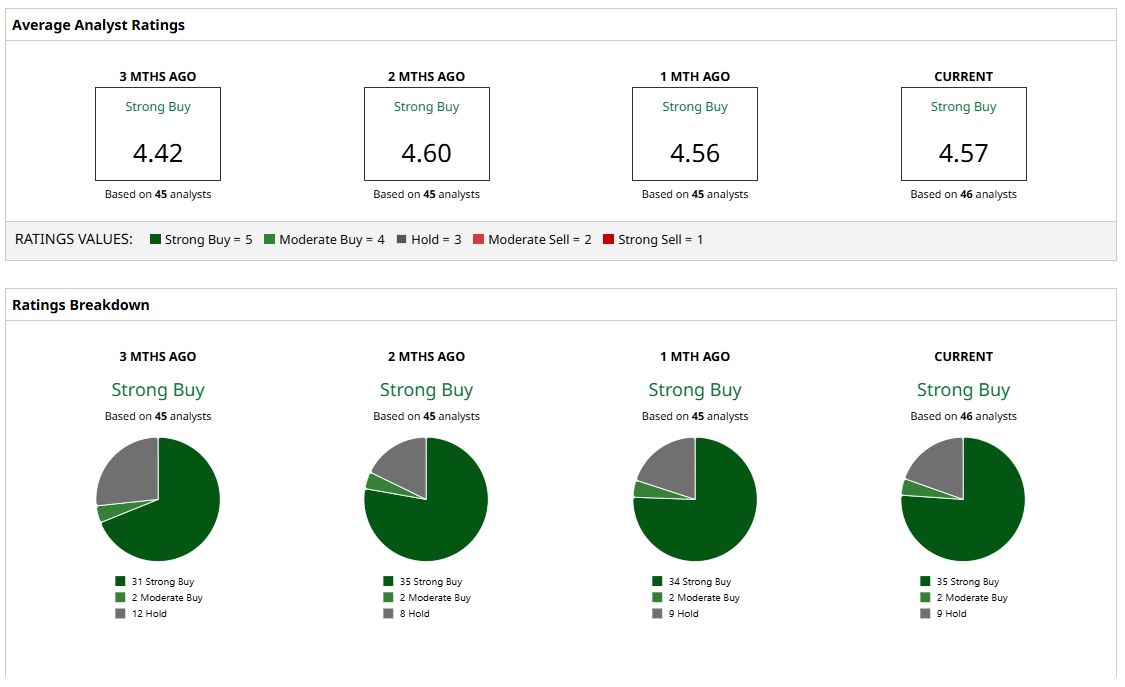
AMD is rated a consensus “Strong Buy” by 46 analysts who cover the stock. None have “Sell” ratings, and 37 of them have “Buy” ratings. The mean price target is $504.12, lower than the current stock price; many analysts have yet to rerate the stock after its massive move higher.
There is some movement, however. Citi upgraded the stock from “Neutral” to “Buy” and raised the price target from $460 to $575. Stifel analyst Ruben Roy raised his price target from $450 to $635 and said AMD is now a “credible number two” to Nvidia.
Roy wrote in a research note that he expects AMD to deliver a beat-and-raise quarter, and I’m inclined to agree. If AMD can see strong CPU revenue growth and avoid slowdowns on shipments in the second half of 2026, the stock appears to be geared for more upside—and potentially a $1 trillion market cap.
 www.barchart.com
 On the date of publication, Patrick Sanders had a position in: NVDA . All information and data in this article is solely for informational purposes. For more information please view the Barchart Disclosure Policy here.
More news from Barchart
SK Hynix Just Sent a Huge AI Demand Signal With Historic U.S. Listing for SKHY Stock Dear Microsoft Stock Fans, Mark Your Calendars for July 13 Thanks to Escalating Iran Tensions, Delta Air Lines Stock Could Face Turbulence. How to Trade It Here. AMD Is Following Nvidia’s Playbook. Here’s Why Investors Should Pay Attention.