


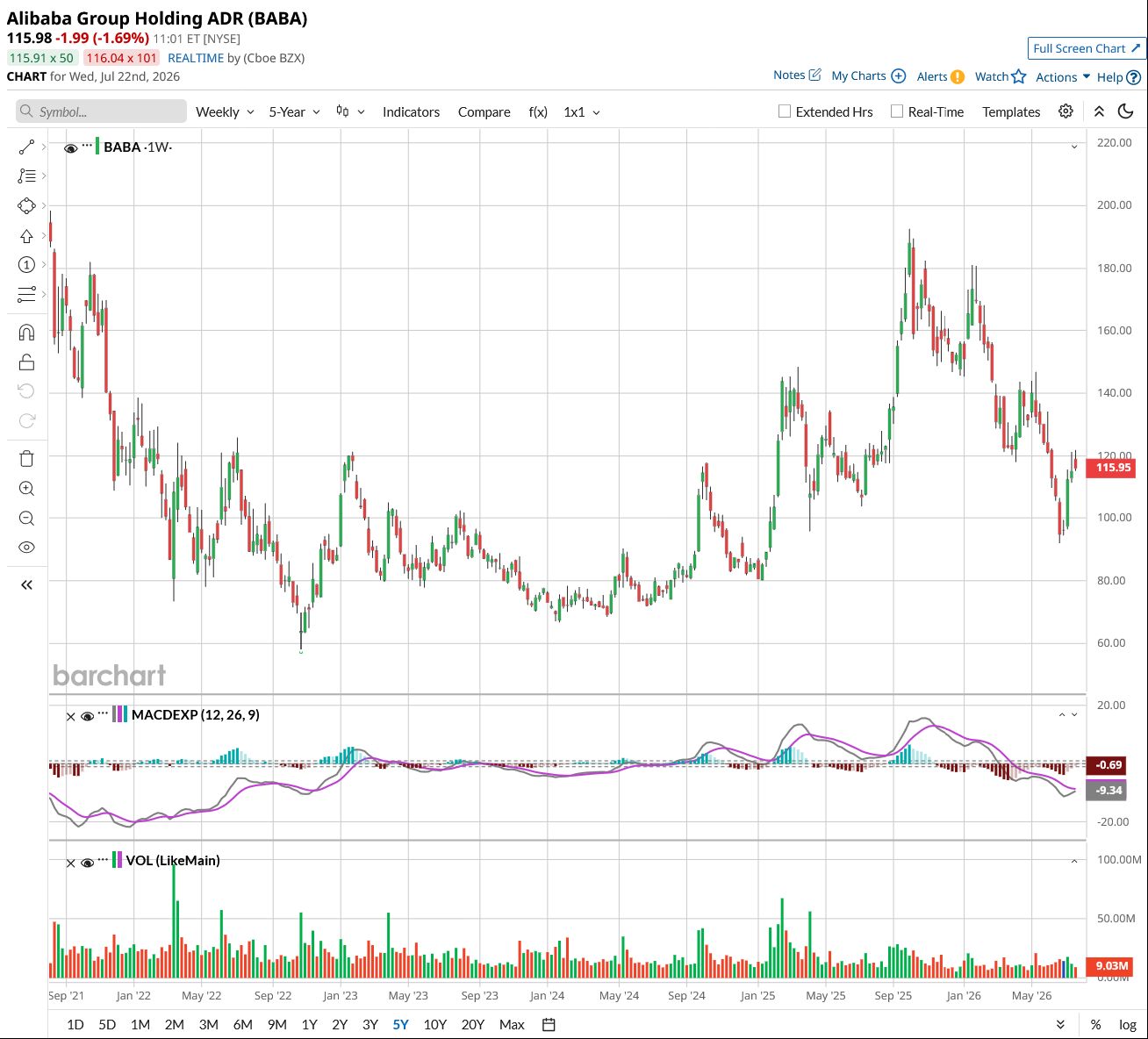
Alibaba (BABA) shares gained pace this week after the Chinese tech giant confirmed a major update to its artificial intelligence push, one that ties its Qwen models directly to hundreds of millions of Apple (AAPL) devices in China. The Chinese tech giant has spent more than a year and billions of dollars building out its AI business, and this latest move shows that bet starting to pay off in a very visible way.
 www.barchart.com
 Alibaba's AI Bet, Explained
Over the past year, Alibaba has shifted its cloud division away from basic storage and computing services and toward artificial intelligence.
More Top Stocks Daily: Go behind Wall Street’s hottest headlines with Barchart’s Active Investor newsletter.
That shift is now showing up in the numbers:
Alibaba's Cloud Intelligence Group posted 40% revenue growth from external customers in its fiscal fourth quarter. AI products accounted for 30% of that revenue, and it has reported triple-digit growth in AI revenue for eleven straight quarters. Much of that growth is tied to the Qwen family of models, Alibaba's answer to OpenAI's GPT and Google's (GOOG) (GOOGL) Gemini.The company released three separate updates to Qwen in just the past three months, including its newest large model, Qwen3.8 Max, which is built specifically to power AI agents that can handle complex reasoning and coding tasks.
Alibaba also launched a consumer-facing Qwen app in November 2025, plugging it into Taobao, Tmall, Alipay, Amap, and other services many Chinese consumers already use daily. On the enterprise side, it rolled out a platform called Wukong to help businesses run AI agents across workflows.
Chairman Joe Tsai and CEO Eddie Wu described this as a turning point in a recent letter to shareholders, writing that Alibaba's AI business has moved past the early investment stage and into full commercialization.
Qwen Lands on Apple Devices in China
According to CNBC:
Alibaba confirmed that its Qwen AI model will be built into Apple's operating systems in China, covering iPhones, iPads, Mac computers, and the Vision Pro headset. An Alibaba spokesperson told the outlet that Qwen will power Apple Intelligence features for users in China, letting them use tools like text and image generation without switching between separate apps. The approval came after China's internet regulator added Apple's AI service to a list of approved providers, which also includes homegrown firms like Huawei. The deal caps a long approval process that started back in 2024, as tension between the U.S. and China over AI technology has grown. Alibaba's U.S.-listed shares rose four percent following the news. Apple has held talks with PrismML, a small startup backed by Khosla Ventures, about shrinking large AI models so they can run directly on an iPhone. PrismML released a compressed version of Alibaba's open-source Qwen3.6 model last week, cutting its size from around 54 gigabytes down to less than 4 gigabytes, small enough to run all 27 billion of its parameters on an iPhone 15 or newer.What's Next for BABA Stock?
Alibaba’s Chief Financial Officer Toby Xu told analysts on the company's earnings call that free cash flow has turned negative because of heavy AI spending. However, the tech giant ended fiscal Q4 with $38 billion in cash, which can support its burn rates.
CEO Eddie Wu compared the buildout to constructing two factories, one for training AI models and one for running them day-to-day, both of which need years of investment before paying off.
He said the return on that investment over the next three to five years looks clear, pointing to strong demand for cloud and AI services from business customers.
For a stock that has moved on AI headlines all year, the Apple partnership gives investors fresh proof that Alibaba's technology is reaching well beyond its own platforms and into devices used by millions of people every day.
Analysts tracking Alibaba's stock forecast revenue to increase from $150.74 billion in fiscal 2026 to $264 billion in fiscal 2031. In this period, it is projected to expand adjusted net income from $9.5 billion to $33.4 billion. If BABA stock is priced at 20 times forward earnings, it could more than double within the next four years.
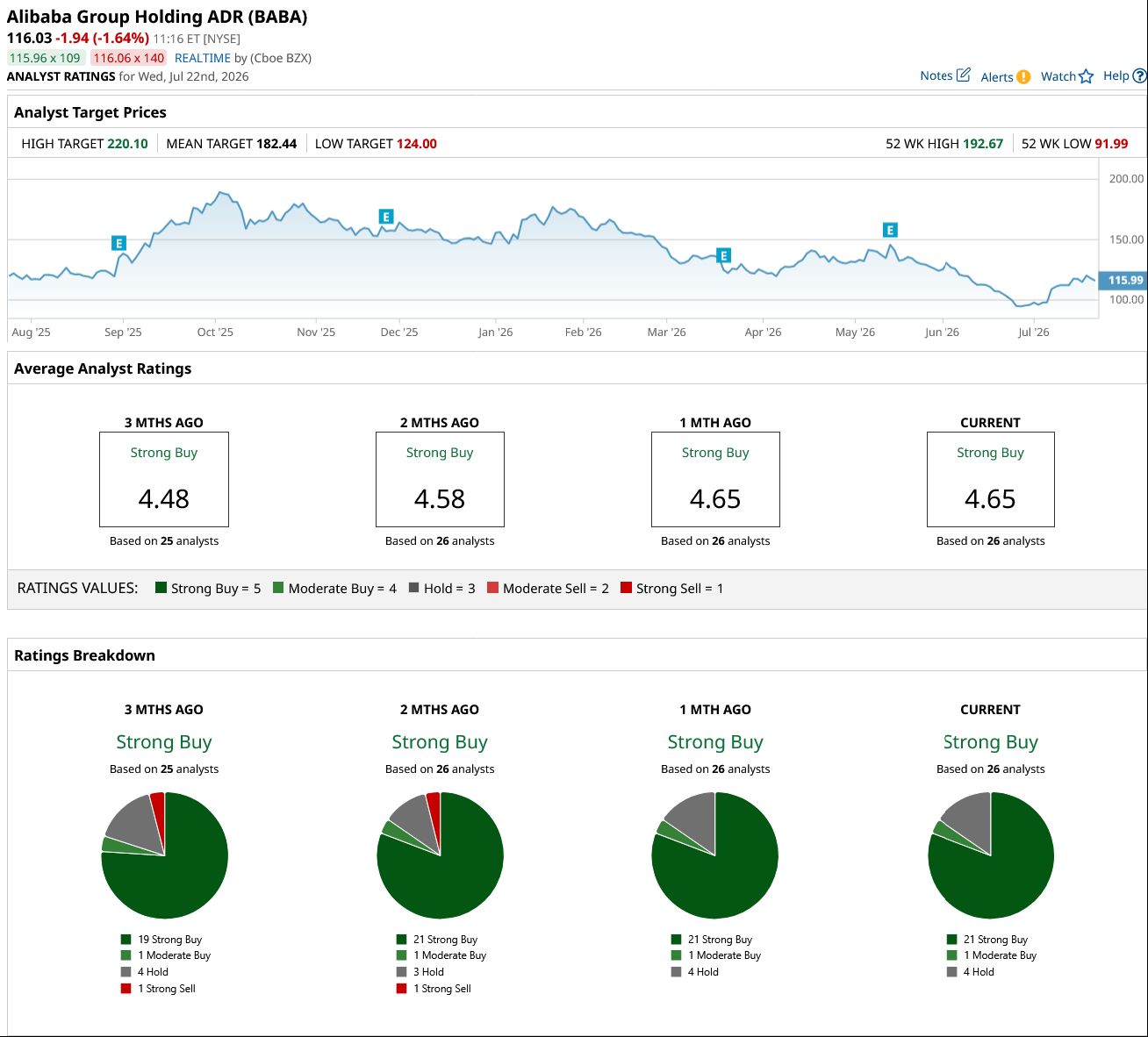
Out of the 26 analysts covering BABA stock, 21 recommend “Strong Buy,” one recommends “Moderate Buy,” and four recommend “Hold.” The average BABA price target is $182.44, above the current price of $116.
 www.barchart.com
 On the date of publication, Aditya Raghunath did not have (either directly or indirectly) positions in any of the securities mentioned in this article. All information and data in this article is solely for informational purposes. For more information please view the Barchart Disclosure Policy here.
More news from Barchart
How to Play BABA Stock as Alibaba Unveils New Qwen AI Model A $19 Billion Reason to Buy Hut 8 Stock Here Execution Issues and a Huge Valuation Make Tesla Stock Unattractive Wedbush Delivers Bold Verdict on Intel Stock Ahead of Earnings