


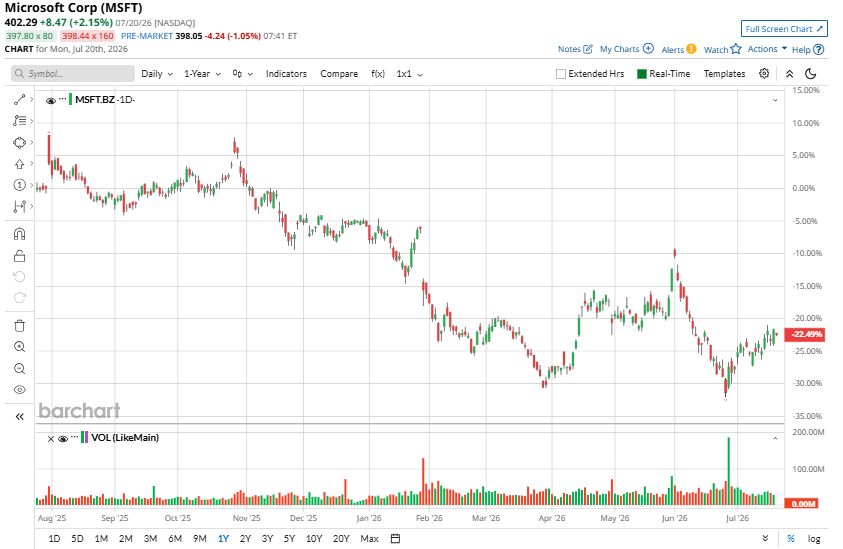
Microsoft (MSFT) will release its fourth-quarter fiscal 2026 earnings on July 29, with investors closely watching whether its massive AI investments are translating into stronger cloud growth. While demand for Azure, AI services, and paid Copilot subscriptions is expected to support another solid quarter, concerns over elevated capital spending could weigh on investor sentiment.
Microsoft plans to spend $190 billion in capital expenditures during fiscal 2026, primarily to expand its data-center footprint and AI infrastructure. These investments should strengthen the company's competitive position and support long-term growth, but they are also pressuring margins and free cash flow in the near term.
More Top Stocks Daily: Go behind Wall Street’s hottest headlines with Barchart’s Active Investor newsletter.
That pressure was already evident last quarter, when Microsoft's gross margin declined year-over-year (YOY) as the company ramped up AI infrastructure investments and absorbed higher costs associated with growing AI workloads.
Meanwhile, management has guided for only modest near-term acceleration in Azure growth. Persistent supply constraints, particularly in AI infrastructure capacity, are expected to continue at least through 2026, limiting Microsoft's ability to fully meet robust customer demand despite strong underlying fundamentals.
Even so, the long-term investment case remains compelling. As additional AI capacity comes online, Azure growth is likely to reaccelerate, while broader Copilot adoption should create another meaningful revenue driver. Combined with improving operating leverage as AI investments mature, these factors could support stronger earnings growth in fiscal 2027 and beyond.
 www.barchart.com
 Microsoft Positioned for Another Strong Quarter
Microsoft heads into its Q4 earnings report with strong momentum, as sustained demand for AI services and cloud computing continues to offset investor concerns over elevated capital expenditures.
The software and AI giant continues to deliver solid growth. Notably, Microsoft reported revenue of $82.9 billion in Q3, up 18% YOY. Microsoft Cloud revenue climbed 29% to $54.5 billion, while Azure and related cloud services grew 40%, driven by broad enterprise adoption of AI workloads.
Microsoft's commercial remaining performance obligation (RPO), a measure of contracted future revenue, surged 99% YOY to $627 billion. Notably, 25% of this backlog will likely convert into revenue over the next 12 months. Microsoft stated that longer-term contractual commitments rose by an even stronger 138%, indicating customers are committing to multiyear AI and cloud investments, which will support future growth.
Microsoft's AI business is scaling rapidly. Management disclosed that its annualized AI revenue run rate exceeded $37 billion, representing 123% YOY growth. Meanwhile, Copilot adoption continues to accelerate, with paid seats surpassing 20 million, up 250% YOY. The number of organizations deploying more than 50,000 Copilot seats has quadrupled, highlighting growing enterprise confidence in Microsoft's AI productivity platform and creating another long-term monetization opportunity.
Looking ahead to Q4, the momentum in Microsoft’s business will likely continue. Intelligent Cloud revenue is projected to reach between $37.95 billion and $38.25 billion, representing up to 28% growth. Azure revenue is expected to expand by roughly 40% in constant currency despite increasingly difficult comparisons. Building on strong Copilot adoption in the prior quarter, Microsoft is also expected to add more paid seats sequentially, supporting continued growth in average revenue per user (ARPU).
While its top line is likely to grow at a solid pace, Microsoft's aggressive investment in AI is expected to weigh on cloud gross margins as the company expands capacity to meet surging customer demand.
Even with those headwinds, profitability is expected to remain strong. Wall Street forecasts earnings of $4.21 per share, representing approximately 15% YOY growth. Given Microsoft's consistent history of exceeding analyst expectations, another earnings beat remains a possibility.
Final Takeaway
Near-term headwinds, including elevated capex and margin pressure, could keep a lid on Microsoft's short-term upside. However, the company's long-term investment case remains solid. Strong Azure demand, rapidly growing AI revenue, rising Copilot adoption, and an expanding backlog of contracted revenue positions Microsoft for sustained earnings growth in the years ahead.
Despite these growth catalysts, Microsoft continues to trade at a reasonable valuation. With a forward price-to-earnings (P/E) ratio of 20.8 times, MSFT stock looks attractively priced relative to many large-cap tech peers, especially given its dominant competitive position in the enterprise software space and significant AI runway.
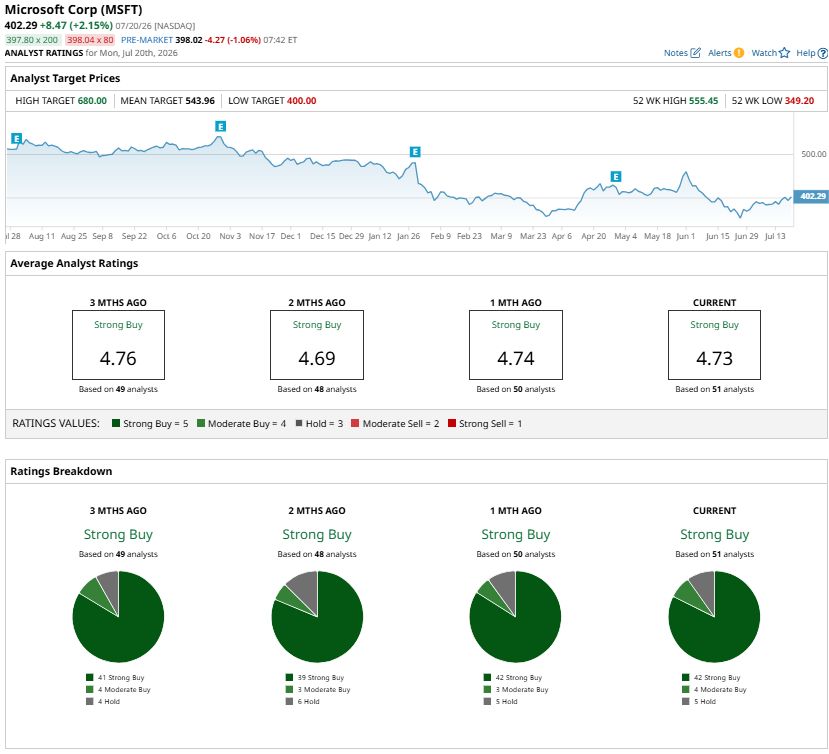
Wall Street remains optimistic, with analysts maintaining a consensus “Strong Buy” rating on MSFT stock ahead of the Q4 earnings release.
 www.barchart.com
 On the date of publication, Amit Singh did not have (either directly or indirectly) positions in any of the securities mentioned in this article. All information and data in this article is solely for informational purposes. For more information please view the Barchart Disclosure Policy here.
More news from Barchart
How 5 Giant Stocks Are Causing a Potentially Nuclear Debt Headache for the U.S. Stock Market DEO Stock Layoffs: What to Know About the Latest Diageo Job Cuts CapEx Is in Focus for Microsoft Stock Ahead of Q4 Earnings, But the Bull Case Remains Strong Fortinet and Intel Just Announced a New Collaboration. The Real Test for FTNT Stock Is Earnings.