

For the past couple of years, Tesla’s (TSLA) core business had been struggling. Yet, investors were willing to look beyond those quarterly numbers as they were swept up in CEO Elon Musk’s bold AI vision. The promise of robotaxis, humanoid robots, and autonomous driving convinced many that Tesla was far more than just an automaker.
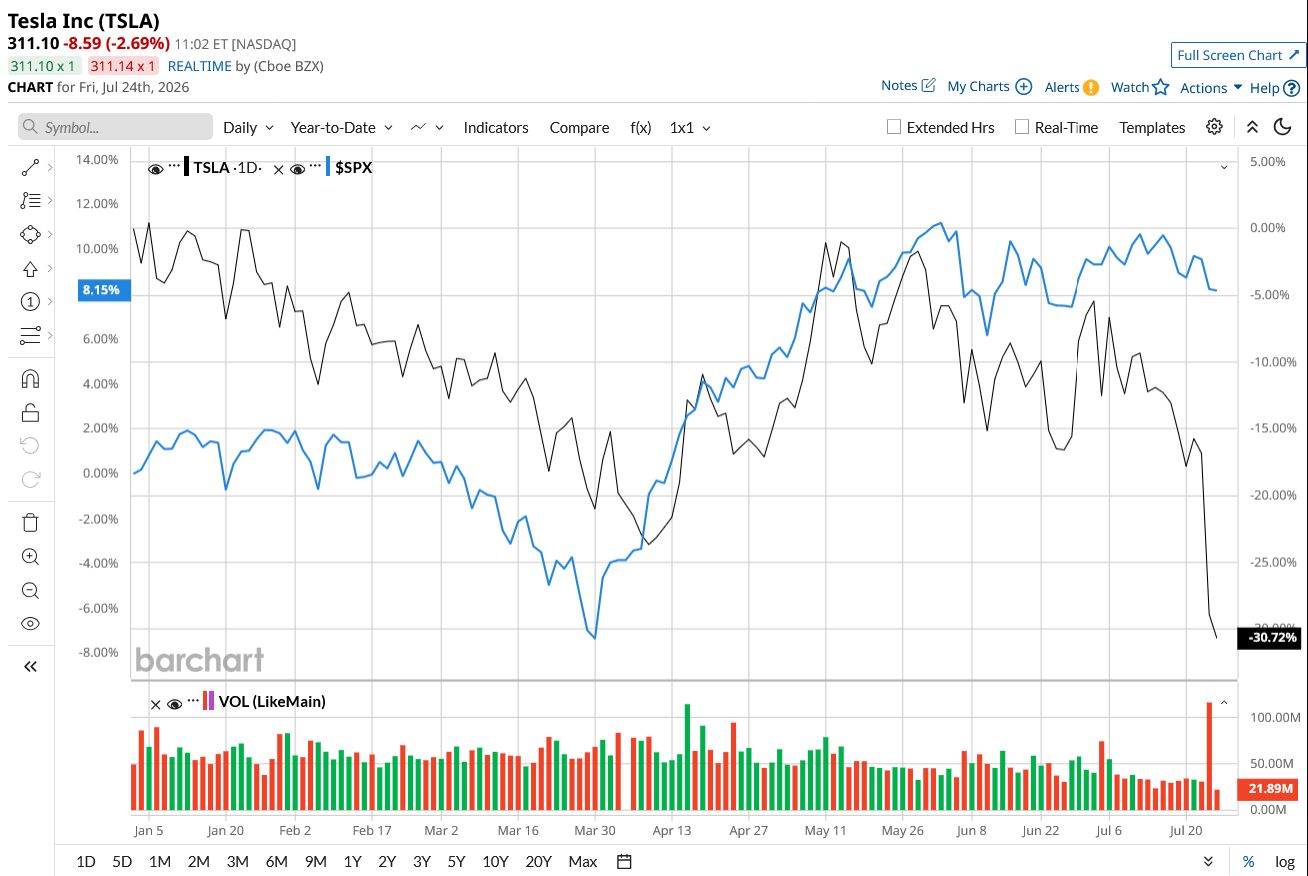
However, those bold AI promises are no longer enough to convince investors to buy or hold on to TSLA stock. They want proof that these expensive ambitions can translate into stronger financial performance. But Tesla's fiscal Q2 earnings failed to provide that proof, dragging the stock down almost 15% yesterday and another 3% today as of this writing. TSLA has also fallen 30% year-to-date (YTD), becoming the worst-performing stock in the Magnificent Seven group.
More Top Stocks Daily: Go behind Wall Street’s hottest headlines with Barchart’s Active Investor newsletter.
 www.barchart.com
 The Financial Reality Is Becoming Harder to Ignore
Like always, Musk spent remarkably little time in the Q2 earnings call discussing the current business performance and more about his AI ambitions. The list of ambitions now grows longer with Robotaxi expansion, Optimus, AI compute, semiconductor fab manufacturing, Digital Optimus, Megapods, Terafab, and massive energy investments. About Optimus, Musk repeatedly emphasized that the humanoid robot could eventually become Tesla's largest product. He described robots that can perform generalized human tasks rather than scripted tasks. However, Musk also stated that every major component of Optimus is new, and the company is building most of them. Musk also warned investors that production would follow a long, initially flat manufacturing curve before meaningful scaling begins.
Additionally, Robotaxis are also expanding into multiple U.S. cities. But Tesla is ensuring that safety is the biggest priority, as a single serious incident could derail expansion plans. Investors have long anticipated a Robotaxi revolution. As a result, Tesla’s cautious approach to nationwide scaling is testing investors’ patience now. That said, not everything in the second quarter was bad. Tesla’s core automotive business showed encouraging signs. Q2 deliveries increased 25% year-over-year (YoY) to 480,122, as Model Y strengthened its position globally. The company also stated that it recorded its largest order backlog since 2023, suggesting customer demand has improved meaningfully. Total automotive revenues increased 23% to $20.5 billion. But automotive gross margins excluding regulatory credits fell sequentially from 19.2% to 16.3%.
The company’s Services and other revenue surged 50% to $4.5 billion. While energy generation and storage revenue also increased 13% to $3.14 billion, energy gross margins fell sharply from 39.5% to 20.4%, hurt by warranty expenses, the absence of earlier tariff benefits, and increasing pricing pressure across industrial storage markets. Although total revenue also increased 26% to $28.2 billion, adjusted earnings per share fell by 18% to $0.33. Total GAAP gross margin also declined from 21.1% to 16.8% sequentially. While growth has improved, profitability has been harder to maintain.
Capital expenditures in the quarter increased 142% to $5.8 billion, pushing free cash flow into negative $1.09 billion. Management now expects capital expenditures to exceed $25 billion this year and continue increasing over the next several years as Tesla expands Robotaxi fleets, scales Optimus manufacturing, builds semiconductor facilities, increases AI compute capacity, and develops additional manufacturing infrastructure. Additionally, the company is securing borrowing capacity of up to $30 billion to fund these investments. The problem is most of these projects could take years before they generate substantial profits. Specifically, it appeared that the theme of the earnings call was Tesla asking investors to ignore today’s numbers because tomorrow will be incredible.
Tesla’s Bull Story Is Still Alive, but It Needs More Than Vision
A few quarters ago, Musk’s mere mention of these ambitious AI projects was enough to convince investors of Tesla’s long-term opportunities. Although that opportunity is still there, investors are no longer overlooking the impact of future projects on today’s performance. These ambitions have already pushed Tesla’s valuation sky-high at 202x forward 2026 earnings, even though earnings are expected to increase just by 11% YoY.
Even if Robotaxis achieve widespread adoption, Optimus becomes commercially successful, and Tesla establishes itself as a leading AI infrastructure company, eventually justifying its premium valuation, it could take years before all this happens. Investors are now losing patience, as they mostly saw shrinking profitability at a time when Tesla continues spending aggressively. Until Tesla provides some solid financial proof, even Elon Musk's biggest AI ambitions may no longer be enough to keep investors fully convinced.
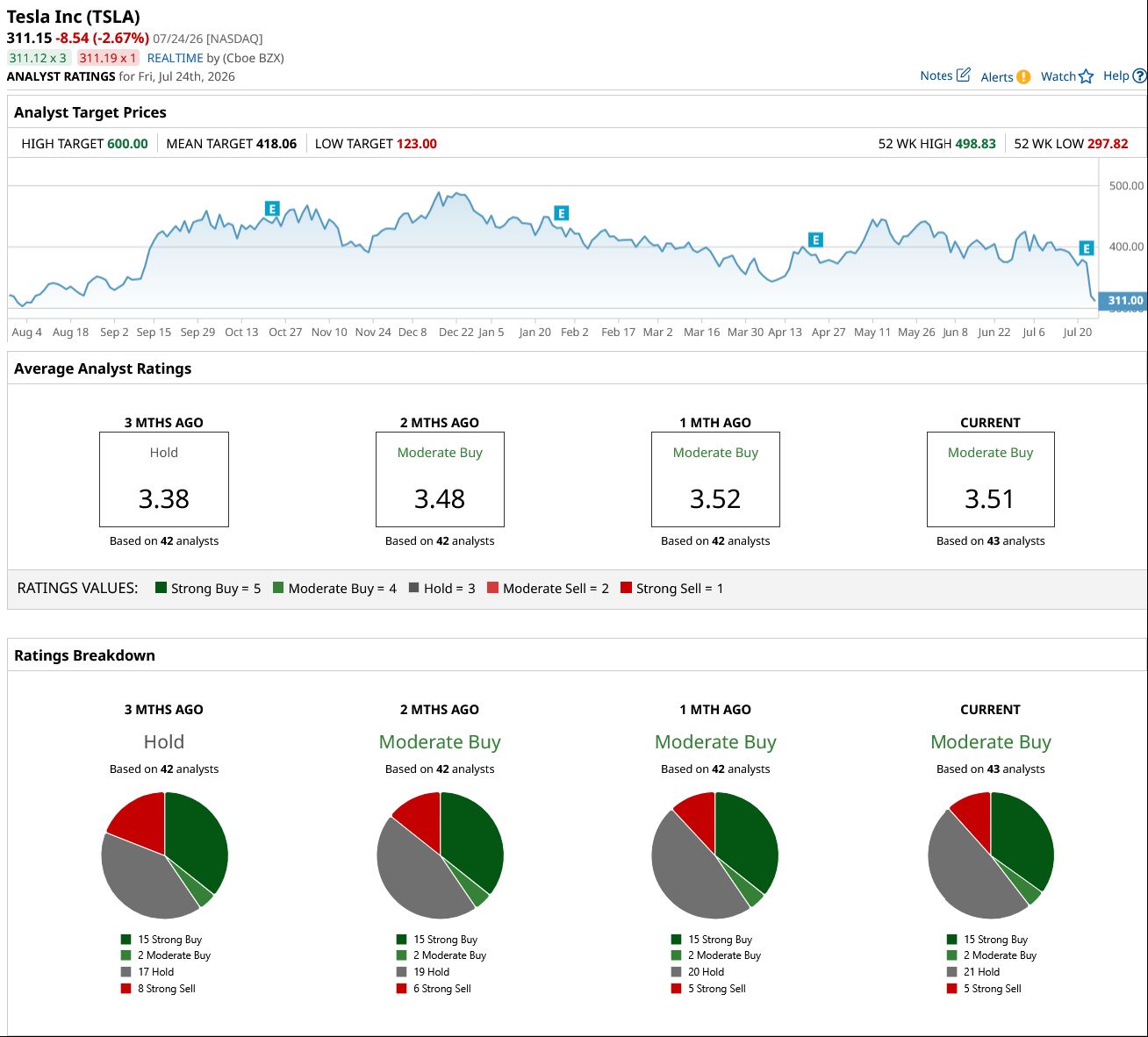
On Wall Street, TSLA stock is a “Moderate Buy” overall. Of the 43 analysts covering the stock, 15 recommend it as a “Strong Buy,” two rate it a “Moderate Buy,” 21 rate it a “Hold,” and five rate it a “Strong Sell.” The average analyst target price of $418.06 indicates a 34% increase from current levels. The high price estimate of $600 implies that TSLA can rise by 93% in the next 12 months.
 www.barchart.com
 On the date of publication, Sushree Mohanty did not have (either directly or indirectly) positions in any of the securities mentioned in this article. All information and data in this article is solely for informational purposes. For more information please view the Barchart Disclosure Policy here.
More news from Barchart
MBLY Stock Alert: What to Know as Mobileye Announces Leadership Transition Tesla Stock: Here’s Why Elon Musk’s Big AI Promises Are No Longer Enough Meta’s Q2 Earnings: Strong Revenue Expected, But AI Spending Could Limit Stock Gains As Musk Teases Tesla-SpaceX Merger, Here's What Shareholders Should Expect