

Uber Technologies, Inc. (UBER), headquartered in San Francisco, California, develops and operates proprietary technology applications and provides ride-hailing services. Valued at $144 billion by market cap, the company develops applications for road transportation, navigation, ride-sharing, and payment processing solutions.
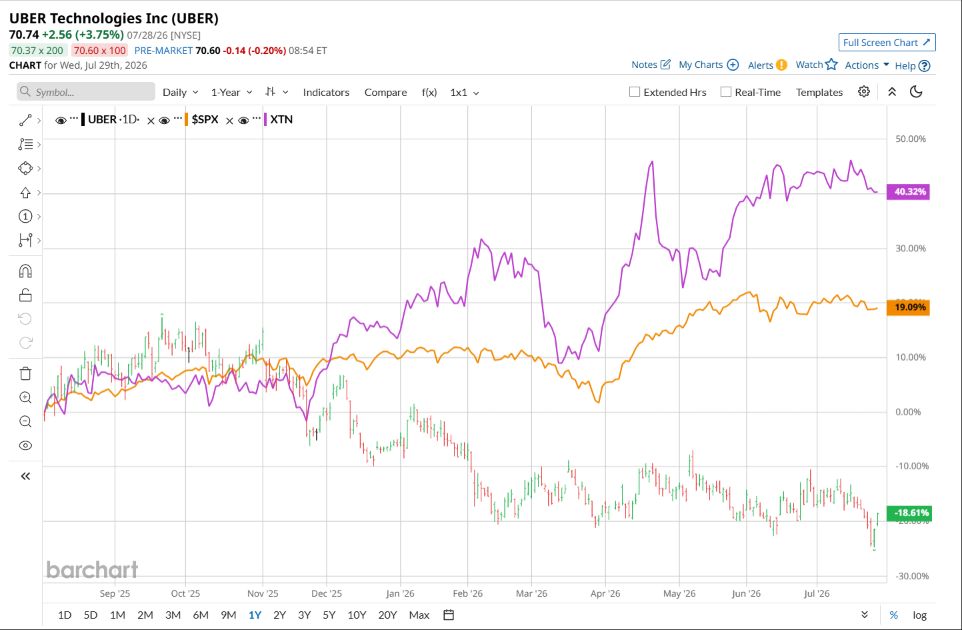
Shares of this ride-hailing giant have underperformed the broader market considerably over the past year. UBER has declined 21.9% over this time frame, while the broader S&P 500 Index ($SPX) has rallied nearly 16.3%. In 2026, UBER’s stock fell 13.4%, compared to the SPX’s 8.5% rise on a YTD basis.
More Top Stocks Daily: Go behind Wall Street’s hottest headlines with Barchart’s Active Investor newsletter.
Narrowing the focus, UBER’s underperformance looks more pronounced compared to State Street SPDR S&P Transportation ETF (XTN). The exchange-traded fund has gained about 29.9% over the past year. Moreover, the ETF’s 23.7% returns on a YTD basis outshine the stock’s losses over the same time frame.
 www.barchart.com
 UBER’s underperformance was driven more by optics than fundamentals. In addition, paper headwinds, including a $1.5 billion pre-tax mark on legacy equity investments and strategic shifts for EU antitrust approval, temporarily depressed GAAP earnings without impairing operational health. Furthermore, while headlines over Waymo ending its Phoenix partnership and plans to operate independently in future markets triggered knee-jerk selling, Uber's quick recovery underscores its resilience. Driven by over 50 million Uber One members, expanding delivery margins, and a flexible platform aggregating multiple third-party autonomous fleets, Uber continues to prove its cash-flow moat remains intact.
For the current fiscal year, ending in December, analysts expect UBER’s EPS to decline 43.8% to $2.98 on a diluted basis. The company’s earnings surprise history is mixed. It beat the consensus estimate in three of the last four quarters while missing the forecast on another occasion.
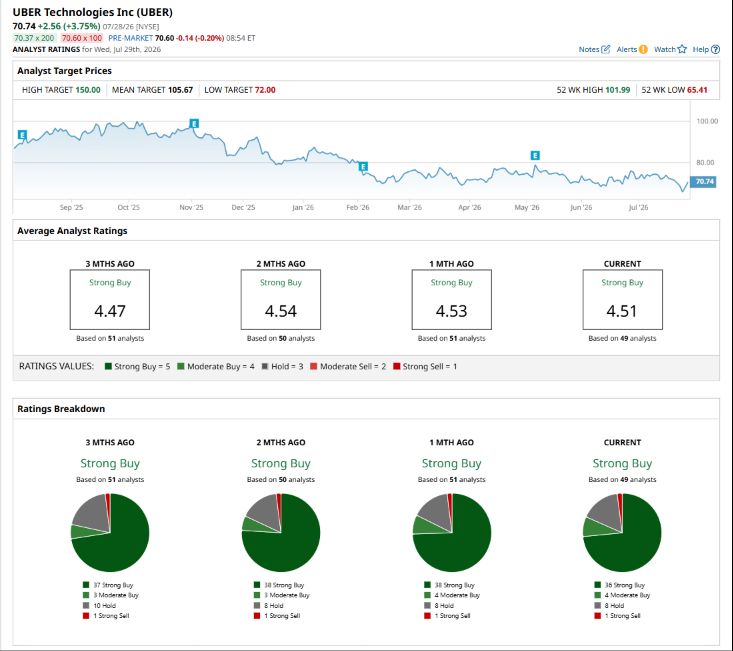
Among the 49 analysts covering UBER stock, the consensus is a “Strong Buy.” That’s based on 36 “Strong Buy” ratings, four “Moderate Buys,” eight “Holds,” and one “Strong Sell.”
 www.barchart.com
 This configuration is less bullish than a month ago, with 38 analysts suggesting a “Strong Buy.”
On Jul. 28, Youssef Squali from Truist Financial Corporation (TFC) maintained a “Buy” rating on UBER, with a price target of $112, implying a potential upside of 58.3% from current levels.
The mean price target of $105.67 represents a 49.4% premium to UBER’s current price levels. The Street-high price target of $150 suggests an ambitious upside potential of 112%.
On the date of publication, Neha Panjwani did not have (either directly or indirectly) positions in any of the securities mentioned in this article. All information and data in this article is solely for informational purposes. For more information please view the Barchart Disclosure Policy here.
More news from Barchart
What Will the Fed Do With Rates Wednesday? Michael Burry Is Doubling Down His Short Bets Against Micron and Nvidia. What That Tells Us About the Future of Chip Stocks. Long Call Butterfly Trade Ideas for July 27th Stock Index Futures Gain With Focus on Fed Rate Decision and Big Tech Earnings