

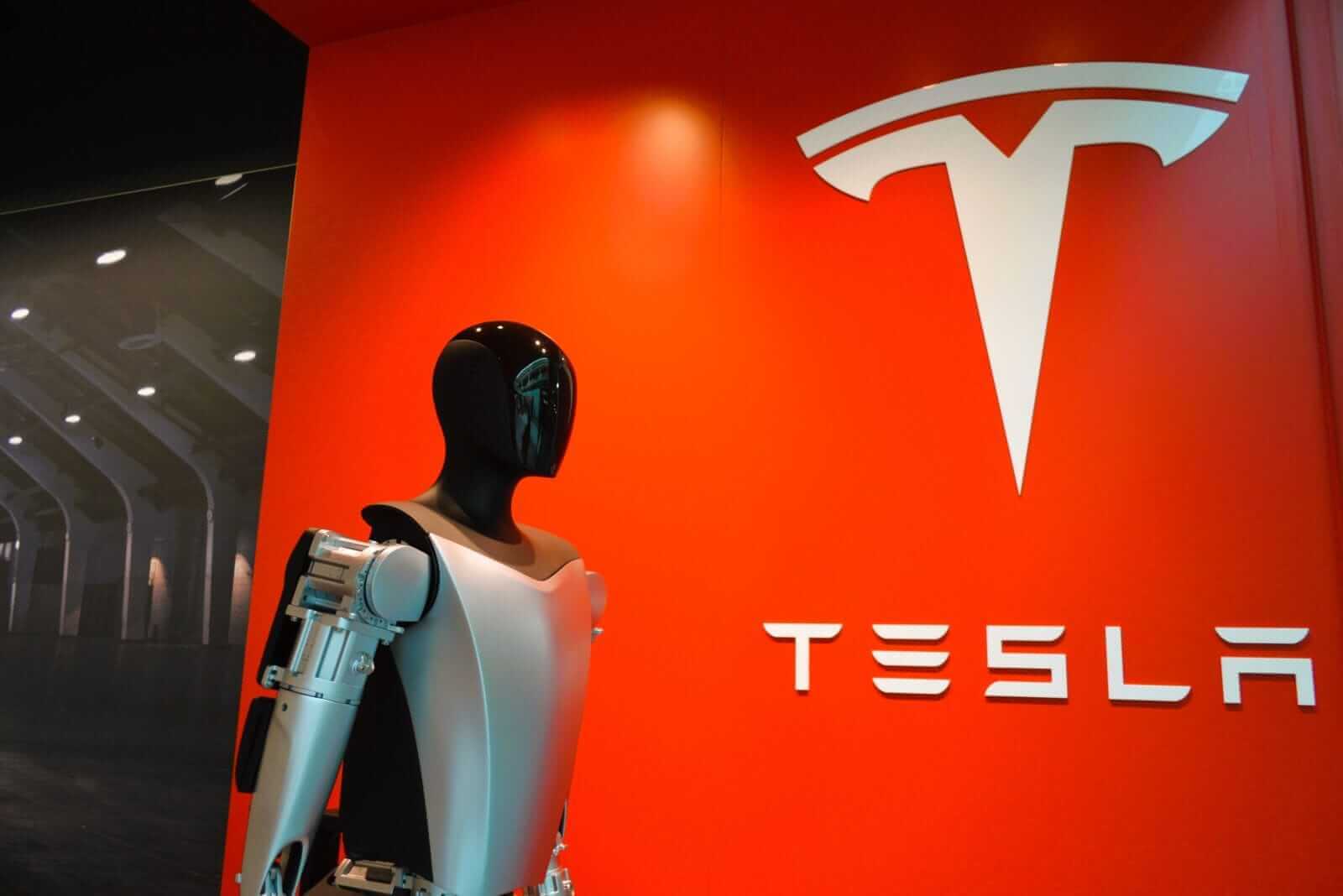
Back in the early 2000s, artificial intelligence (AI) was firmly something of science fiction. Sure, there were companies working on it, but any meaningful development was… unlikely, at least at the time.
Now it’s more than 20 years later, and AI has taken over practically everything. It's in your smartphone, your web browser, and in a toaster. In all seriousness, businesses are using it to write code, generate content, analyze data – you name it, AI’s doing it.
More Top Stocks Daily: Go behind Wall Street’s hottest headlines with Barchart’s Active Investor newsletter.
Yet despite all of its recent progress, today's AI still has one major limitation: it only exists behind a screen.
It can answer questions, recognize images, summarize documents, and write code, sure. But for the most part, it can't stock shelves, assemble cars, deliver packages, care for patients, or repair infrastructure.
But what if it could?
What if companies today are working hard to give AI something bigger, like a body? What could that mean for the industries it touches, the companies building the technology, and the investors trying to identify the biggest winners?
Let’s look at Robotics as it stands today, which companies are at the forefront of the industry, and how investors can think about gaining exposure to one of the next major frontiers of artificial intelligence.
Welcome to the era of physical AI.
Is Robotics Having Its 2022 AI Moment?
Robotics isn't a new industry. The first industrial robot, a hulking hydraulic arm called Unimate, started transporting hot die casts on a General Motors (GM) assembly line back in 1961.
Since then, robotic arms have been welding, painting, and assembling cars, electronics, and just about every other manufactured good you can think of. Walk into any modern car plant, and you'll find hundreds of them, moving with a precision and consistency no human assembly line could match.
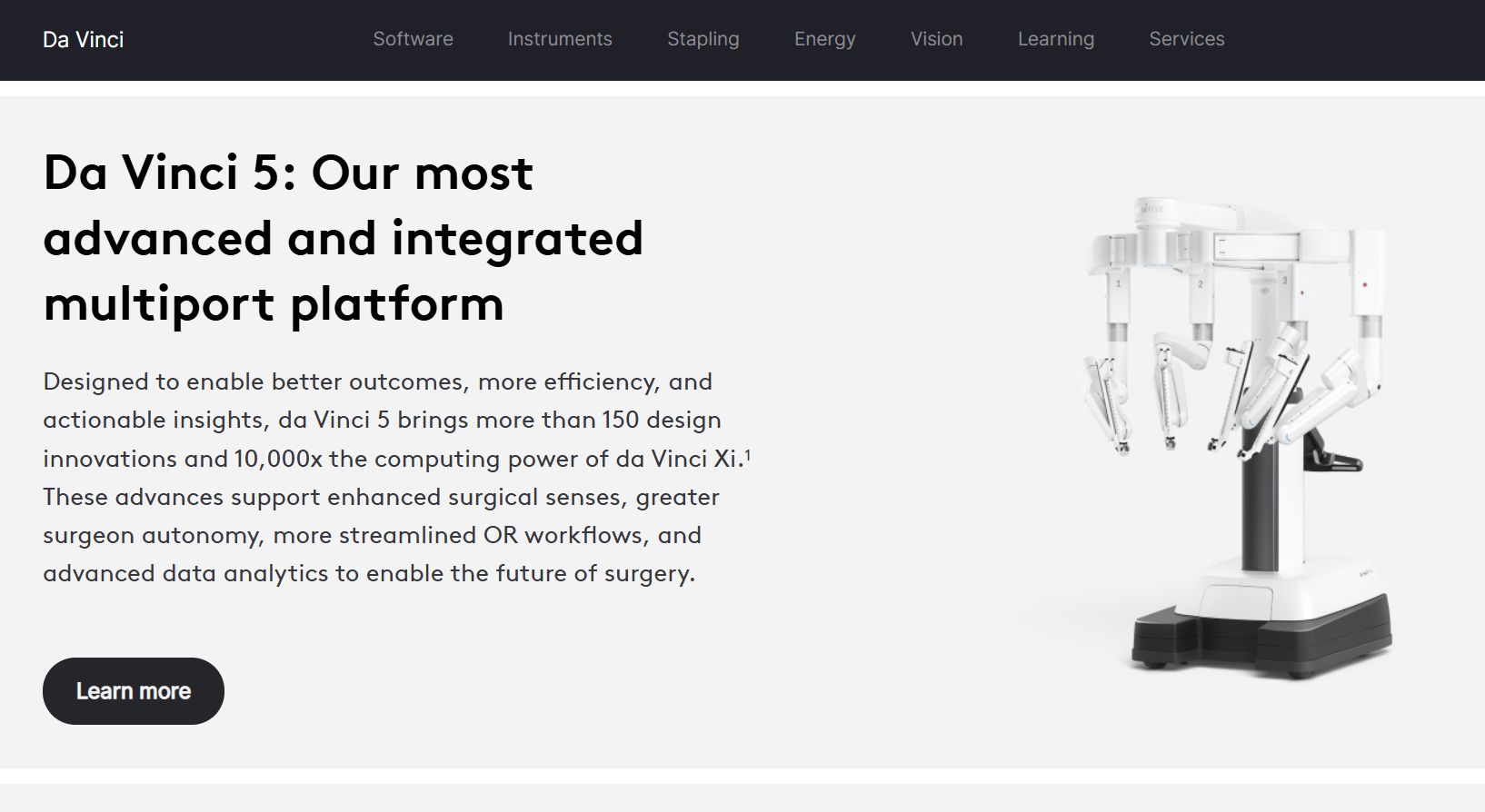
Robotic-assisted surgery followed a similar path. Systems like Intuitive Surgical's (ISRG) Da Vinci have gone from a novelty to a staple in hospitals worldwide, giving surgeons steadier hands and better visibility during delicate procedures.
 www.intuitive.com
 But here’s the problem with all those robots: they’re rigid. Unless they're directly controlled by a human, like to remove an appendix or gallbladder, these machines can only do what they’re programmed to do, where they’re programmed to do it.
Move that part two inches to the left, and the assembly-line robot would have no idea how to deal with it. Worse, it might just try to do what it always does and break something in the process.
That’s changing now.
Companies are seeing increasing success in integrating AI with robotics. But it’s not a plug-and-play type of deal where they just wire an AI chip into a robot’s head and tell it to stack boxes. The integration is much more complicated than that - but there is a foundational concept that helps bring those two together.
Let’s talk about VLA.
What Is Vision-Language-Action (VLA) AI? The Technology Behind Smarter Robots
VLA, or vision-language-action, does the same thing that large language models (LLMs) did for AI chatbots, but it's not just limited to text. VLA gives machines the ability to see the world around them, understand human instructions, and translate that understanding into physical actions.
The name itself explains how the technology works. Vision allows a robot to observe its surroundings through cameras and sensors. Language allows it to listen to and interpret spoken commands. Action brings both together. The result is a robot that can see its environment, understand what needs to be done, and perform the task as instructed.
Think about your typical robotic vacuum. It can navigate your home, avoid obstacles, and clean your floors. And it does all that through a combination of sensors, cameras, and mapping technology – all while sometimes keeping your cat amused.
But tell it to “clean up that spill near the TV” or “kitchen area first, please,” and you’ll immediately be reminded of what it feels like to talk to a brick wall (or your cat, for that matter).
The thing is, the vacuum doesn’t have the capacity to even understand what you just said. But VLA fixes that problem. But of course, its applications reach beyond cleaning your dusty floors.
With VLA, robots can identify and sort thousands of different products instead of handling just a handful of predefined items. They can adapt to changing production lines without needing to turn every single one off for a big software update.
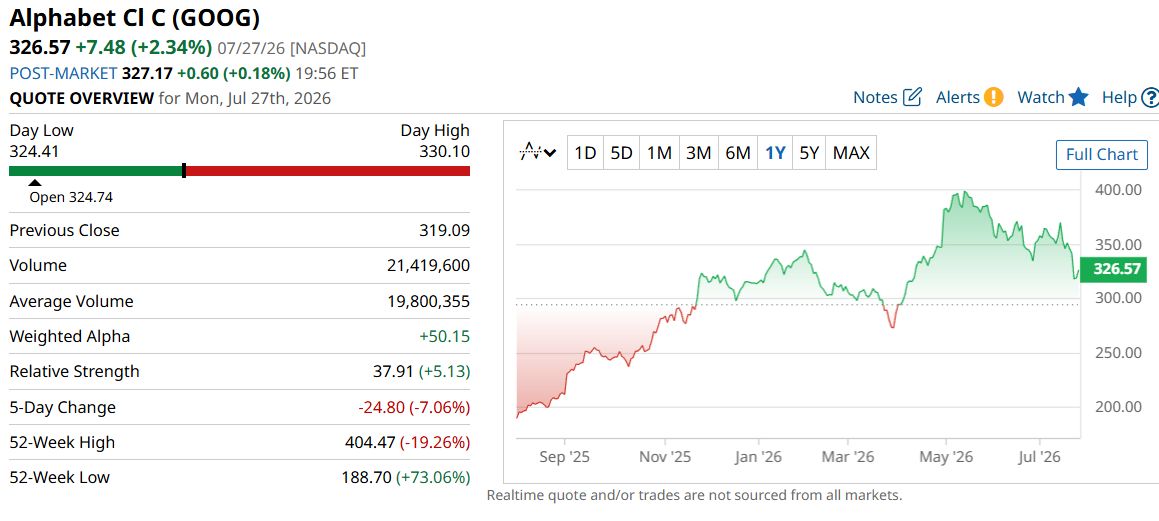
Suffice it to say, the applications for VLA development could be massive. So it shouldn’t be a surprise to find out that Alphabet (GOOG) is already working on it with Google DeepMind’s Gemini Robotics.
 www.barchart.com
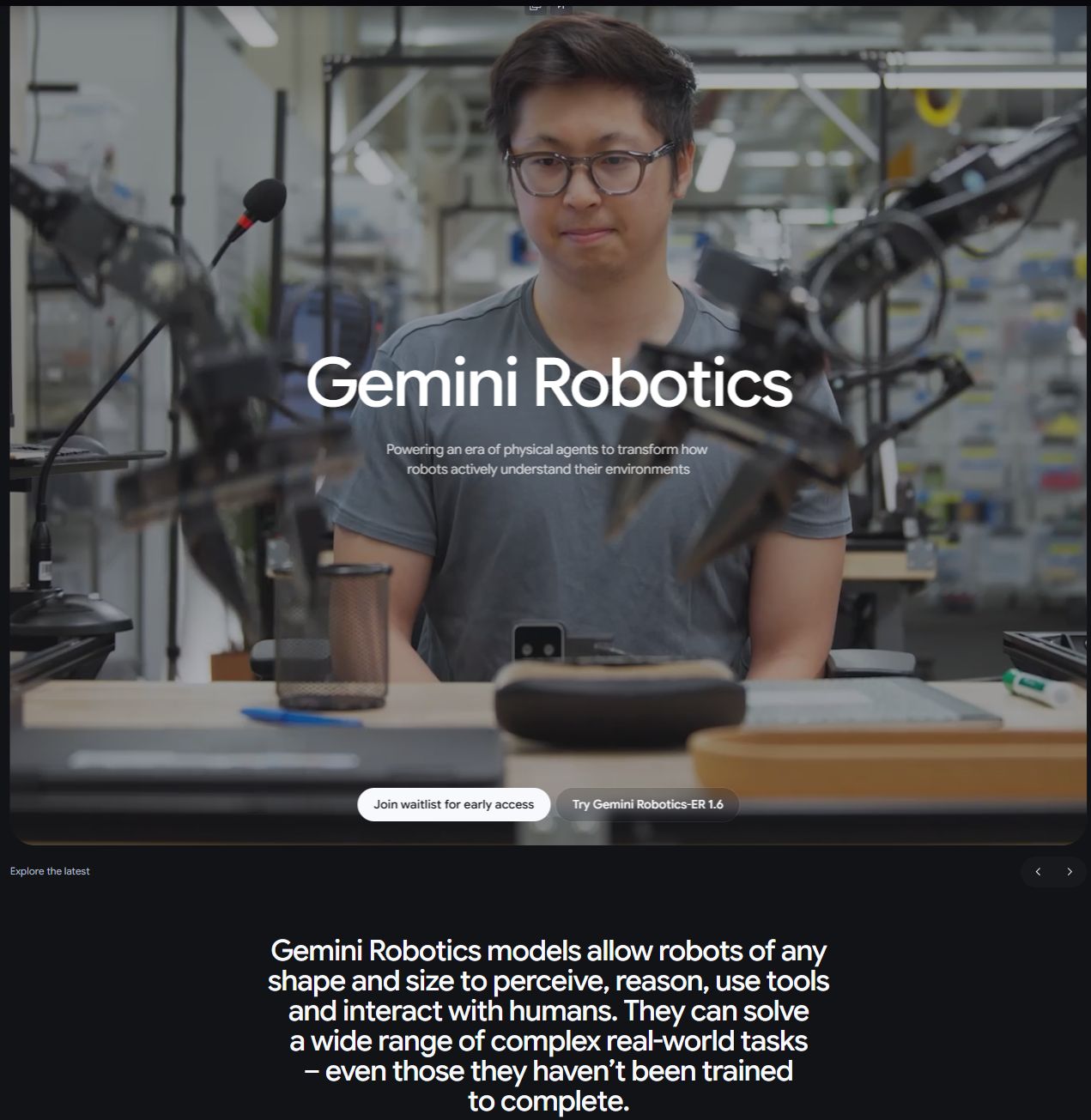
 Google DeepMind has developed separate but complementary systems: Gemini Robotics, a VLA model that converts visual information and instructions into motor commands, and Gemini Robotics-ER, an embodied-reasoning model designed for spatial reasoning, planning, and decision-making. But both platforms are working toward the same goal: making AI work within a robotic body.
 deepmind.google
 In its earlier iterations, the platform proved that robots can wrap a wire around a headphone.
Now, we humans, with our thumbs and our fancy ability to think, thanks to millions of years of (selective) evolution, might consider that task a literal short step away from breathing. I mean, how hard could it be to pick up a piece of wire and wrap it around another object?
But for a robot, it’s one of the hardest tasks to manipulate on its own. The robot has to recognize a flexible object that constantly changes shape, predict how it will bend and twist as it’s being moved, check if the wire is wrapped loosely or too tightly, adjust its grip in real time, and recover if the wire slips out of place.
Every tiny movement changes the next one. That means every motion leads to a chain of decisions that could change at any moment. That requires the ability to adapt and adjust – something that people take for granted because of how easy it is for us.
That's precisely why Google's demonstration was so impressive. The programming wasn’t geared for a rigid task with a set number of parameters in a controlled environment, like the typical automation we have today. Instead, the robot listened to the instructions, performed the motions, watched what happened, and adjusted as necessary.
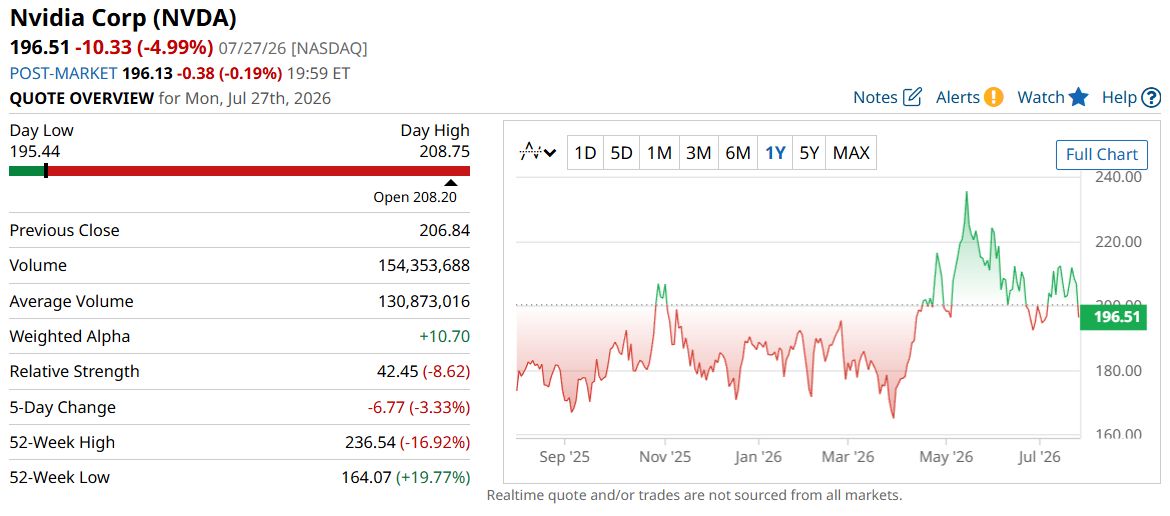
Nvidia (NVDA) is doing something similar, though it’s more focused on supplying, training, and deploying technology at scale, all through its Isaac platform.
 www.barchart.com
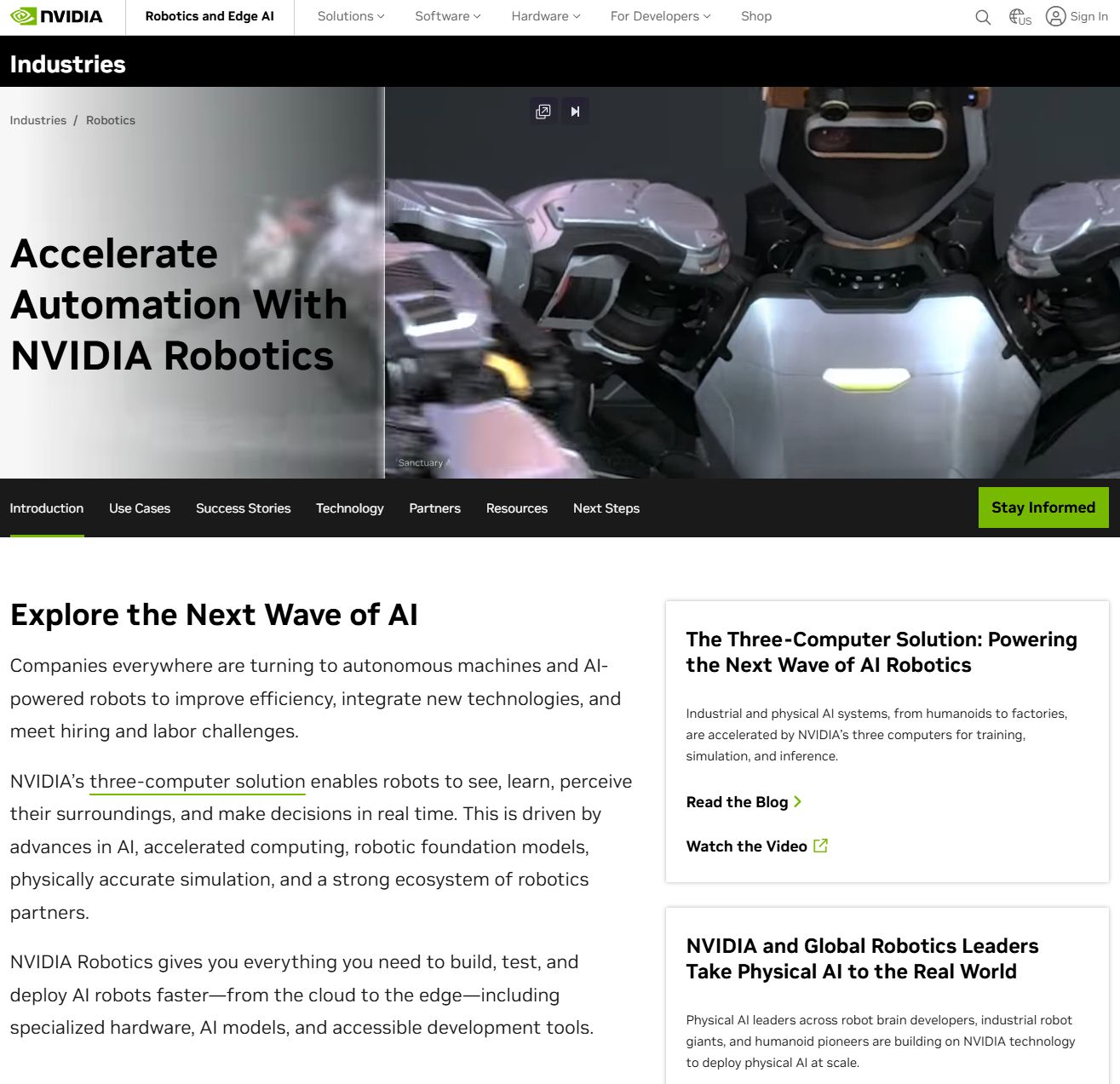
 Isaac combines Nvidia's accelerated computing hardware, simulation software, and AI models into a single robotics platform.
Before a robot ever enters a warehouse or factory, it can spend millions of hours inside a virtual environment, learning how to navigate obstacles, manipulate objects, and recover from mistakes.
 www.nvidia.com
 Once that training is complete, the same AI models can be deployed onto Nvidia's Jetson edge computers, allowing robots to process sensor data, understand natural language instructions, and make decisions in real time without a full internet connection.
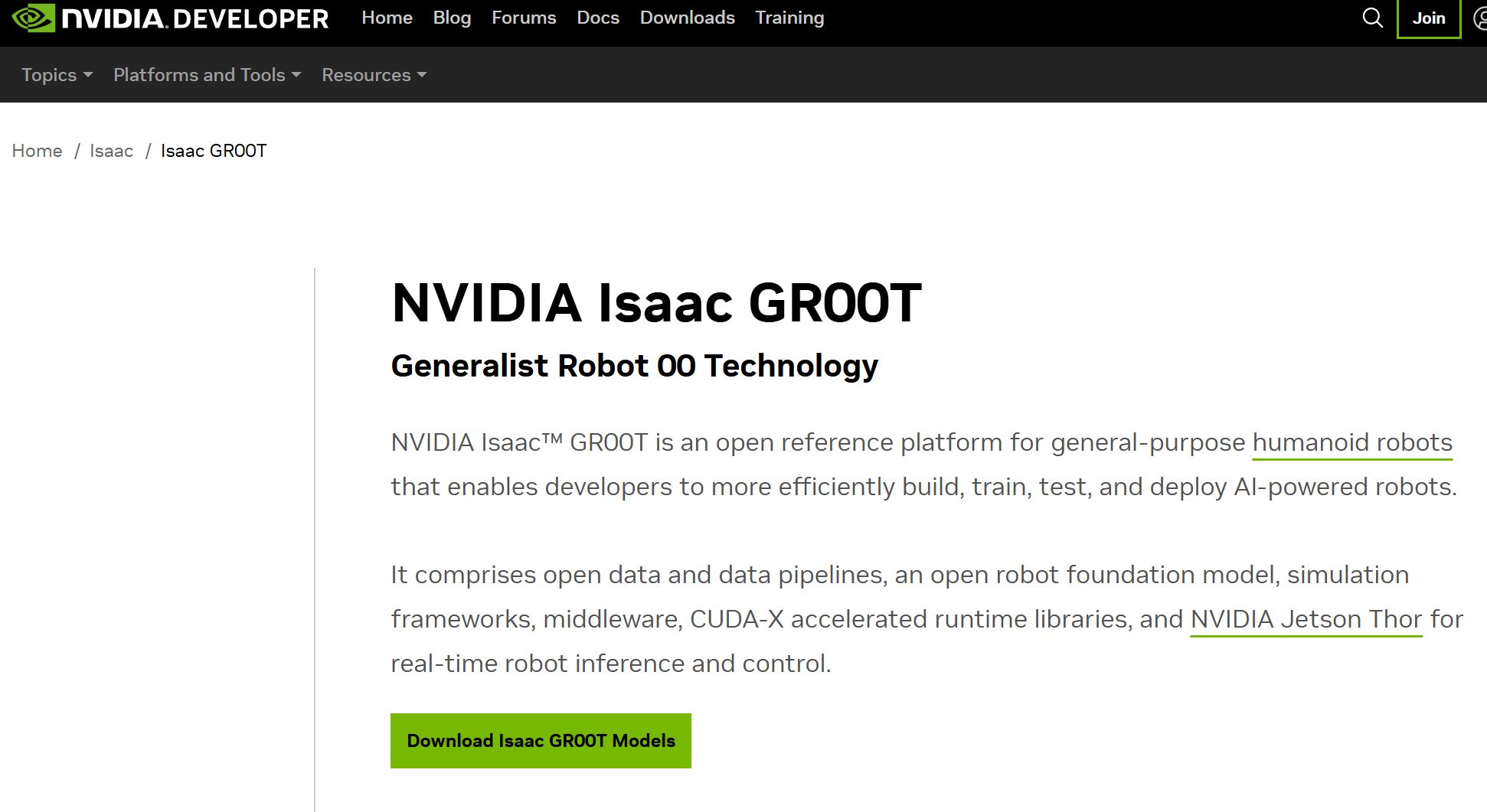
The company has taken things a step further with Isaac GR00T, an open development platform that includes foundation models designed specifically for humanoid robots.
 www.developer.nvidia.com
 Much like a large language model serves as a general-purpose brain for chatbots, GR00T gives robots a common starting point for understanding the physical world. This can help said robots perform new tasks without requiring developers to program every movement from scratch.
But brains alone don't build a robot. Eyes, nerves, and joints still need someone to make them – and that's where the real opportunity might be hiding.
Best Robotics Stocks To Watch: The Vision, Sensor, and Motion Control Companies Powering Physical AI
While Nvidia and Alphabet are laying the groundwork for physical AI, they're far from the only companies poised to benefit. Indeed, they’re not the only ones pushing the boundaries of the industry.
But big as they are, they can be stretched too thin. And neither one is really a manufacturing company.
Every robot, whether it exists today or not, needs to see, move, and interact with the world to make all this worthwhile. So someone has to make those parts – and preferably a company with expertise in a particular field.
Take machine vision. A humanoid robot may carry the most advanced AI model ever created, but without reliable cameras and vision software, it's effectively blind.
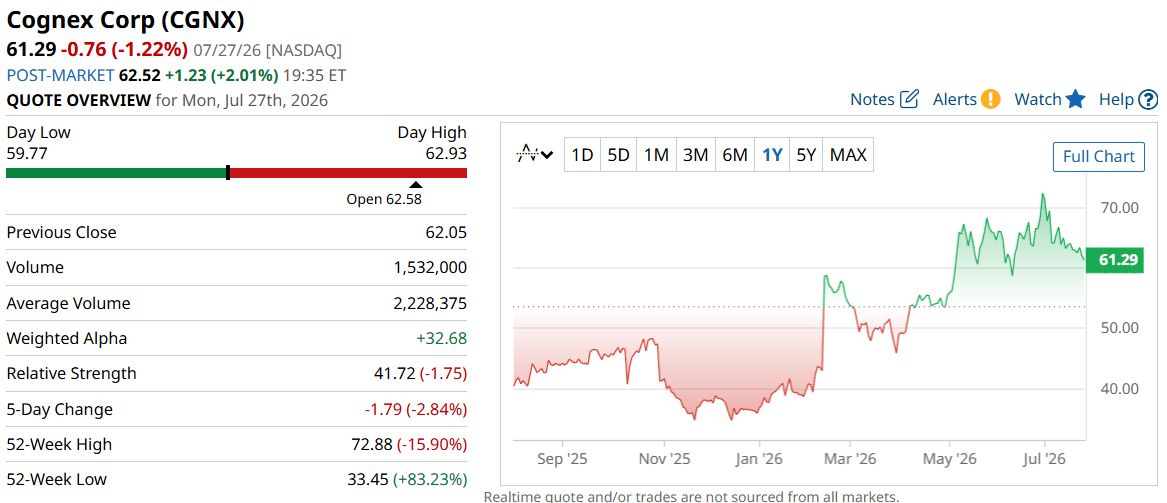
That's why companies like Cognex (CGNX) are seeing some success in the industry.
 www.barchart.com
 Their vision systems allow robots to identify objects, inspect products, read barcodes, and detect defects with a level of speed and consistency that humans simply can't match. Cognex has been at this for over 40 years, and it shows.
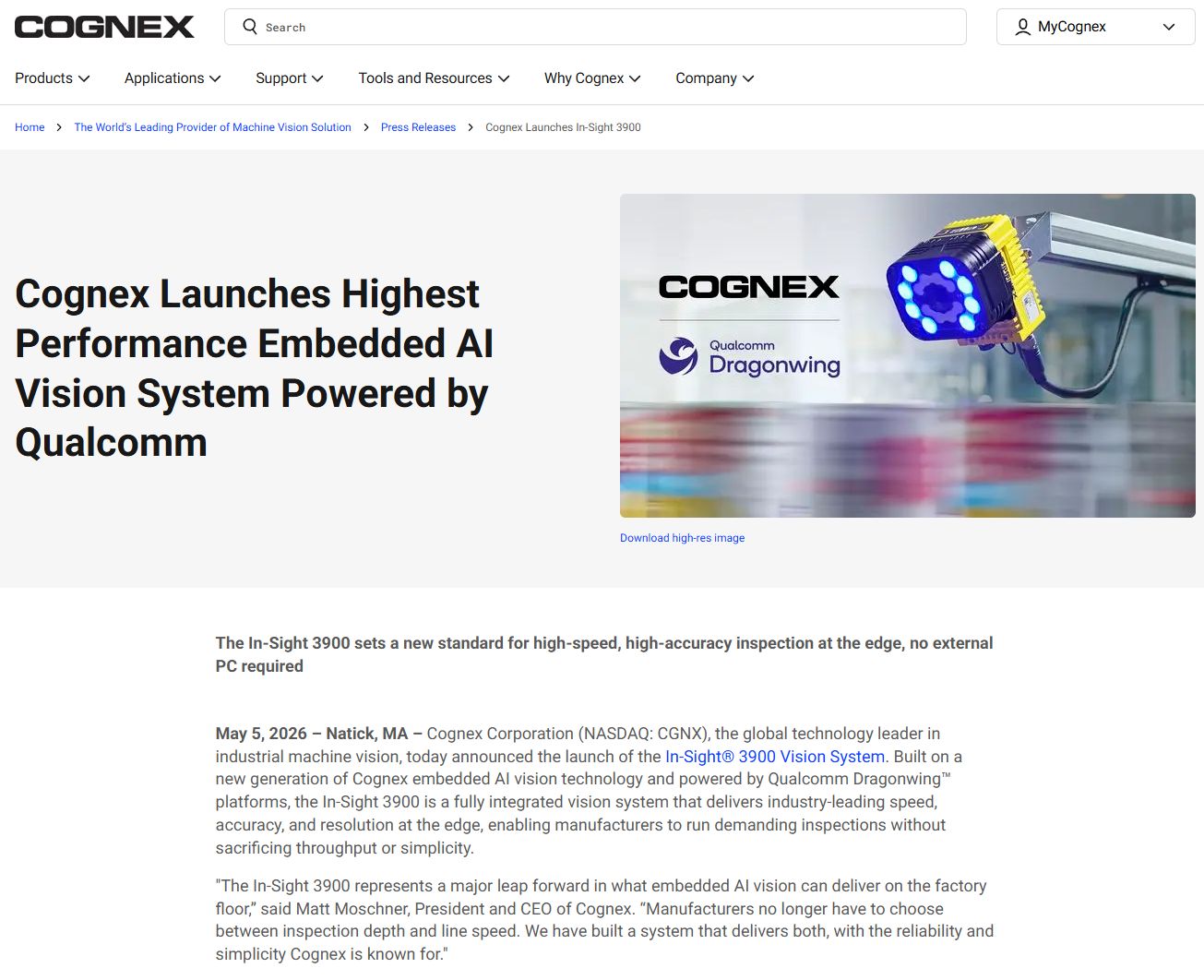
The company's recently launched In-Sight 3900 vision system and In-Sight 6900 vision controller push AI processing directly to the edge, meaning robots can inspect parts and make decisions on the factory floor without waiting on a round trip to some server farm.
 www.cognex.com
 But cameras alone aren't enough. Someone has to process everything those cameras capture, in real time, without draining a battery or requiring an entire server rack bolted to the robot's back. Ambarella (AMBA) offers exactly that.
The company designs low-power edge vision chips that allow AI to operate locally. Its latest, the CV7 system-on-chip, is built to handle multiple camera streams and run the same deep learning models used for object recognition, all while keeping power draw to a minimum.
But beyond cameras and AI chips, robots need to have depth perception. Cameras are great at recognizing what something is, but they're not always great at knowing exactly how far away it is, especially in bad lighting or a cluttered environment. (Oh, the many woes of living in a three-dimensional world.)
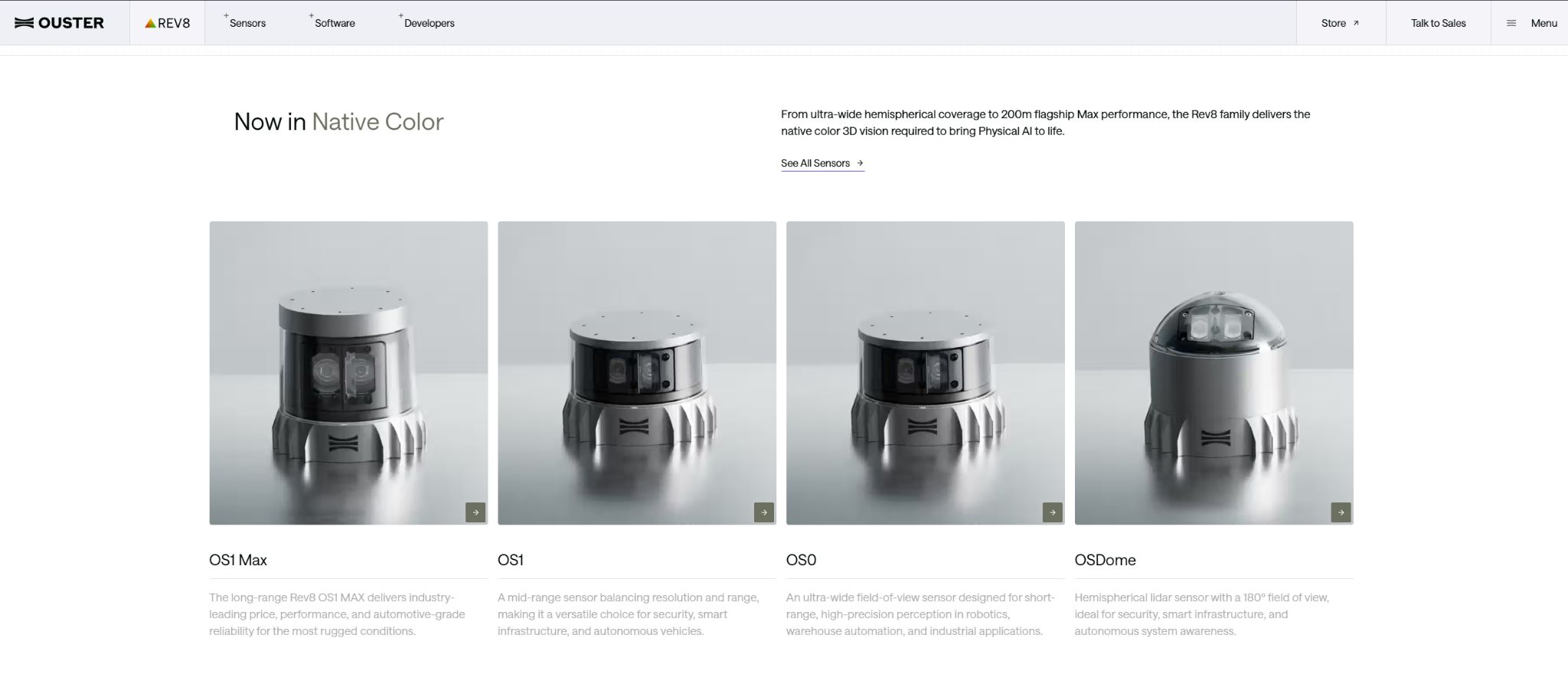
Thankfully, Ouster (OUST) fills in that gap with its digital lidar (light detection and ranging) units. The company builds its sensors around solid-state silicon chips, making everything smaller, cheaper, and more durable. Its newest Rev8 lineup even adds native color sensing, letting a robot generate a 3D map of its surroundings with real depth data baked in.
 www.ouster.com
 Then we have motion control. A robot that can think but cannot move is, well, just a chatbot. And a robot that can move but lacks precision, repeatability, or control may not be useful enough to justify its cost. That is why precision motion components are so important to robotics manufacturers.
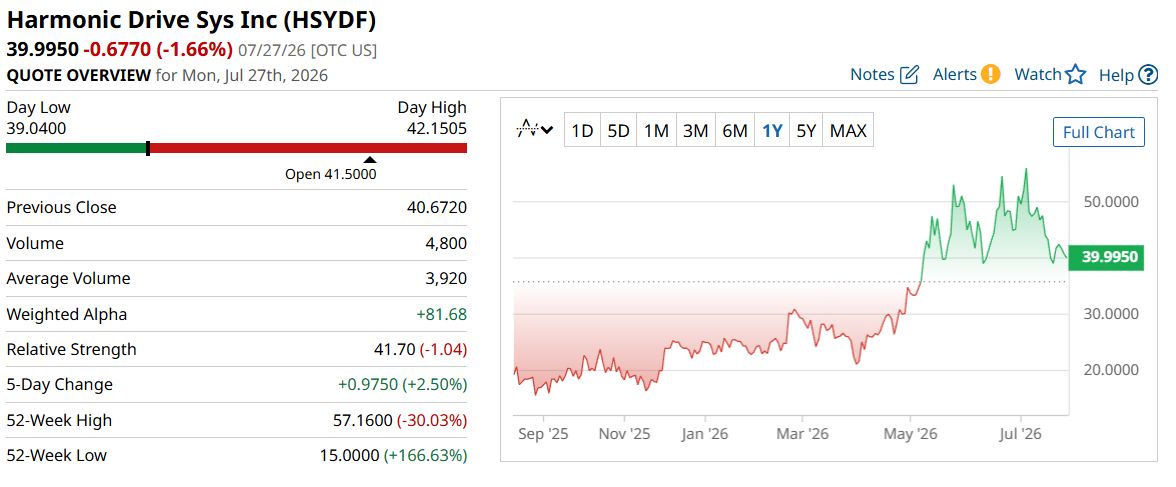
They often turn to companies such as Harmonic Drive Systems (HSYDF), a leading manufacturer of precision speed reducers and related mechatronics products used in robotic joints and other high-precision positioning systems.
 www.barchart.com
 Higher-quality motion components can improve positioning accuracy, repeatability, torque transmission, and control. Those improvements can expand their effective range of applications from simple lifting and walking to more articulate and complex tasks.
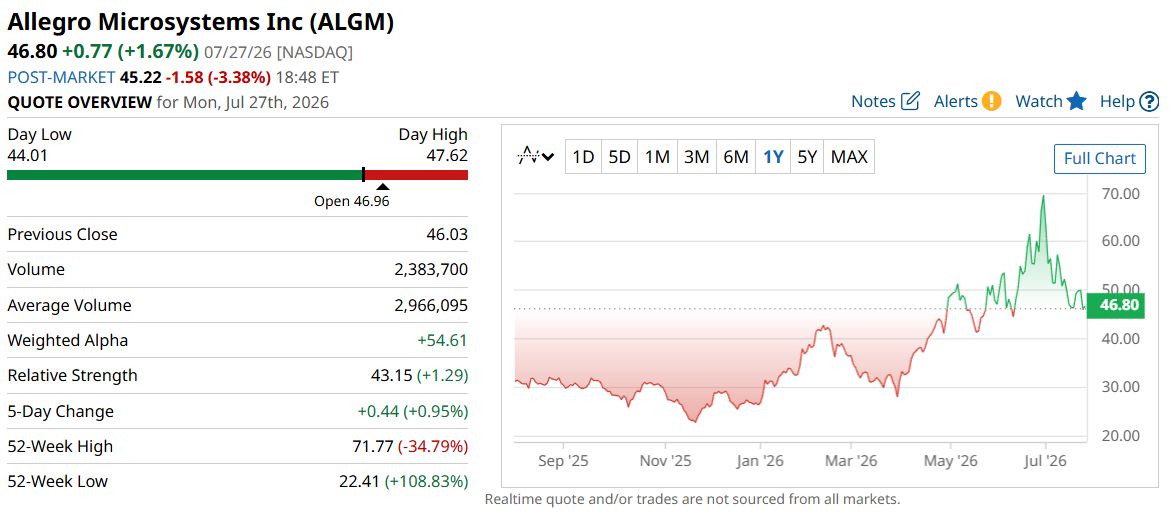
But even deeper than that, there's another layer most people never think about: the sensor chips telling the robot's joints and motors exactly where they are and how much current they're drawing at any given moment. That's the business Allegro MicroSystems (ALGM) is in.
 www.barchart.com
 Its magnetic position sensors, current sensors, and motor drivers are what let a robotic arm know precisely where it's pointed or let a mobile robot's motor controller adjust torque on the fly.
I know; it’s not the flashiest part of the tech stack. Not as glamorous as Nvidia’s or Google’s fancy AI brain, and certainly not as immediately important as Cognex’s AI eyes or Ouster’s depth-perception cameras.
But without these micro-sensors, that fancy AI robot might as well be a brain with no nerves. It can plan the perfect move down to the very last minute detail, but it’ll have no idea whether its arm actually reached the right position, if a motor is straining, or if it's about to crush the object it's trying to pick up.
So who's actually trying to bolt all these pieces together into one finished, working robot? One company comes to mind before anyone else.
Tesla Optimus: Is This Humanoid The Future of Robotics?
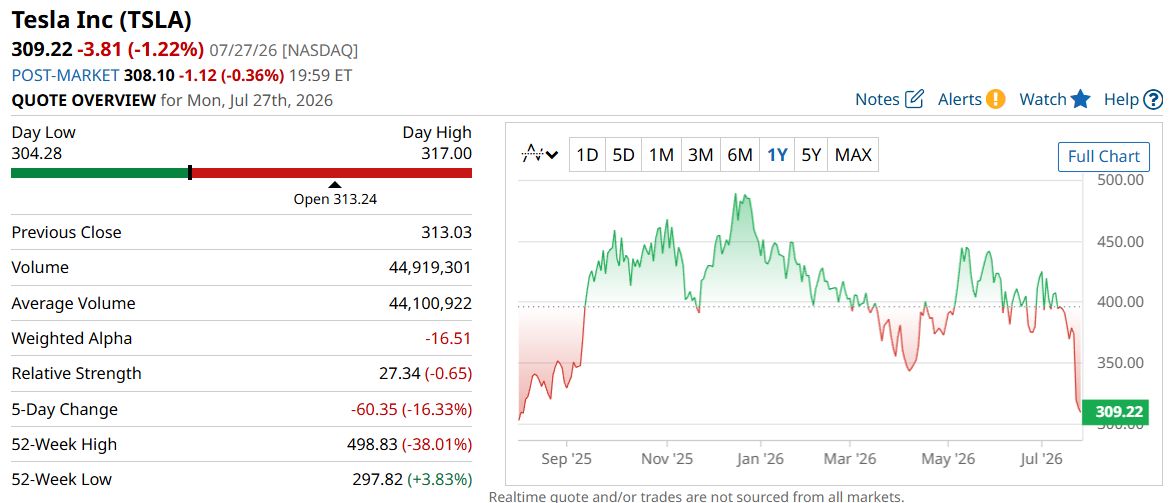
Of course, no discussion about robotics and physical AI would be complete without mentioning Tesla (TSLA).
 www.barchart.com
 The Optimus program is Tesla’s humanoid robot designed to perform repetitive, dangerous, or physically strenuous tasks. The ultimate goal is to build a general-purpose, mass-market robot capable of working in warehouses, manufacturing plants, businesses, and eventually even homes.
Here, Tesla stands apart from Nvidia and Alphabet. Those two companies are building the brain and its constituent parts and programs. Tesla is building the whole thing: an integrated humanoid robot intended to operate autonomously. And it’s where Tesla may hold one of its biggest competitive advantages in the field.
Tesla already operates some of the world's largest and most automated manufacturing facilities. It has years of experience in large-scale production and supply management. And it can turn that infrastructure and expertise into full-fledged Optimus factories.
It’s also no stranger to AI, as it applies related computer vision, neural network, and planning technologies into its self-driving cars.
Tesla is also developing much of the robot's technology in-house. From custom AI chips and battery systems to electric motors, actuators, software, and control systems, the company owns and controls a significant portion of its own technology stack. The obvious benefit here is that the company can develop and optimize components itself rather than relying on third-party suppliers. That can potentially mean faster development times, tighter cost control, and higher quality performance.
And perhaps Tesla's biggest advantage is that it doesn't have to wait for outside customers to validate Optimus. It already owns factories around the world that perform exactly the kind of work humanoid robots are designed to handle.
Repetitive tasks? Check. Physically demanding work? Check. Potentially dangerous work environment? Triple check.
That gives Tesla a real-world proving ground where engineers can continuously refine Optimus' hardware and software before offering it to external customers. Every improvement can be tested in production, allowing the company to identify problems, collect data, and iterate much faster than a startup deploying robots one customer at a time.
But that’s the key word here: can.
All of this is theoretical. Optimus is part of Tesla’s long-term vision, not its current reality. Sure, the program has shown us some impressive progress, but it’s still moving towards production. There’s no definitive proof yet that Optimus robots can deliver on all of the promises. Even more so, manufacturing millions of affordable humanoid robots is an engineering challenge unlike anything the industry has attempted before. So we’re not likely going to see big progress here in the next few years.
Still, if the company can deliver on its goals and the robotics industry unfolds just as CEO Elon Musk envisions, Optimus could eventually become Tesla’s next growth platform, rivaling its electric vehicle business during its heyday.
But before you get swept up into humanoid robot daydreams, there's a much less comfortable question waiting on the other side of this technology.
The Human Impact of AI Robotics And Automation
What happens to the humans?
Every sweeping technological advancement, from the printing press to the Industrial Revolution to the birth of the Digital Age, had a vast impact on manual labor and existing businesses at that time.
Think about it. When was the last time you popped out for a quick walk on a Saturday morning to get your newspaper? Are newspapers – I mean the actual, physical, printed sheets – even a thing anymore? I haven’t seen one in a while.
That’s the problem here. When a new facet of technology advances, someone always gets left behind. We saw it with newspapers. Heck, if reports are accurate, we’re seeing it now as customer service workers are being replaced with AI helplines.
And even worse, it’s looking a lot different this time around.
Unlike previous waves of automation – which were, to be honest, largely confined to factory floors or computer screens – the advent of intelligent, highly-mobile robots has the potential to spill over into the blue-collar and service industries.
Warehouse workers. Janitors. Orderlies. Retail stock clerks. Construction laborers. All of them and more could soon be replaced with automated machines. All thanks to better economics.
Robots won’t ask for overtime. They’re not going to call in sick on the morning of an important deal. No paid leaves, no health insurance, no fringe benefits. They don’t need pretty, open environments with ping-pong tables to optimize workflow and improve morale. And they’re certainly not going to pick a fight with Janice on the 17th floor.
Give a robot electricity, routine maintenance, and a task to perform, and it can theoretically operate around the clock.
For businesses facing rising labor costs, chronic worker shortages, and increasing pressure to improve productivity, that's an incredibly attractive proposition.
So, can we expect robots to take over our jobs now? Which industries are safe and which ones are right in the crosshairs? Do you need to worry about your job security in the coming years?
Well… those are actually the wrong questions.
History shows that technology rarely eliminates entire professions overnight.
Take accountants. Spreadsheet software didn't wipe out the accounting profession. The accountants still did the work, but used the new tools themselves.
ATMs didn’t make bank tellers extinct. In fact, the last time I went to a bank, it was sorely in need of tellers, based on how many people were lining up. And even if they’re not handling as much cash over the counter as they once did, tellers can shift to customer service, offering other financial products, and general relationship management.
But that’s me being optimistic. (Too optimistic, my other half might say.)
Because the truth is, manual jobs that require almost entirely repetitive, predictable work are precisely the ones the robotics industry is targeting.
So if your day consists of performing the same sequence of movements hundreds of times, in roughly the same environment, with very minor variations throughout, then, yes, you're standing right in the crosshairs of automation. If the physical AI revolution succeeds, those jobs are going away.
And over time, that hit list may expand.
VLA models will become more capable. We saw it with AI chatbots. We went from the utter nonsense SimSimi used to respond with back in the early 2000s to LLMs writing entire books about any chosen subject.
The only difference is that ChatGPT, Gemini, Claude, and Grok are all targeting endeavors that heavily rely on human touch and creativity. As such, the results are… telling.
There are painfully obvious markers of written AI work. Even if we move on to images or videos, they all look so plasticky. Like ambulatory Barbie and Ken dolls.
But if you see a shelf neatly stacked in a warehouse, will you be able to tell if a human or a robot did it?
That’s why physical AI is so different from generative AI.
A robot moving inventory, unloading trucks, or cleaning a factory floor doesn't leave behind those obvious fingerprints. If it performs the task correctly, the outcome is exactly the same.
And for businesses, that's all that matters.
Ultimately, companies get paid when the work gets done. That’s why robotics has attracted so much attention from some of the world's largest technology companies. That's also why the face of the global labor force could look very different a decade from now.
Whether that future arrives in five years or 15 is still up for debate. But the direction is becoming increasingly clear.
But what does all this mean for investors?
It’s easy to forget that five years ago, Nvidia was a boring graphics card company, and AI was still a science project. But, unlike the AI boom, where Nvidia emerged as the clear winner early on, robotics is shaping up to be a far broader ecosystem. There will be companies building the robots, companies supplying the chips, companies developing the software, and countless others manufacturing the sensors, actuators, gears, motors, and vision systems that all make physical AI possible.
Could Tesla become the new Nvidia? No one really knows. But, ironically, just like the AI boom, the robotics revolution is likely to reward companies across the entire supply chain.
On the date of publication, Rick Orford had a position in: GOOGL . All information and data in this article is solely for informational purposes. For more information please view the Barchart Disclosure Policy here.
More news from Barchart
What Will the Fed Do With Rates Wednesday? Michael Burry Is Doubling Down His Short Bets Against Micron and Nvidia. What That Tells Us About the Future of Chip Stocks. Long Call Butterfly Trade Ideas for July 27th Stock Index Futures Gain With Focus on Fed Rate Decision and Big Tech Earnings