

It has been a roller-coaster year for artificial intelligence (AI) stocks. On one side, the technology's enormous long-term potential has kept investors searching for the next AI winner. On the other, mounting concerns over an AI bubble and whether the industry's unprecedented spending spree can be justified have made the market far less forgiving. That tension has been on full display this earnings season. While several technology giants have delivered results that comfortably topped Wall Street's expectations, investors have looked beyond the headline beats.
Instead, the spotlight has shifted to ballooning AI-related capital expenditures, with tech companies facing sharp sell-offs whenever soaring infrastructure investments threatened near-term profitability or management hinted at even higher spending ahead. Alphabet (GOOG) (GOOGL) became the latest casualty of that trend following its second-quarter earnings report on July 22. Despite reporting another strong quarter, its shares plunged as investors focused on the company's accelerating AI investments rather than its earnings beat.
More Top Stocks Daily: Go behind Wall Street’s hottest headlines with Barchart’s Active Investor newsletter.
Against that backdrop, Advanced Micro Devices (AMD) is among the biggest AI names still left to report earnings this season. The semiconductor giant is scheduled to release its fiscal 2026 second-quarter results after the market closes on Tuesday, Aug. 4, setting the stage for another closely watched test of investor sentiment toward AI. Unlike many of its peers, AMD has largely weathered the recent turbulence.
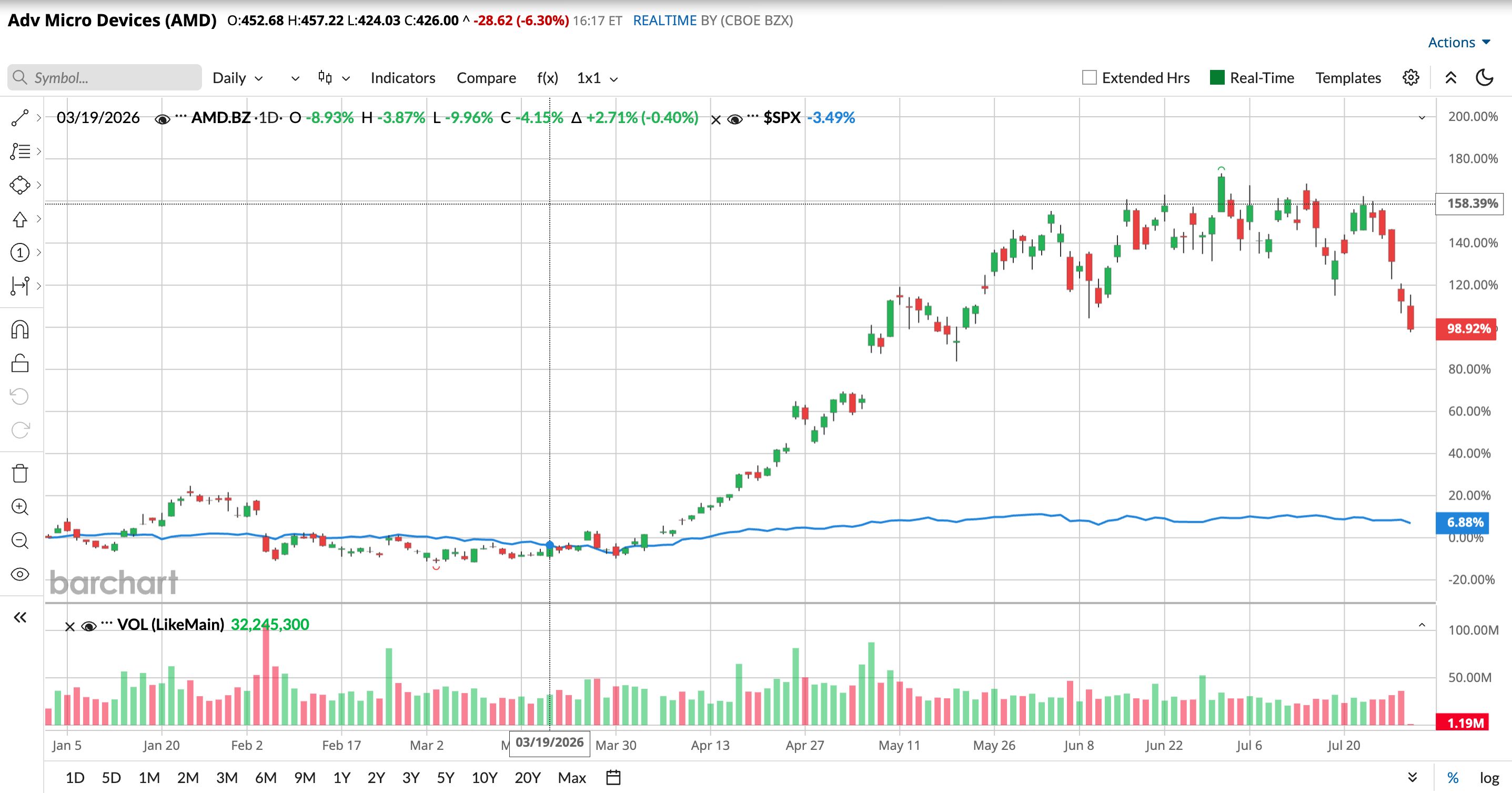
While the stock has shed 27.7% from its June all-time high, AMD has still delivered impressive performance this year despite broader technology-sector headwinds, supported by strategic partnerships, strengthening fundamentals, and growing confidence in the company's AI roadmap. With investors becoming increasingly selective about AI stocks, AMD's upcoming earnings report could be one of the defining events of the season. So, ahead of the results, here's a closer look at the chipmaker.
About AMD Stock
Based in California, Advanced Micro Devices has established itself as one of the world's leading semiconductor innovators, designing the GPUs, CPUs, and high-performance computing solutions that power some of today's fastest-growing industries, including gaming, data centers, and artificial intelligence. Its technologies touch billions of lives every day, supporting everything from Fortune 500 enterprises to cutting-edge scientific research that is reshaping the way the world works, plays, and innovates.
AMD's AI ambitions are becoming increasingly difficult to overlook. A growing number of enterprises are deploying the company's Instinct MI300-series accelerators for AI training and data center workloads, positioning AMD as one of the most formidable challengers to Nvidia's (NVDA) dominance in the rapidly expanding AI chip market. The company is also making significant strides in the emerging AI PC market with its Ryzen AI Max and Strix Halo processors, which combine powerful Zen CPU cores, integrated RDNA graphics, and dedicated NPUs to deliver advanced AI capabilities directly on users' devices.
That progress has been reinforced by a series of high-profile achievements. Strong earnings, expanding partnerships with leading technology companies, and continued market-share gains against rivals such as Intel (INTC) and Nvidia have strengthened AMD's position as one of Wall Street's most closely watched AI investments. The market has rewarded that execution.
Currently valued at roughly $741.30 billion, AMD has surged 148.3% over the past year and another 105.7% year-to-date (YTD), leaving the broader market far behind. By comparison, the S&P 500 Index ($SPX) has advanced 15.7% over the past year and 7.7% YTD, highlighting the remarkable enthusiasm surrounding AMD's AI-driven growth story. However, sentiment has become increasingly fragile as earnings season has put AI valuations under the microscope.
Despite its stellar run, AMD has surrendered 27.7% from its record high of $584.73, reached in June, and the selling pressure has intensified recently, with the stock tumbling 20.25% over the past five trading sessions. The sharp pullback underscores the speed in which investors can shift from rewarding AI optimism to questioning whether lofty expectations can continue to be met.
 www.barchart.com
 AMD’s Fundamentals Remain Strong
AMD gave investors another compelling reason to stay optimistic when it unveiled blockbuster fiscal 2026 first-quarter results on May 5, comfortably surpassing Wall Street's expectations on both revenue and earnings. The market responded enthusiastically, sending the stock soaring 18.6% in the following trading session. Revenue climbed 38% year-over-year (YOY) to $10.25 billion, handily beating analysts' expectations of $9.85 billion and rising sharply from $7.44 billion in the year-ago quarter.
The robust revenue growth was accompanied by equally impressive gains in profitability. Non-GAAP earnings per share increased 43% to $1.37, ahead of the consensus estimate of $1.30, while GAAP net income nearly doubled to $1.38 billion. The strong quarter highlighted AMD's growing ability to translate surging AI demand into higher earnings as its AI-focused business continues to gain scale.
The Data Center segment once again emerged as AMD's biggest growth driver and remained the centerpiece of the company's expansion story. Revenue from the division surged 57% YOY to $5.78 billion, fueled by robust demand for EPYC server processors and rising shipments of Instinct AI accelerators. However, AMD's momentum extended well beyond its data center business. Its Client and Gaming segments also posted solid growth, generating a combined $3.61 billion in revenue, up 23% from the same period last year.
The Client segment contributed $2.9 billion in revenue, representing 26% annual growth, driven by strong demand for Ryzen processors and continued market-share gains. Meanwhile, Gaming revenue increased 11% to $720 million, as healthy demand for Radeon GPUs more than offset softness in semi-custom products. Profitability also continued to trend higher, with non-GAAP gross margin expanding to 55% from 54% a year earlier, reflecting the growing contribution of AMD's higher-margin AI and data center portfolio.
Management credited the strong performance to accelerating demand for AI infrastructure. The rapid adoption of AI inferencing and agentic AI workloads is driving greater demand for high-performance CPUs and AI accelerators, while customer interest in AMD's next-generation MI450 Series and Helios platforms continues to build. Adding to the upbeat outlook, management revealed that demand forecasts from several major customers are already running ahead of the company's initial expectations, further reinforcing confidence in AMD's long-term growth trajectory.
Looking ahead, management expects the momentum to continue. For the fiscal 2026 second quarter, AMD forecast revenue of approximately $11.2 billion, plus or minus $300 million. At the midpoint, the guidance implies roughly 46% YOY growth and about 9% sequential growth. The company also expects non-GAAP gross margin to improve further to approximately 56%, signaling management's confidence that demand for its AI and data center portfolio remains exceptionally strong.
How Do Analysts View AMD Stock?
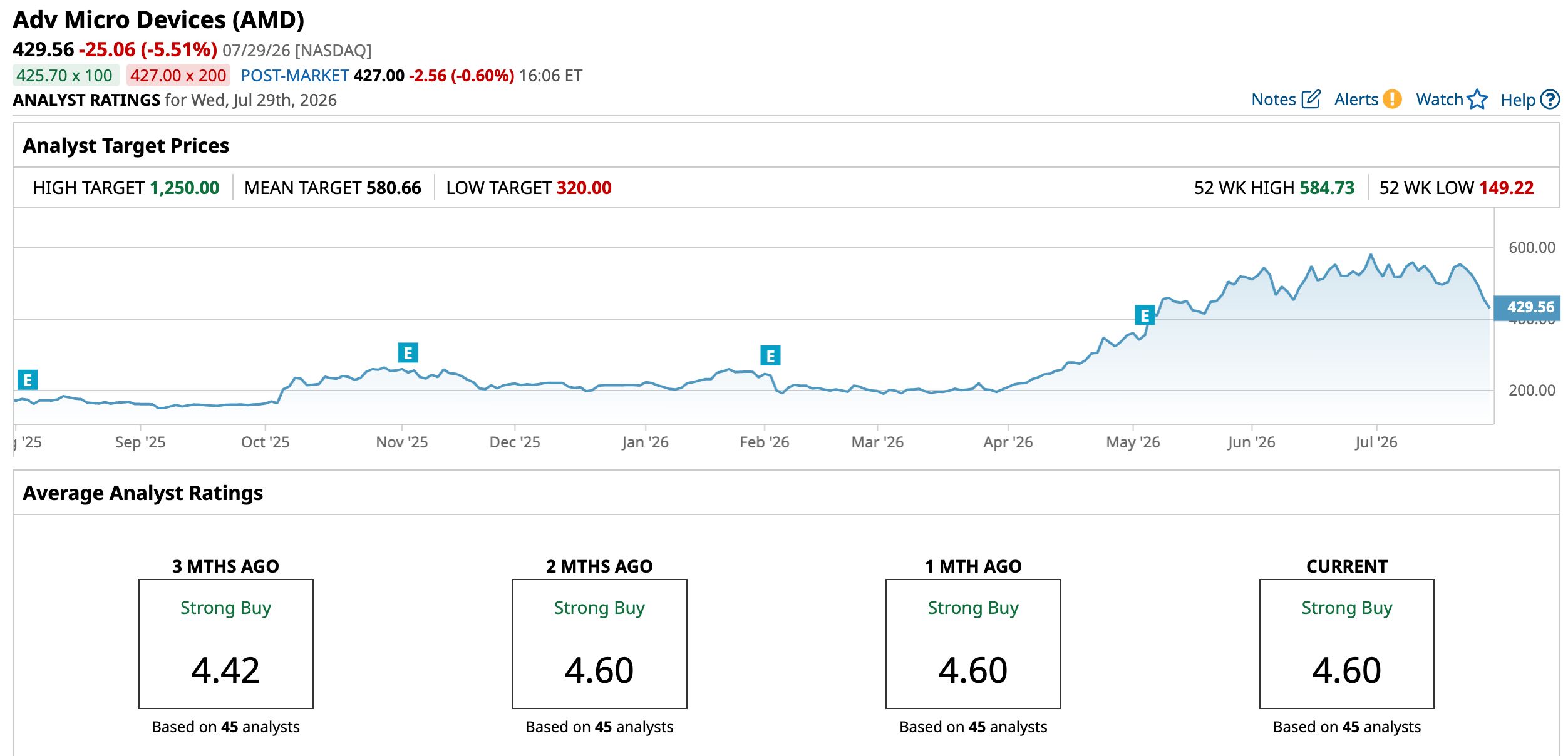
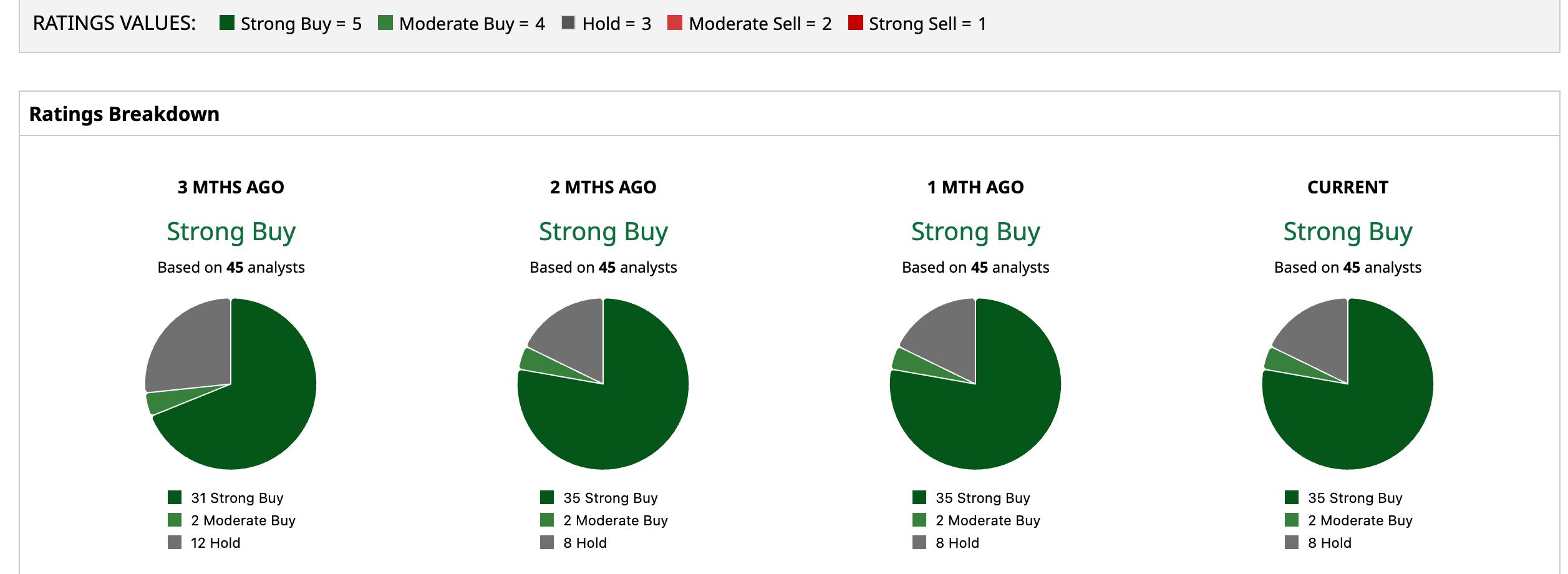
Despite the recent pullback, Wall Street remains broadly optimistic about AMD's long-term prospects. The chipmaker currently carries a consensus "Strong Buy" rating, reflecting continued confidence in its AI growth story despite heightened volatility across the semiconductor sector.
Among the 45 analysts covering AMD, 35 rate the stock a "Strong Buy," two recommend a "Moderate Buy," while eight remain on the sidelines with a "Hold." The average price target of $580.66 implies potential upside of approximately 35.2% from current levels. Even more notably, the Street-high target of $1,250 suggests the stock could rally as much as 191%, underscoring just how bullish some analysts remain on AMD's long-term AI opportunity.
 www.barchart.com
  www.barchart.com
 On the date of publication, Anushka Mukherji did not have (either directly or indirectly) positions in any of the securities mentioned in this article. All information and data in this article is solely for informational purposes. For more information please view the Barchart Disclosure Policy here.
More news from Barchart
Dear AMD Stock Fans, Mark Your Calendars for August 4 Intel Stock Sinks 40%, But Most Analysts Still Aren’t Bullish on INTC Vertiv (VRT) Stock Sinks Despite Earnings Beat. What to Know. Agentic AI Is Coming to Chip Design. Here Is Why Synopsys Stock Could Be the Biggest Beneficiary.