


In his appearance earlier this month on "The Master Investor Podcast with Wilfred Frost," JPMorgan Chase (JPM) CEO Jamie Dimon was predictably opinionated when it came to finding opportunities in the market – or, more specifically, a lack thereof.
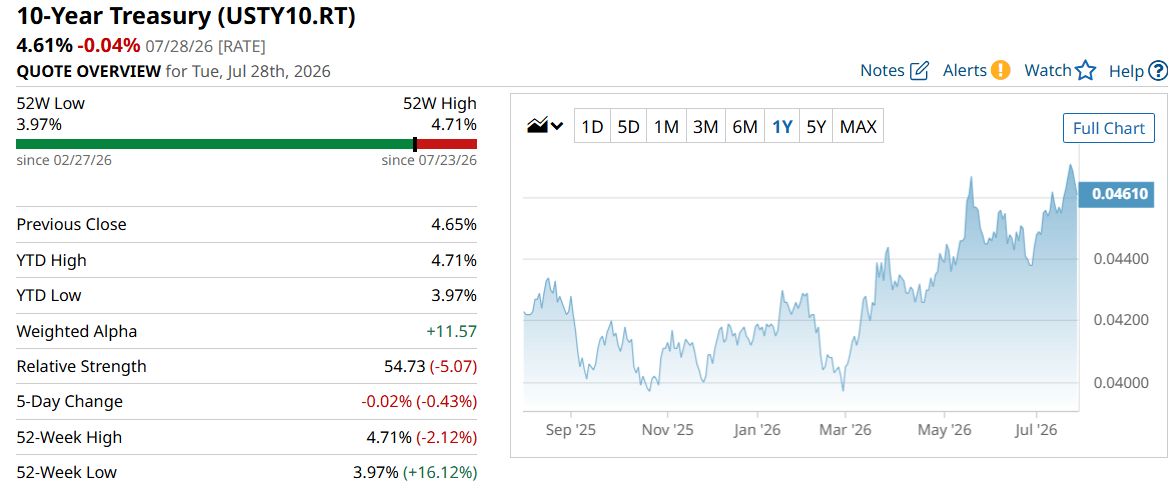
With yields on the 10-year Treasury near recent highs above 4.61%, Dimon said, "Personally, no. I would not be a buyer."
Join 200K+ Subscribers: Find out why the midday Barchart Brief newsletter is a must-read for thousands daily.
In the Wall Street CEO’s opinion, even in a best-case scenario for inflation, “the 10-year bond should probably be at four to four and a half."
Given that inflation runs much hotter than that 2% target and yields are currently around 4.6%, Dimon says there’s just not enough payoff for the risk in the bond trade right now.
 www.barchart.com
 But then again, the almost notoriously bearish Dimon hasn’t been buying much of anything else, either, per the interview.
So is Jamie Dimon right about long-term bonds here – or just overly cautious?
Why Jamie Dimon Is Bearish on Long-Term Bonds
Dimon’s argument centers on the idea that bond investors, sometimes called bond vigilantes, will demand higher yields to compensate for the risk of lending to a government with expanding deficits and no credible plan for fiscal consolidation.
The JPMorgan boss made his case by drawing parallels to the inflation turbulence of the 1970s, when headline inflation improved before accelerating again, and suggested that investors may be placing too much confidence in individual data releases.
The 10-year Treasury yield currently sits around 4.6%, having risen significantly since the start of the Iran War earlier in the year. The 30-year yield has touched levels above 5% – last seen in 2007 – and the Vanguard Long-Term Treasury ETF (VGLT) has delivered negative annualized returns over both five-year and 10-year periods.
Structurally, JPMorgan's own strategists have identified what they call "six D's" reshaping the economy: deficits, deregulation, decarbonization, depopulation, deglobalization, and de-dollarization.
The U.S. government continues to run large fiscal deficits with little political appetite for spending restraint, and total global debt has reached approximately $251 trillion.
Geopolitically, the ongoing U.S.-Iran conflict has pushed oil prices significantly higher, feeding inflationary pressures that complicate the Fed's policy path. Three Fed officials dissented in favor of raising rates at the most recent meeting, signaling a hawkish bias that makes long-duration bonds particularly vulnerable.
Why Dimon Could Be Wrong on Bonds
However, there are counterarguments worth considering.
JPMorgan's own trading desk issued a note on July 27 describing falling bond yields as one of five tailwinds supporting a tactical equity rally, suggesting that at least some within the firm see yields potentially declining in the near term.
Separately, Wharton professor Jeremy Siegel has noted that while real yields are elevated at 2.43%, they have not yet reached levels that constitute a definitive threat, implying some room for stabilization.
To that point, the recent three-day decline in 10-year yields to around 4.61% from higher levels at 4.71% confirms that short-term reversals remain possible.
Who Should Be Listening to Jamie Dimon on Bonds Here?
Dimon's bearishness on bonds is worth a listen for investors with a multi-year horizon.
Right now, a combination of structural fiscal deterioration, geopolitical risk, and a Federal Reserve that may need to raise rather than cut rates creates an asymmetric risk profile for long-dated Treasuries where the downside to bondholders meaningfully exceeds the upside.
For investors seeking fixed-income exposure, Dimon's implicit recommendation to favor shorter-duration bonds, which carry far less sensitivity to these structural forces, appears prudent in the current environment.
The 10-year Treasury at roughly 4.6% may look attractive in isolation, but when adjusted for the realistic probability of further yield increases driven by deficits, sticky inflation, and geopolitical shocks, the risk-reward calculus tilts against long-duration government debt.
Or, for investors ready to take a more proactive and nuanced approach to Treasury-based income generation, check out this in-depth explainer from Barchart columnist Rob Isbitts on how to build a bond ladder >>
This article was created with the support of automated content tools from our partners at Sigma.AI. Together, our financial data and AI solutions help us to deliver more informed market headline analysis to readers faster than ever.
On the date of publication, Sarah Holzmann did not have (either directly or indirectly) positions in any of the securities mentioned in this article. All information and data in this article is solely for informational purposes. For more information please view the Barchart Disclosure Policy here.