

Advanced Micro Devices (AMD) recently made a move that caught Wall Street's attention. The chipmaker is teaming up with Core Scientific (CORZ) to secure massive amounts of data-center capacity across the United States. For a company racing to keep pace with Nvidia (NVDA) in the AI chip war, power and space are just as important as silicon. This deal tackles both.
Here's what investors need to know about the agreement, and why it could matter for AMD stock in the months ahead.
More Top Stocks Daily: Go behind Wall Street’s hottest headlines with Barchart’s Active Investor newsletter.
 www.barchart.com
Why Data-Center Capacity Is a Hot AI Commodity
AI demand has exploded faster than most predictions. Moreover, running AI workloads requires enormous amounts of electricity, land, and physical infrastructure. Without enough power and space, even the best chips cannot be deployed at scale.
AMD's leadership made this point clear during its Advancing AI 2026 event on July 23. CEO Lisa Su told attendees that the AI accelerator market could reach roughly $1.4 trillion by 2030, up from an earlier estimate of about $500 billion by 2028. Su also said the market for AMD's broader computing products could approach $2 trillion by 2030.
Su explained that agentic AI — meaning AI systems that complete multistep tasks on their own — is driving much of this growth. Running these agents takes far more computing power than a simple chatbot response, since each task involves reasoning, platform integration, and data analysis.
A growing appetite for compute is precisely why AMD needs partners who can deliver ready-to-use data-center space quickly.
What the Core Scientific Deal Includes
According to a company statement, AMD will secure up to 2.5 gigawatts of data-center capacity from Core Scientific to support deployments of AMD's AI products. That includes AMD's Instinct GPUs, EPYC processors, and its ROCm software platform. The rollout will start with more than 500 megawatts of U.S. infrastructure starting in 2027, with room to expand toward the full 2.5 GW over time.
The two companies will also work together on physical infrastructure design. This means Core Scientific will lease space while helping build facilities specifically suited for AMD's hardware.
As part of the arrangement, AMD will receive market-priced warrants to purchase Core Scientific common stock, subject to certain commercial conditions. That structure mirrors similar warrant-based partnerships AMD has struck with other large customers, giving AMD potential upside if the relationship grows.
AMD Senior Vice President and Chief Strategy Officer of Corporate Development Mathew Hein said in the statement that Core Scientific's portfolio of AI-ready data centers “expands access” to infrastructure that AMD's customers need. He added that the goal is to help model builders, cloud providers, and enterprises “accelerate AI adoption while strengthening the AMD ecosystem.” Meanwhile, Core Scientific CEO Adam Sullivan said that the company is proud to establish the strategic relationship with AMD and expects it to grow meaningfully over time.
What's Next for AMD Stock?
AMD has spent the past year signing a string of massive infrastructure agreements. At its July event, executives detailed deployments of up to 6 GW with OpenAI, up to 6 GW with Meta Platforms (META), and up to 2 GW with Anthropic tied to AMD's MI450 chips.
The Core Scientific agreement fits a similar pattern, but it solves a different problem. Rather than committing chips to a single customer, AMD is locking down the physical real estate and power needed to deploy that hardware once it ships.
AMD CFO Jean Hu said during the Bank of America Global Technology Conference on June 2 that access to power, land, and infrastructure has become one of the biggest constraints on bringing new AI compute online.
Executives at AMD's July event echoed that view, noting that data centers can take years to plan and build, so locking in capacity early gives AMD and its customers a clearer runway. For investors, that runway is the real signal here, given AMD is winning chip orders and making sure it has somewhere to put them.
These deals reduce one of the biggest risks facing every company racing to scale AI, and it gives AMD more control over how quickly its next-generation Instinct GPUs and EPYC CPUs reach customers.
With server CPU demand alone projected to grow past $200 billion by 2030, according to AMD's updated forecast, having secured infrastructure like this could prove just as valuable to the AMD stock story as any single chip announcement.
What Does Wall Street Think of AMD Stock?
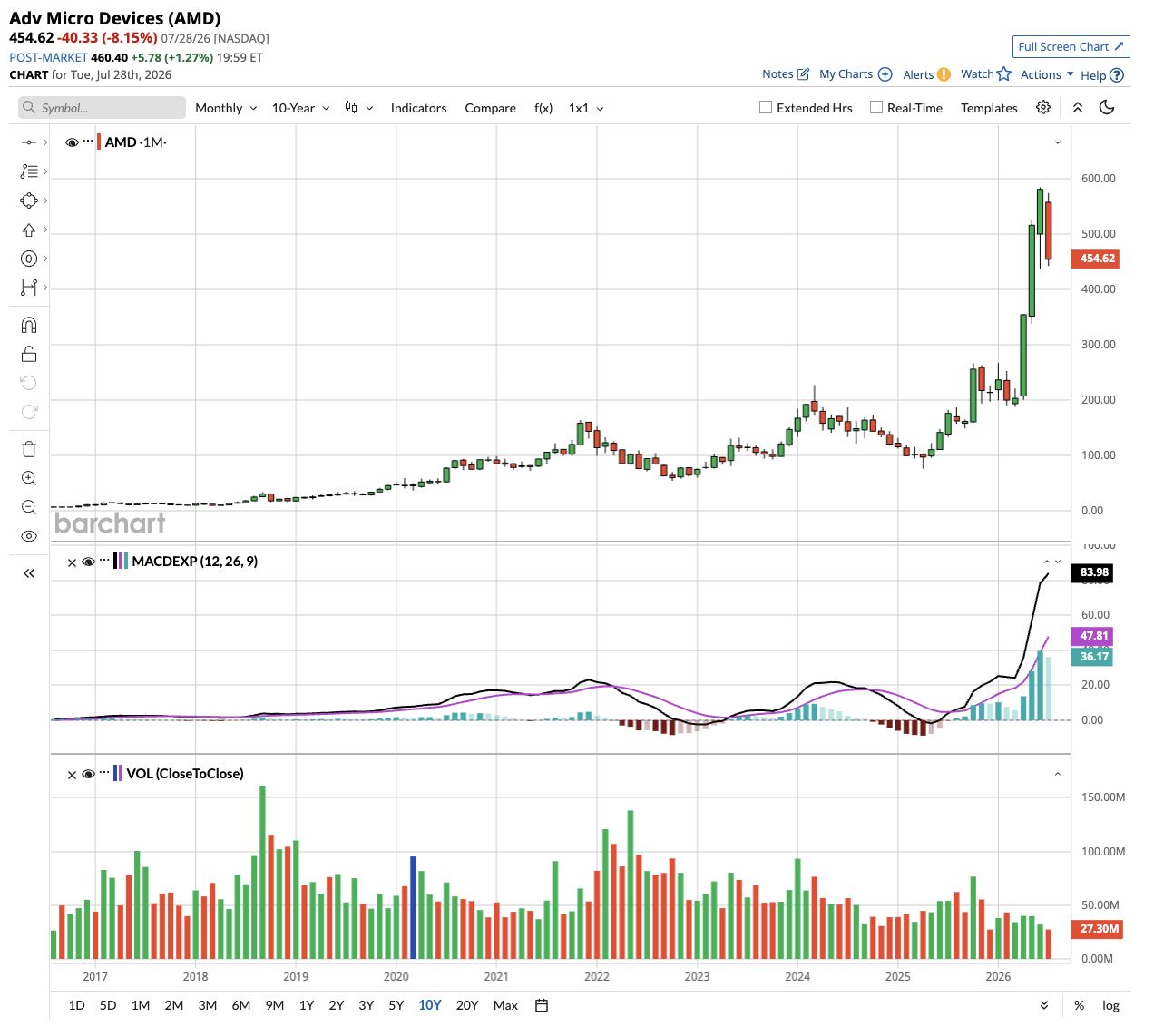
Valued at a market capitalization of $700 billion, AMD stock has risen more than 270% in the last three years. Despite these market-beating gains, the chip stock is down more than 15% from all-time highs.
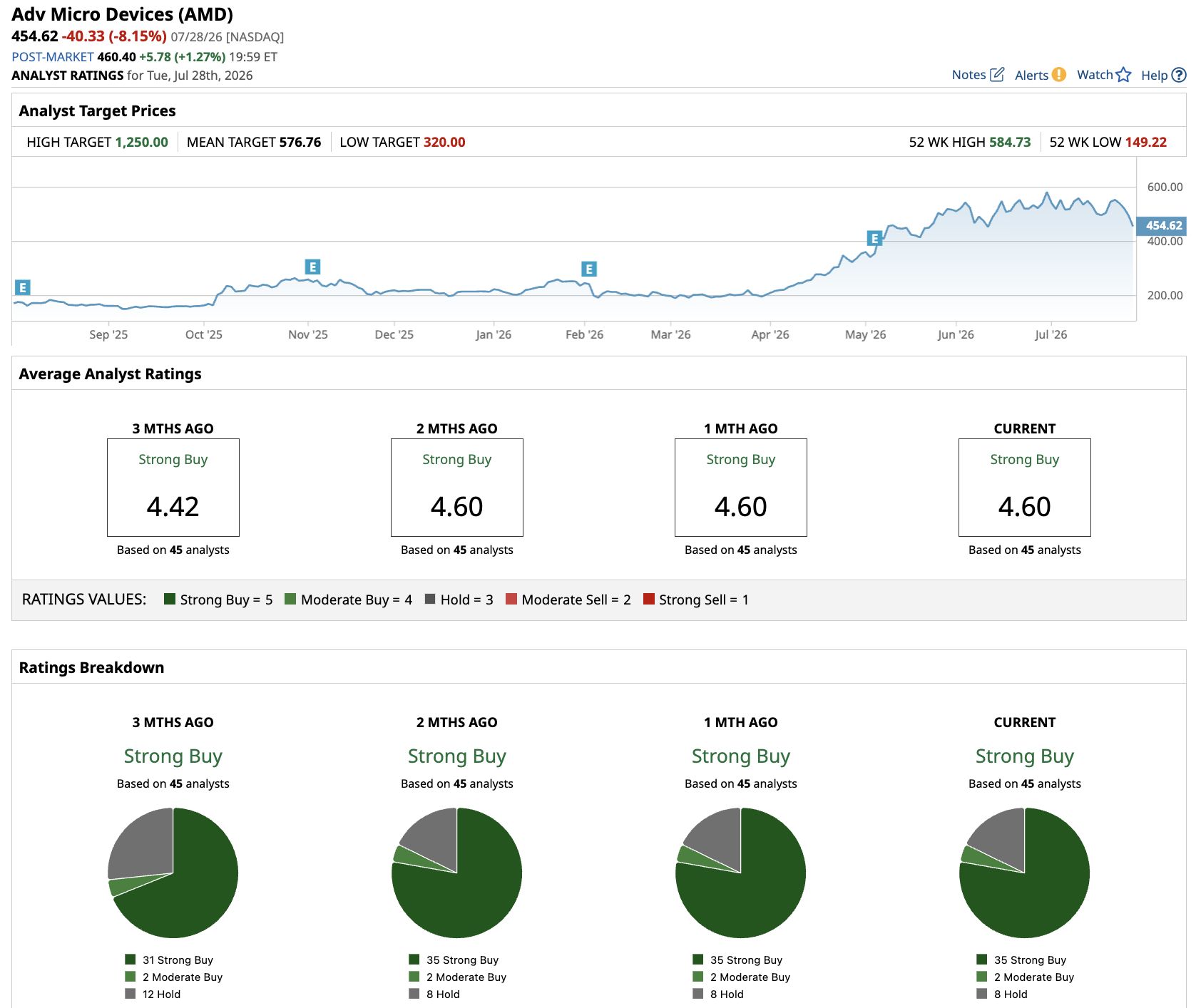
Overall, AMD has a “Strong Buy” consensus rating on Wall Street. Out of the 45 analysts covering AMD stock, 35 recommend a “Strong Buy” rating, two recommend a “Moderate Buy,” and eight recommend a “Hold” rating. The average price target of $580.66 suggests potential upside of 19% from current levels.
 www.barchart.com
 On the date of publication, Aditya Raghunath did not have (either directly or indirectly) positions in any of the securities mentioned in this article. All information and data in this article is solely for informational purposes. For more information please view the Barchart Disclosure Policy here.
More news from Barchart
Morgan Stanley Just Upped Its Price Target on Cognizant Stock. Here's Why. Landmark AI Power Agreement Sends Huge Signal for AMD Stock As Sam Altman Celebrates the Singularity, Palantir CEO Alex Karp Warns: ‘There Are Dangers… We Are Going to End Up Having to Regulate AI’ Susquehanna Just Upped Its Price Target on AMD Stock. Here's Why.