

On July 29, Arm (ARM) delivered a record quarter. The firm beat Wall Street consensus on both key metrics. Revenue of $1.29 billion was up 22% from a year ago, and the non-GAAP earnings of $0.45 per share also rose 29%. Free cash flow also saw exceptional growth, jumping 343% from a year ago to $665 million. Even so, the stock price, which was already down by more than $100 in the past month, continued to decline after the earnings release. The reason was primarily how high the stock is priced. Arm currently trades at more than 200 times forward earnings. At that level, even a solid quarter often isn’t enough to push ARM stock higher. Pointing to a soft smartphone market and high memory costs, the management also reduced the full-year royalty growth outlook to the high teens.
While that got most of the attention, the company quietly offset much of the weakness by more than doubling data center royalties from a year earlier. Management pushed back too, calling the smartphone slump cyclical, guiding to a recovery next year. It also maintained its target of more than 20% royalty growth by fiscal 2029. Demand for Arm’s new AGI CPU, its first in-house server chip, has already surpassed $2 billion, double management’s own initial estimate. As I covered previously, that chip puts Arm in direct competition with the same customers who license its architecture, from Amazon (AMZN) and Alphabet (GOOG) (GOOGL) to Nvidia (NVDA). That tension is now what has the FTC examining Arm, after it opened an antitrust probe in May. Regulators are looking at whether Arm might degrade or deny blueprint licenses to the very customers its chips now compete with. The record numbers are real, but so is the risk sitting underneath them.
More Top Stocks Daily: Go behind Wall Street’s hottest headlines with Barchart’s Active Investor newsletter.
About Arm Holdings Stock
Arm Holdings is involved in the research, development, marketing, and licensing of semiconductor technologies. The company’s technologies are used in data centers, networking equipment, AI processors, automotive systems, smartphones, and IoT devices. Its product portfolio includes GPU, CPU, and neural processing unit (NPU) designs, as well as software and development tools used by semiconductor companies to design advanced chips.
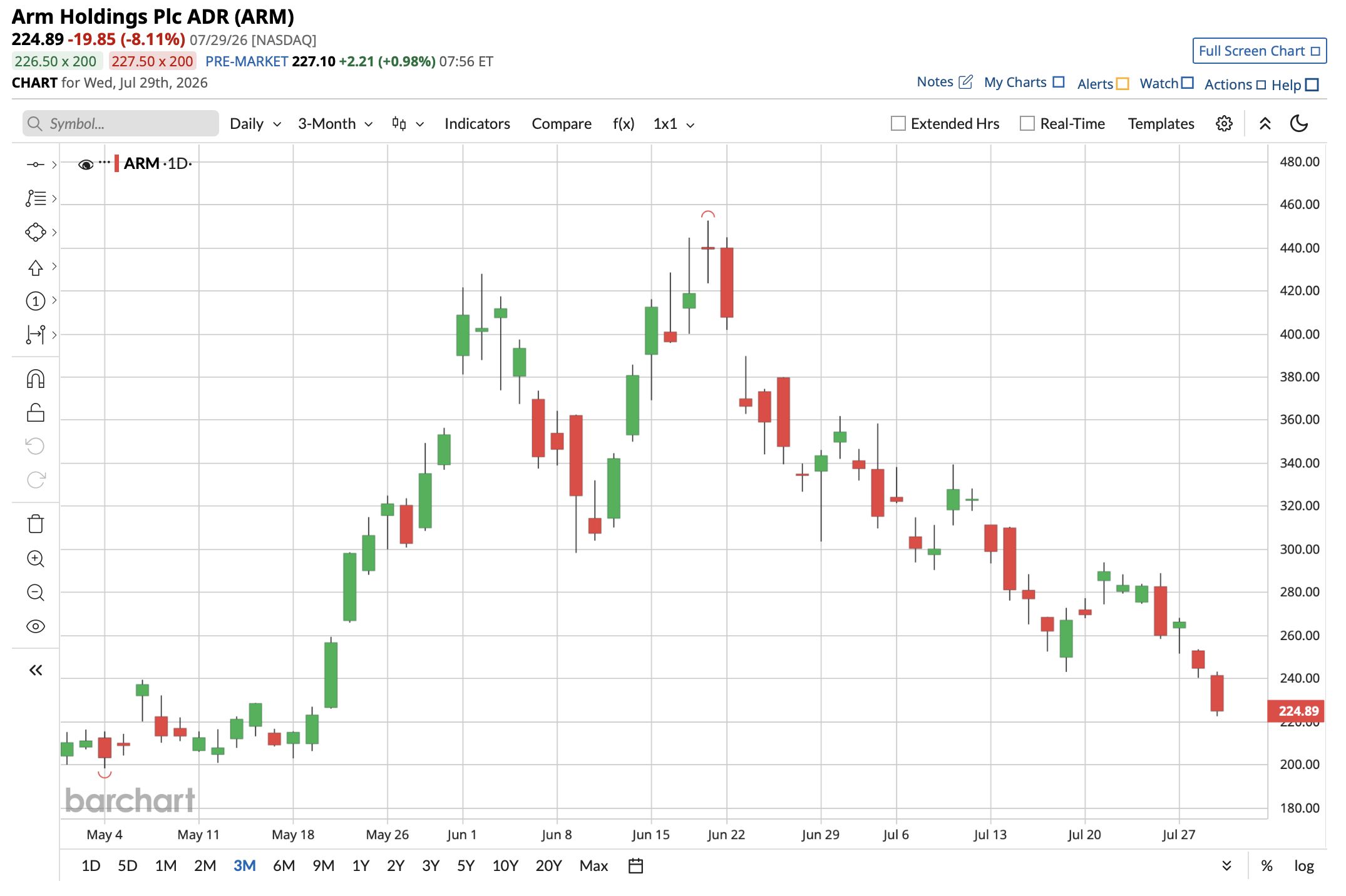
Over the past year, Arm Holdings posted strong returns of around 38%. Much of that performance came this year when the rally started after reports of the company’s plans to develop its own AGI CPU and rising demand for AI-driven processors following Intel’s (INTC) earnings. Despite delivering strong gains this year, the stock underperformed the iShares Semiconductor ETF (SOXX), which gained nearly 104%.
 barchart.com
Arm’s valuation is difficult to judge against its own history. The company only went public in late 2023, so it has no five-year average to compare against. What is clear is that the stock is expensive. The forward GAAP price-to-earnings (P/E) of 201.79x and the forward price-to-sales (P/S) ratio of 43.77x both sit considerably above where most chip stocks trade. At these levels, the market is pricing in years of strong growth with very little room for error. The EPS outlook offers some justification for the high multiples. Analysts expect strong growth through the rest of the decade. Earnings are expected to grow 24% in fiscal 2027, 40% in 2028, 33% in 2029, and roughly 50% in 2030. This is a rare growth trajectory for a company of its size.
The balance sheet is clean. The company holds $3.6 billion in cash against just $491 million in debt, putting it net cash positive by over $3 billion. That gives Arm the flexibility it needs to keep funding its push into its own silicon without strain. Overall, while there are positives, the stock trading at more than 200 times forward earnings leaves little margin for anything to go wrong.
What Do Analysts Expect for ARM Stock?
Wells Fargo analyst Joseph Quatrochi had only recently lowered ARM's price target from $410 to $350. After the earnings report, the analyst has now lowered the target further, going from $350 to $280. Despite the considerable reductions, Quatrochi maintained a “Buy” rating for the firm. RBC analyst Srini Pajjuri also lowered the stock's price target from $475 to $340 while reiterating a “Buy” rating.
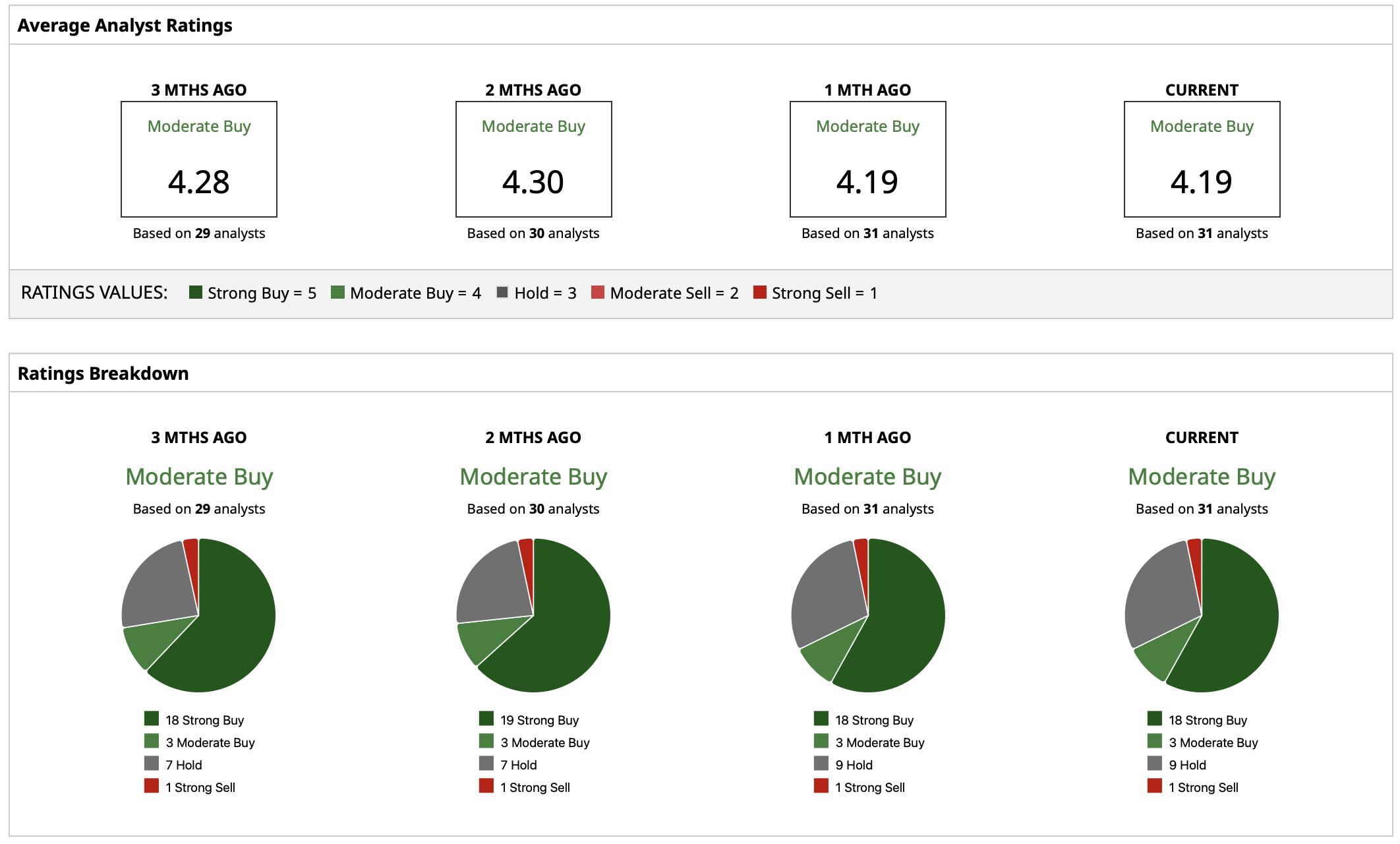
ARM stock currently enjoys a consensus “Moderate Buy” rating from 31 Wall Street analysts covering it. Based on their estimates, the stock has an average price target of $317.48, implying a further 41% upside from current levels. The highest price target of $500 suggests an additional 122% upside from here.
 www.barchart.com
 On the date of publication, Jabran Kundi did not have (either directly or indirectly) positions in any of the securities mentioned in this article. All information and data in this article is solely for informational purposes. For more information please view the Barchart Disclosure Policy here.
More news from Barchart
Morgan Stanley Just Upped Its Price Target on Cognizant Stock. Here's Why. Landmark AI Power Agreement Sends Huge Signal for AMD Stock As Sam Altman Celebrates the Singularity, Palantir CEO Alex Karp Warns: ‘There Are Dangers… We Are Going to End Up Having to Regulate AI’ Susquehanna Just Upped Its Price Target on AMD Stock. Here's Why.