

Qualcomm (QCOM) is a San Diego, California-based semiconductor and wireless technology company founded in 1985 by Irwin Jacobs and six co-founders. The company operates through three segments. Qualcomm CDMA Technologies designs and supplies integrated circuits and system software for smartphones, automotive, and internet of things. Qualcomm Technology Licensing monetizes its extensive wireless patent portfolio. And, Qualcomm Strategic Initiatives invests in early-stage technology companies.
Qualcomm Stock
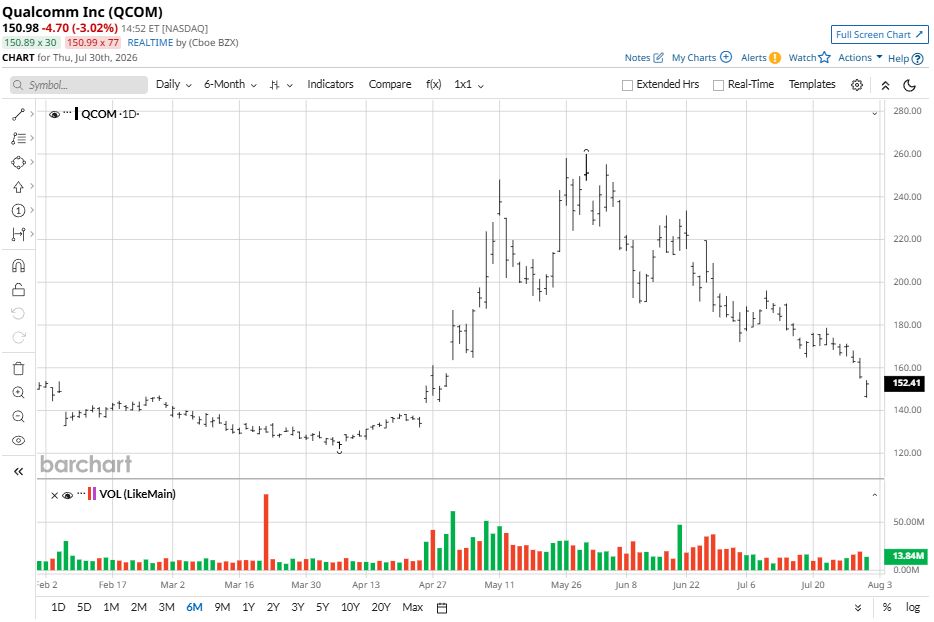
Qualcomm has had a volatile 2026. On April 29, shares surged 4% in a single session after Q2 earnings, briefly touching a 52-week high of $237.53 with the stock up 37.2% year-to-date (YTD) at that peak. However, momentum has since reversed sharply as shares closed lower in late July, down 41.7% from the 2026 peak of $259.92. Following Q3 earnings on July 29, shares fell 7.16% in after-hours trading to $144.53, down from a regular-session close of $155.57, reflecting investor concern over guidance and margin pressure.
More Top Stocks Daily: Go behind Wall Street’s hottest headlines with Barchart’s Active Investor newsletter.
Earlier in 2026, QCOM underperformed broader markets, with shares down 11% over the trailing 52 weeks versus a 15% gain for the S&P 500 Index ($SPX) and trailing the S&P 500 Information Technology Sector SPDR ($SRIT), which surged 27.7% over the same period. Qualcomm's recent post-earnings slide widens this underperformance gap versus tech-sector peers further.
 www.barchart.com
 Qualcomm Results Outperform Market
Qualcomm reported fiscal third-quarter 2026 results on July 29. Revenue came in at $9.9 billion with non-GAAP EPS of $2.21, topping the company's revenue outlook but falling just short of Wall Street's $2.23 EPS forecast. On a GAAP basis, net income was $2 billion, or $1.87 per diluted share, down 25% from $2.67 billion, or $2.43 per share, a year earlier.
Segment highlights were mixed. Automotive revenue hit a record $1.6 billion, up 61% year-over-year (YOY), while non-handset QCT revenue rose 28% YOY, underscoring continued diversification away from smartphones. However, the mixed results reflected a sharp drop in Apple-related revenue outlook, margin pressure in the core chip business, and a cautious near-term view for handsets. CEO Cristiano Amon noted weakening consumer preference toward lower-end premium phones due to memory price increases.
Guidance disappointed markets. Qualcomm forecast fiscal Q4 adjusted EPS of $2.05 to $2.25 on revenue of $9.7 to $10.5 billion, below analyst expectations of $2.36 to $2.38 EPS on roughly $10.02 to $10.07 billion in revenue, with management citing an ongoing supply crunch for computer parts, especially memory. Strategically, Qualcomm completed its acquisition of AI software startup Modular and reiterated plans to accelerate non-handset revenue growth from 24% in fiscal 2026 to over 60% in fiscal 2027.
Why Qualcomm's Plan to Raise Prices Could Hurt Them
Qualcomm is reportedly planning to raise chip prices by a double-digit percentage across its product portfolio, a bold move that Wedbush Securities analyst Matt Bryson described as a double-edged sword for the San Diego-based chipmaker.
On the positive side, Bryson noted the price increases create room for a one-time step-up in sales and margins as higher pricing flows through customer contracts, providing a near-term profitability tailwind for a company already absorbing industry-wide cost inflation across wafer fabrication, advanced packaging, and memory. However, the analyst warned that over the intermediate to longer term, aggressive pricing could weigh on Qualcomm's market share, potentially handing rival MediaTek an opportunity to either capture share gains or similarly lift its own pricing.
On the handset side, Bryson acknowledged the added cost pressure on smartphone makers, though noted that Qualcomm's price hikes are likely to be far less impactful on OEM economics than the ongoing surge in memory chip prices.
Is QCOM a ‘Buy’ Post Earnings Sell-Off?
Wedbush's double-edged sword warning captures the central tension in Qualcomm's investment thesis perfectly, near-term pricing power offering a margin tailwind, offset by longer-term share risk to MediaTek in a market where customer loyalty is price sensitive.
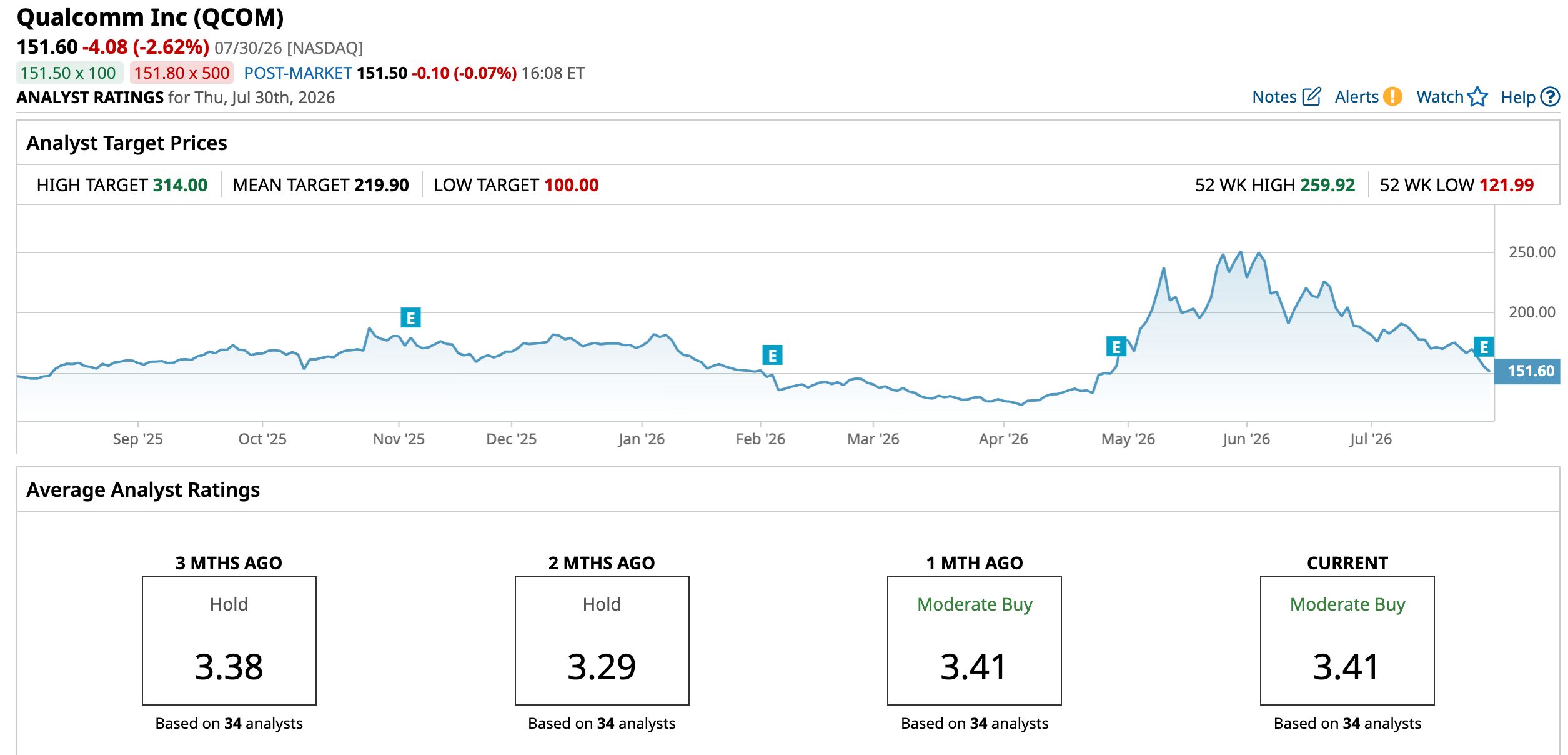
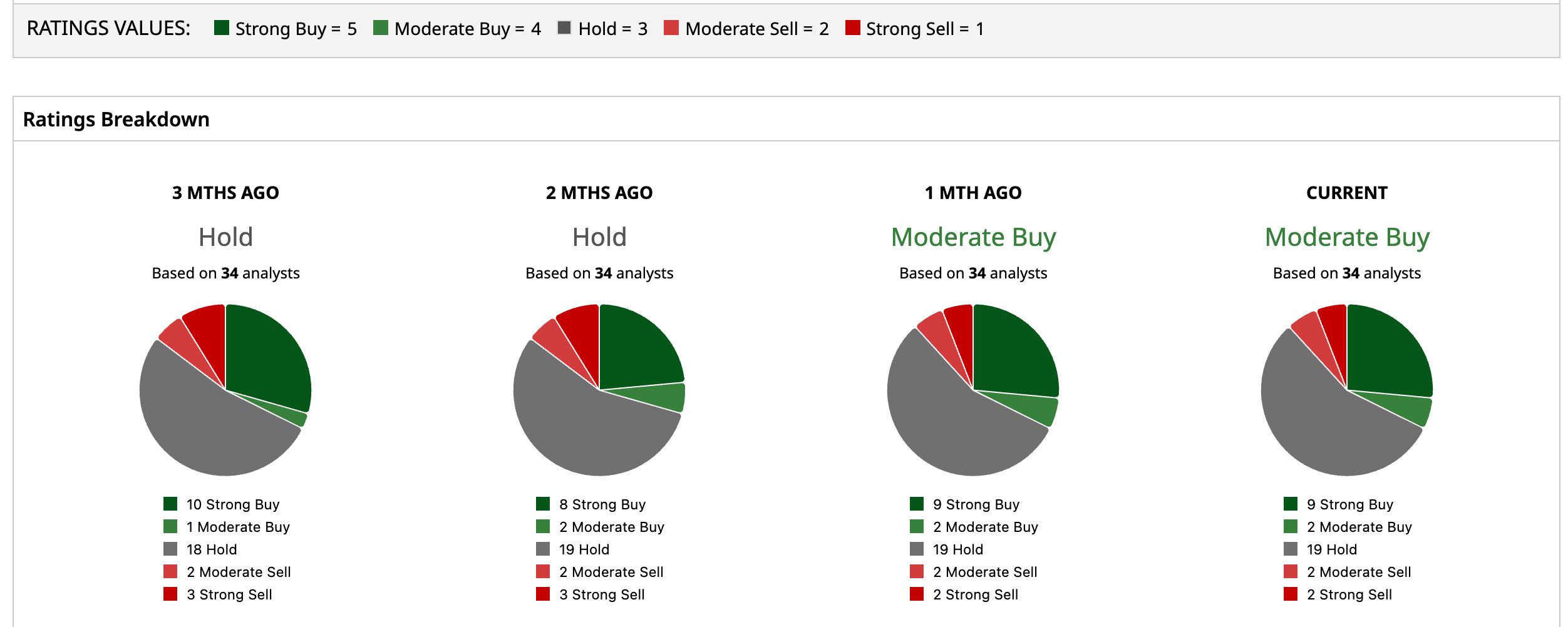
Wall Street reflects this ambivalence. QCOM carries a consensus "Moderate Buy" rating across 34 analyst ratings, comprising nine “Strong Buy,” two “Moderate Buy,” 19 “Hold,” two “Moderate Sell,” and two “Strong Sell.” This is one of the most evenly divided analyst spreads in the semiconductor sector. The mean price target of $219.90 implies a compelling 45.1% upside from current levels, suggesting the post-earnings sell-off may have created a genuine value opportunity for patient investors.
 www.barchart.com
  www.barchart.com
 On the date of publication, Ruchi Gupta did not have (either directly or indirectly) positions in any of the securities mentioned in this article. All information and data in this article is solely for informational purposes. For more information please view the Barchart Disclosure Policy here.
More news from Barchart
The $6 Billion Reason MarketAxess Stock Is Up Today Why Wedbush Says Price Hikes Are a Double-Edged Sword for Qualcomm Stock Teladoc (TDOC) Stock Plummets on Disappointing Q2 Earnings Results CVNA Stock Is Dropping After a Record Quarter. Here's Why.