

Telecom giant Verizon Communications (VZ) has built its reputation not as a high-growth stock but as a dependable income stock. Verizon offers one of the highest dividend yields among large-cap U.S. companies, at 6.7%, thanks to its predictable earnings and cash flows. With another strong quarter reported last week, Verizon strengthened its investment case as a must-buy dividend stock in August.
 www.barchart.com
 The Dividend Remains Verizon’s Biggest Attraction
Verizon doesn’t just pay a high dividend yield but has also increased its dividends for 21 years in a row. The company is very close to becoming a Dividend Aristocrat, which is awarded to businesses that increase dividends for 25 years in a row. While Verizon’s dividend yield and consistency of hikes remain attractive, income investors are more concerned with the strengthening business that supports the payout. And that’s precisely what Verizon proved in the second quarter.
More Yield, Less Trap: Sign up free to get Barchart’s daily Dividend Investor newsletter straight to your inbox.
Verizon owns and operates one of the largest wireless, fiber, and network infrastructure systems in the U.S. The company added 184,000 postpaid phone net additions in the quarter. During the first six months of 2026, postpaid phone net additions improved by 537,000 year-over-year (YoY). The company now believes it is on track to reach the upper half of its full-year guidance of 750,000 to 1 million net additions.
In broadband, Verizon added 348,000 broadband subscribers in Q2, bringing total mobility and broadband net additions to more than 550,000 customers. The company also remains on track to end the year with more than 32 million fiber passings, further expanding its addressable market. Telecom companies generate recurring monthly revenue, so every additional subscriber leads to long-term cash generation.
While adding customers is a win, retaining them is equally important. Consumer postpaid phone churn rate fell to 0.84% during the quarter, down from 0.90% in Q1 and from 0.95% in Q4 of 2025. This rate shows how many consumers canceled or disconnected their memberships. Verizon now expects mobility and broadband service revenue to grow between 2.5% and 3% for the full year.
Furthermore, Verizon sees AI infrastructure as another growing long-term opportunity, as data centers don’t just need powerful chips but also need extremely fast networks to move massive amounts of data between facilities. Verizon has recently signed a more than $1 billion agreement with Google (GOOG) (GOOGL) to provide its dark fiber connectivity between the company's data centers. Additionally, management said more AI infrastructure contracts worth multiple billions of dollars are under negotiation.
Free Cash Flow Makes the Dividend Look Much Safer
For dividend investors, nothing matters more than free cash flow (FCF), as dividends are paid from it. In the second quarter, Verizon generated $6.4 billion in FCF, an increase of 24% YoY. In the first half of 2026, the company’s FCF balance has reached $10.2 billion. The company has paid $5.9 billion in dividends and repurchased shares worth $3.5 billion year-to-date. Verizon now plans to repurchase shares worth $4.5 billion for the full year. Management is confident of generating around 9% to 10% of FCF for the full year. For dividend investors, higher FCF generation provides assurance that dividend payments will continue. Currently, Verizon offers a forward payout ratio of 56.7%, which is quite sustainable, as the company also expects its full-year adjusted earnings per share to increase by 6% to 7%.
Not only that, a good FCF balance also gives Verizon the flexibility to invest in its business, reduce debt, and repurchase shares without placing unnecessary pressure on its balance sheet. Importantly, the company is also working on reducing its debt, which is a main concern for income investors. Building nationwide wireless infrastructure and acquiring valuable spectrum licenses necessitated enormous capital investments over the past decade. As a result, Verizon accumulated substantial long-term debt.
And once the debt load increases, the company prioritizes reducing that load, which ultimately affects dividends. However, even while reducing the load, Verizon ensured dividend payments remained intact. In the quarter, Verizon paid off substantially all of Frontier's debt six months ahead of schedule, reducing its net unsecured debt-to-adjusted EBITDA ratio to 2.5x. For dividend investors, this balanced approach to capital allocation is important.
What Is Wall Street Saying About VZ Stock?
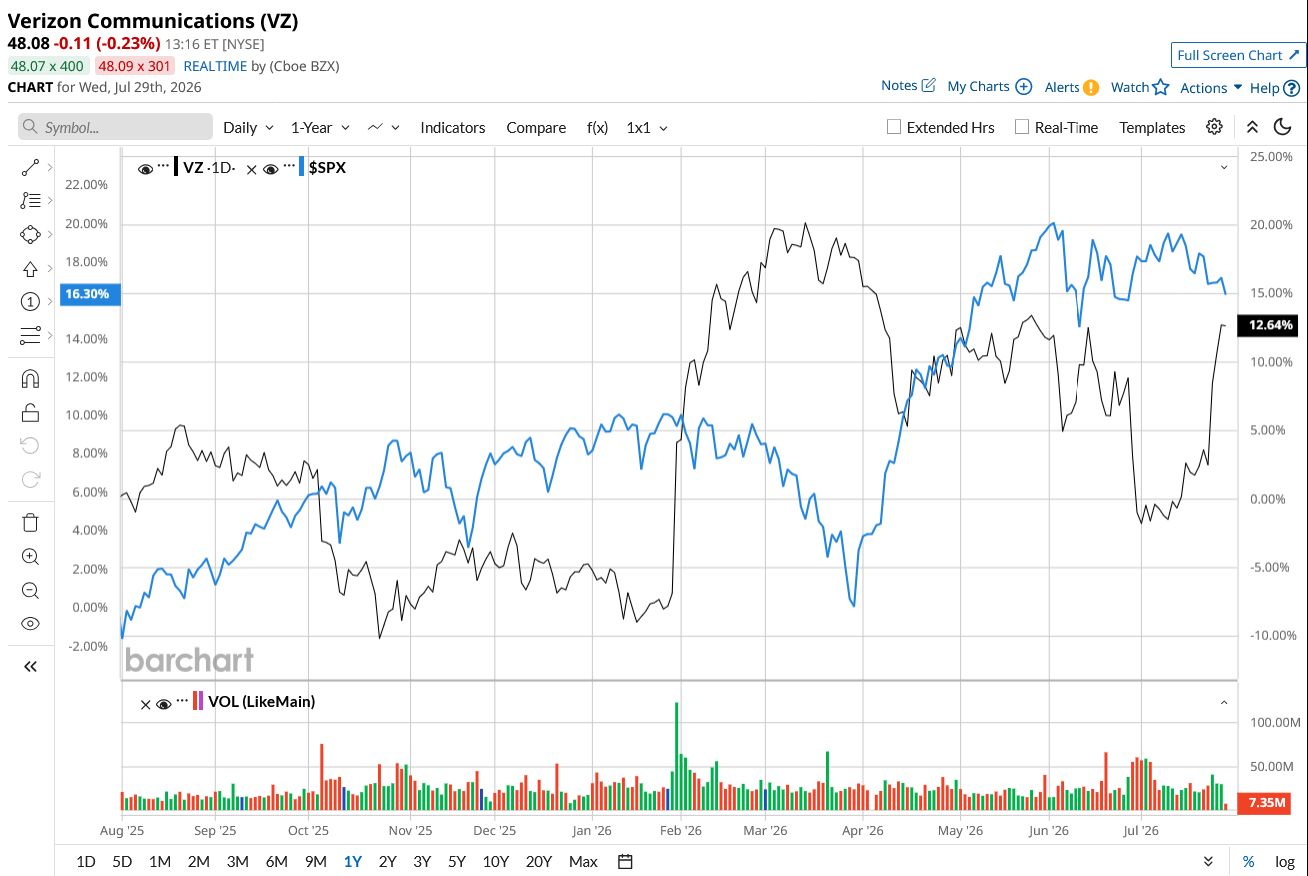
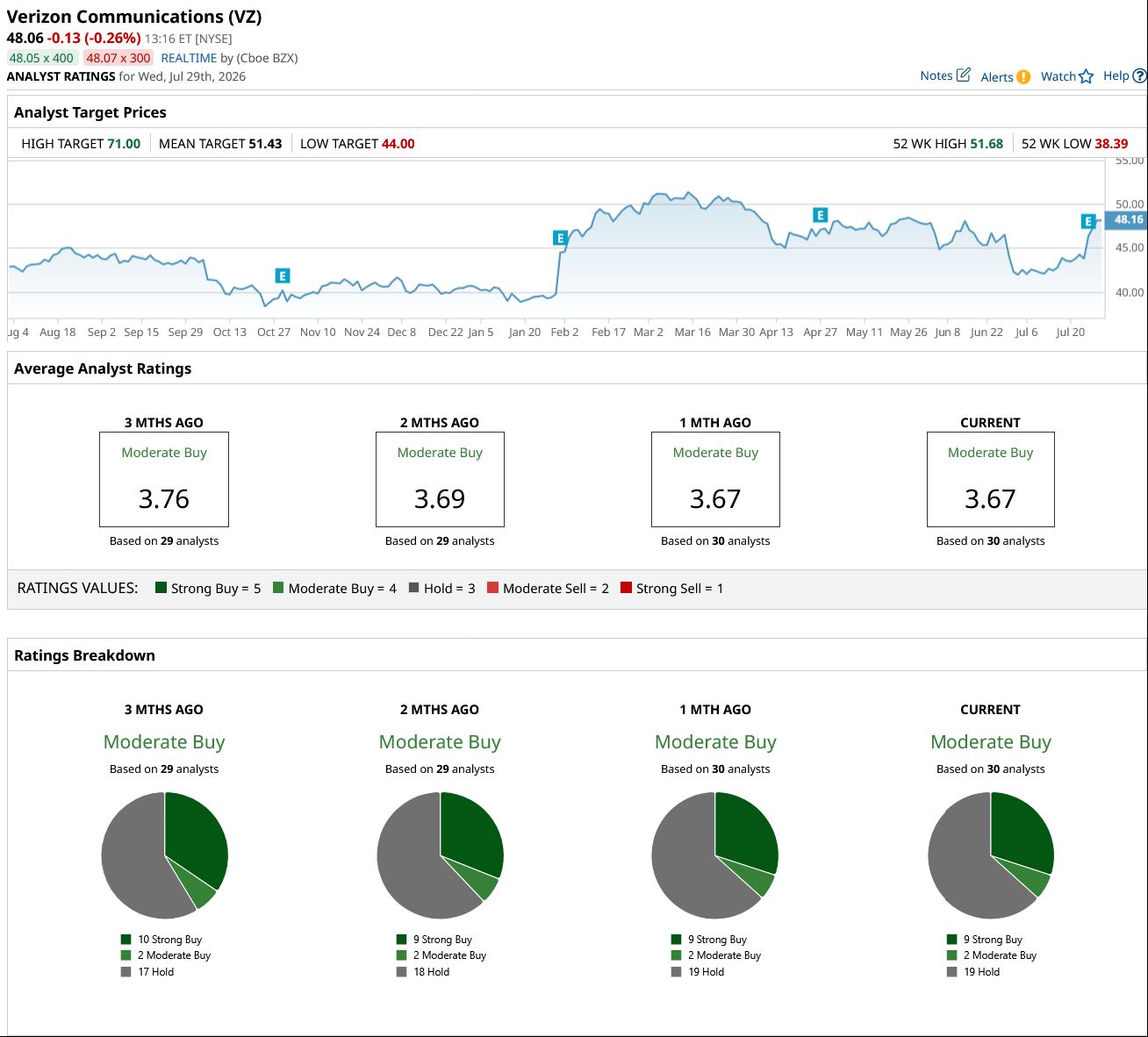
Overall, on Wall Street, VZ stock is rated a “Moderate Buy.” Out of the 30 analysts who cover Verizon's stock, nine rate it a “Strong Buy,” two suggest it’s a “Moderate Buy,” and 19 rate it a “Hold.” VZ has gained 16.8% year-to-date (YTD). But its average price target of $51.43 suggests that the stock can increase by 7% over current levels. However, its high target price of $71 implies upside potential of 38% over the next 12 months.
 www.barchart.com
 On the date of publication, Sushree Mohanty did not have (either directly or indirectly) positions in any of the securities mentioned in this article. All information and data in this article is solely for informational purposes. For more information please view the Barchart Disclosure Policy here.
More news from Barchart
Here’s Why Verizon Stock Is a Buy for Income Investors in August Nvidia Stock Warning: Why Wedbush Is Worried About Rising Memory Prices Nebius Stock Gets Another Wall Street Upgrade. Here’s Why Investors Are Paying Attention. This Dividend Stock Is Up 22% in a Month Despite Mixed Q2 Earnings. Don’t Sell Just Yet.