

The earnings season is in full swing, with tech giants unveiling their quarterly results one after another. This time, however, the market has been highly selective. Even companies posting blockbuster earnings have struggled to impress investors as concerns over heavy artificial intelligence (AI) spending and sky-high expectations continue to weigh on sentiment. Qualcomm (QCOM) became the latest casualty after reporting its fiscal 2026 third-quarter results on July 29.
While the chipmaker posted another solid quarter overall, its earnings report revealed a few cracks that were enough to sour investor sentiment. The biggest weakness came from Qualcomm's core semiconductor business (QCT), where handset revenue tumbled nearly 20% year-over-year (YOY). The decline was driven by ongoing memory supply shortages and a faster-than-expected loss of modem share at Apple (AAPL).
More Top Stocks Daily: Go behind Wall Street’s hottest headlines with Barchart’s Active Investor newsletter.
Qualcomm said the impact will intensify in its fiscal fourth quarter after its share in Apple's next iPhone lineup fell materially below its earlier expectations. Apple has been steadily rolling out its in-house modem across more iPhone models as part of its long-term plan to reduce its dependence on third-party suppliers. Adding to investor concerns, Qualcomm issued softer-than-expected guidance for the fourth quarter, citing persistent supply shortages for PC components, particularly memory. The mixed report sent investors rushing for the exits, but not everyone on Wall Street is worried.
In fact, many analysts argue that the market is focusing too much on Qualcomm's near-term handset struggles while overlooking the company's rapidly growing businesses in AI data centers, automotive, and the Internet of Things (IoT). Why do experts think Qualcomm's recent pullback may be more of a buying opportunity than a reason to panic?
About Qualcomm Stock
For decades, Qualcomm has been at the heart of the mobile revolution. Headquartered in San Diego, California, the semiconductor leader rose to global prominence by developing the modem and processor technologies that power smartphones across the world. Its Snapdragon chips have become synonymous with premium Android devices, while its vast portfolio of wireless patents has made Qualcomm one of the most influential players in the communications industry.
But Qualcomm's story today goes far beyond smartphones. Through its Qualcomm CDMA Technologies (QCT) segment, the company designs advanced semiconductors for smartphones, AI-powered PCs, automotive platforms, networking equipment, and IoT devices. Meanwhile, its Qualcomm Technology Licensing (QTL) business generates high-margin royalty income by licensing its industry-leading wireless technologies.
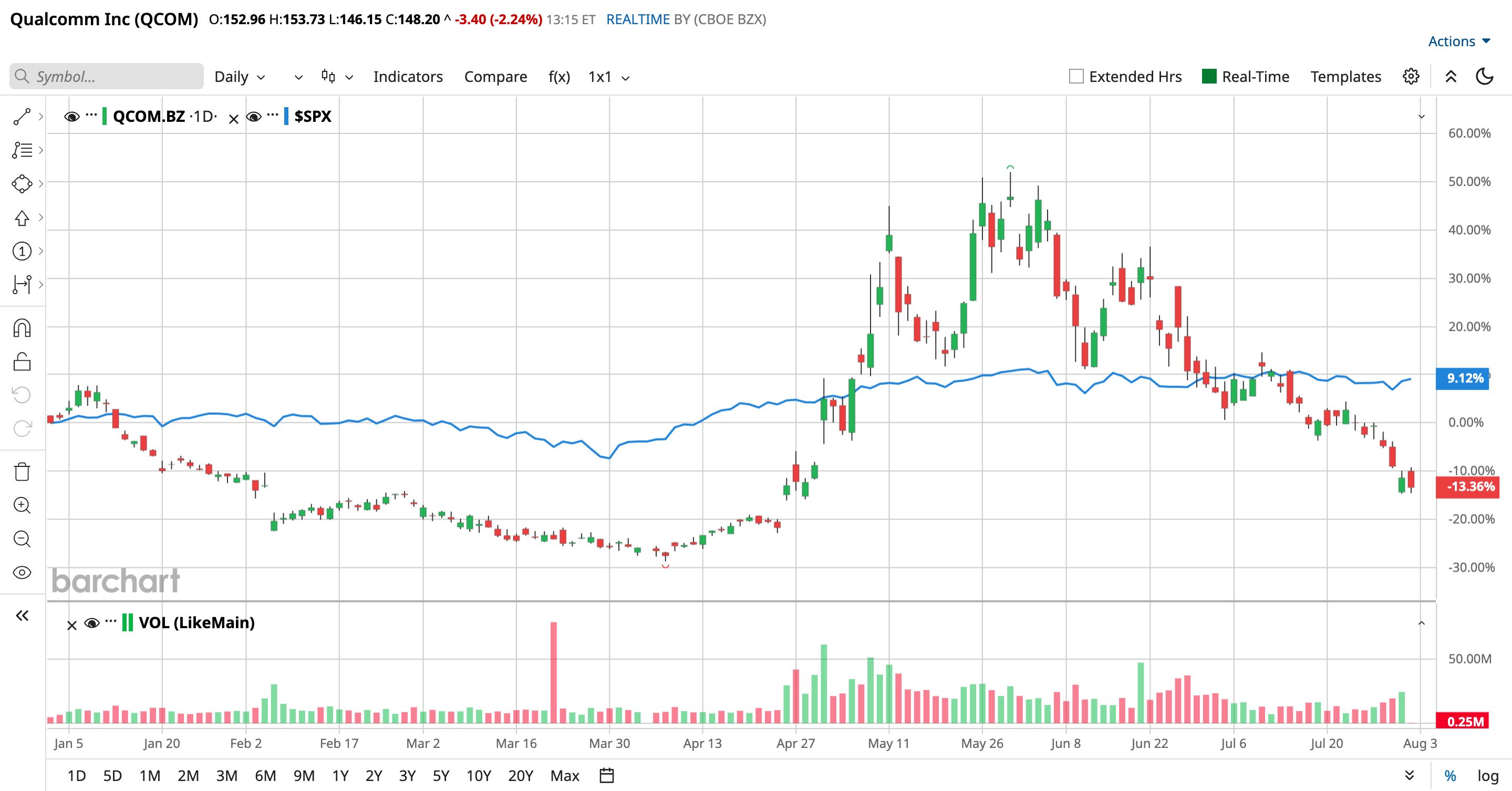
As demand for AI accelerates, Qualcomm is also expanding into edge AI, autonomous vehicles, and custom AI chips for data centers, positioning itself to capitalize on some of the fastest-growing trends in the semiconductor industry. But despite its strong competitive position, Qualcomm's stock has struggled to gain traction this year. The semiconductor giant, which currently boasts a market capitalization of $159.79 billion, has fallen 13.36% year-to-date (YTD) and 6.83% over the past 12 months, significantly lagging the broader S&P 500 Index ($SPX), which has returned 9.2% in 2026 and 17.5% over the past year.
The weakness reflects a combination of near-term challenges that have clouded the company's outlook. Investors have grown increasingly concerned about Qualcomm's faster-than-anticipated decline in Apple revenue as the tech giant transitions to its own modem chips, sluggish smartphone and Android demand, and persistent memory and manufacturing cost pressures that are squeezing margins.
The company's mixed third-quarter earnings report only added to those concerns, sending the stock down 2.62% in the following session. As a result, Qualcomm now trades roughly 43% below its record high of $259.92, reached in May, highlighting just how cautious investors have become despite the company's expanding opportunities beyond smartphones.
 www.barchart.com
 Inside Qualcomm’s Q3 Earnings Report
Qualcomm's fiscal 2026 third-quarter results painted a mixed picture. While the chipmaker comfortably topped revenue expectations, earnings came in just shy of Wall Street forecasts as margin pressures weighed on profitability. For the quarter, total revenue came in at $9.95 billion, down 4% YOY but ahead of analysts' estimates of roughly $9.71 billion. Non-GAAP earnings per share stood at $2.21, a 20% decline from a year ago and just below the Street's estimate of $2.22, reflecting the impact of ongoing margin headwinds.
The biggest drag came from Qualcomm's core semiconductor business, Qualcomm CDMA Technologies (QCT). Revenue from the segment slipped 5% YOY to $8.50 billion, largely due to weakness in the handset business. Handset revenue plunged 20% YOY to $5.09 billion, underscoring the challenges posed by softer smartphone demand, memory supply constraints, and a faster-than-expected decline in Apple-related business.
However, Qualcomm's diversification strategy continued to pay off. Its automotive business delivered another standout quarter, with revenue soaring 61% YOY to $1.59 billion, driven by growing demand for connected and software-defined vehicles. The IoT division also remained resilient, with revenue rising 9% YOY to $1.83 billion. Combined, automotive and IoT revenue jumped 28%, reinforcing Qualcomm's long-term shift away from relying primarily on smartphones.
Meanwhile, the company's high-margin Qualcomm Technology Licensing (QTL) business generated $1.28 billion in revenue, down 3% YOY as softer cellular device volumes weighed on licensing income. Even so, the segment maintained a robust operating margin of nearly 69%, highlighting the strength of Qualcomm's valuable patent portfolio. Qualcomm also continued to reward shareholders during the quarter, returning $2.3 billion through dividends and share repurchases.
Looking ahead, management expects fiscal fourth-quarter revenue to range between $9.7 billion and $10.5 billion, while non-GAAP EPS is projected to come in between $2.05 and $2.25, signaling a cautious outlook amid ongoing supply chain and handset market challenges. Despite the near-term headwinds, Qualcomm remains confident about its long-term growth trajectory. CEO Cristiano Amon reiterated the company's ambitious vision, saying Qualcomm is well positioned to execute on its strategy.
Management now expects non-handset revenue to reach $40 billion by fiscal 2029, nearly double the target it shared in November 2024. Even more notably, Qualcomm expects YOY growth in its non-handset businesses, including its emerging data center segment, to accelerate from 24% in fiscal 2026 to more than 60% in fiscal 2027, marking what Amon described as a significant inflection point in the company's transformation beyond smartphones.
What Analysts Think About Qualcomm Stock
Qualcomm's handset business may have stumbled in the third quarter, but analysts say investors have little reason to panic. While weaker Android demand in China, memory shortages, and a faster-than-expected loss of Apple's modem business weighed on results, experts believe the chipmaker's future growth lies well beyond smartphones. Morgan Stanley's Joseph Moore said Android weakness in China is largely behind Qualcomm, although memory supply issues remain a hurdle.
He also pointed out that Qualcomm is expected to lose more of Apple's iPhone modem business than initially anticipated, with Apple-related chipset revenue likely becoming minimal next year. Still, Qualcomm continues to collect Apple royalty payments, which management says remain intact. Morgan Stanley maintained its "Equal-weight" rating while trimming its price target to $220 from $231.
RBC Capital Markets is looking past the handset slowdown and focusing on Qualcomm's push into AI data centers. RBC highlighted that Qualcomm's management reaffirmed its ambitious goal of generating $5 billion in data center revenue by fiscal 2027 through custom AI chips for hyperscale customers. Several analysts also believe Qualcomm's biggest growth drivers are now outside the smartphone market. Stone Fox Capital, for instance, emphasized that the investment case increasingly hinges on Qualcomm's target of reaching $40 billion in non-handset revenue by fiscal 2029, supported by more than 60% growth expected in fiscal 2027. The firm argued that the stock looks inexpensive, trading at 14.35 times current earnings despite its expanding opportunities in AI, automotive, and IoT.
Seeking Alpha analyst Motti Sapir echoed that view, maintaining a "Buy" rating. He noted that Qualcomm's core business remains healthy, with automotive revenue surging 61% YOY and IoT revenue rising 9% in the third quarter. Combined automotive and IoT revenue climbed 28%, reinforcing the company's successful diversification beyond smartphones. Sapir added that Qualcomm's attractive valuation, strong cash generation, and growing exposure to AI, automotive, and connected devices make the recent handset weakness easier for long-term investors to overlook.
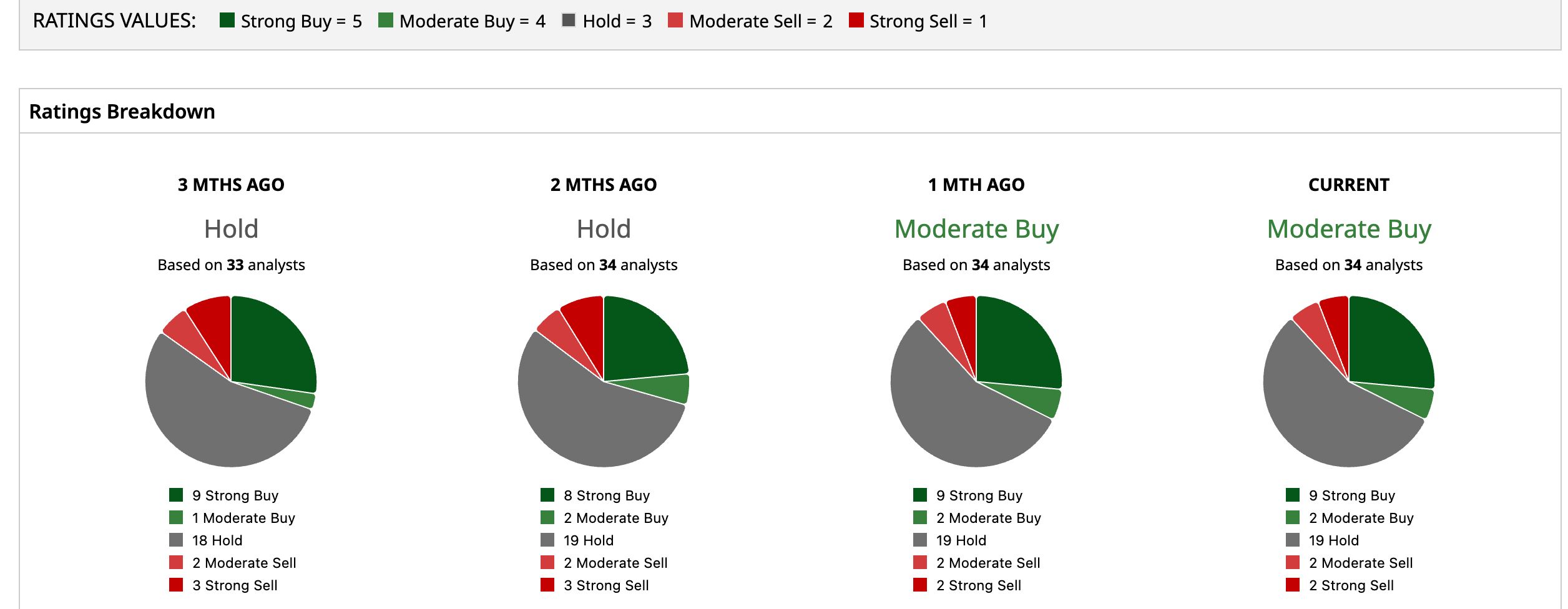
Despite the recent pullback, Wall Street remains broadly constructive on Qualcomm's long-term prospects. The stock currently carries a consensus "Moderate Buy" rating. Among the 34 analysts covering the company, nine recommend a "Strong Buy," two rate it a "Moderate Buy," 19 suggest "Hold," while two recommend a "Moderate Sell," and another two maintain a "Strong Sell" rating.
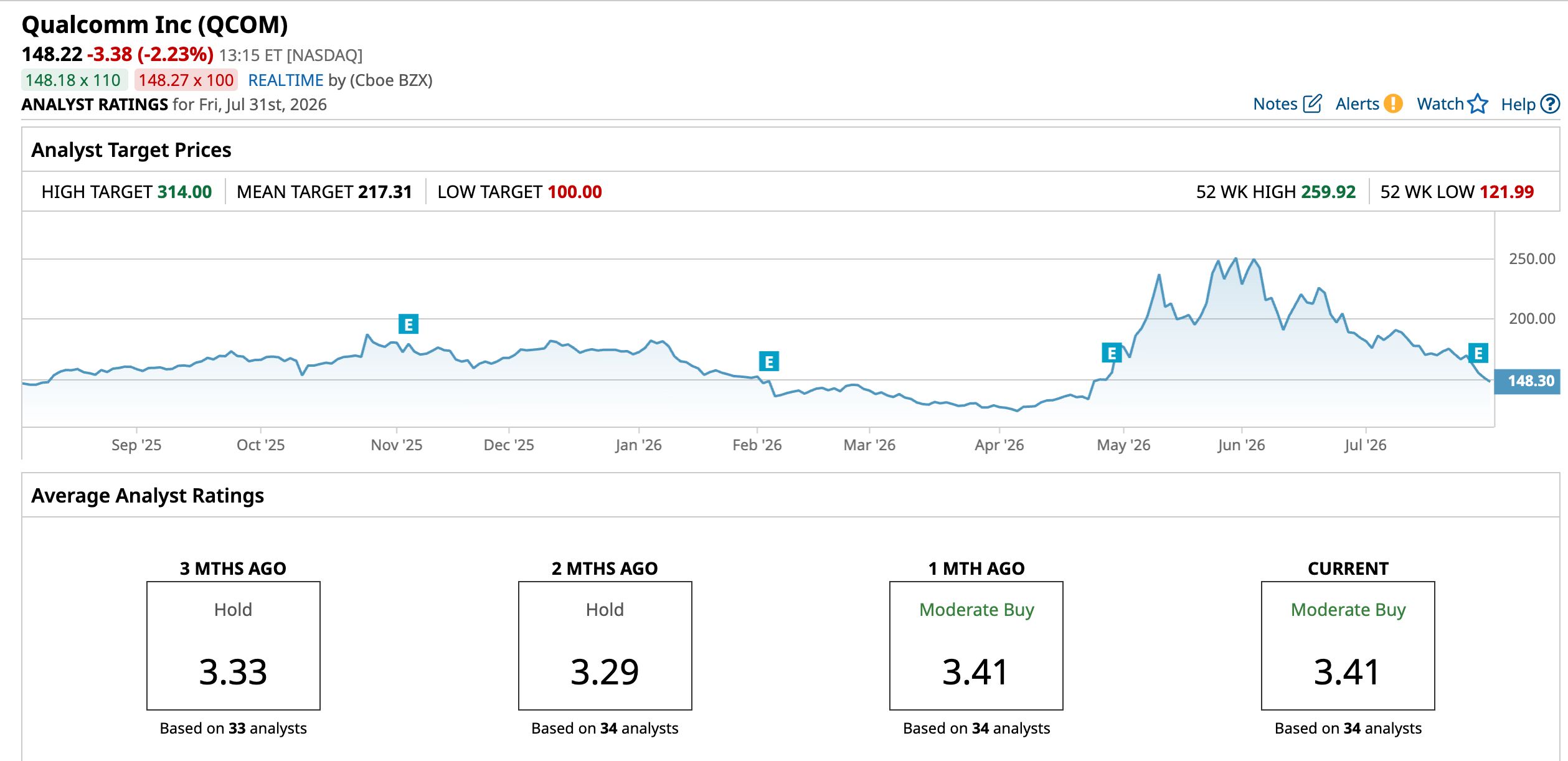
Analysts see meaningful upside ahead. The average price target of $217.31 implies the stock could rally 46.6% over the next 12 months, while the Street-high target of $314 points to a potential upside of 111.9% from current levels, underscoring growing confidence that Qualcomm's expanding AI, automotive, and IoT businesses could more than offset its near-term handset challenges.
 www.barchart.com
  www.barchart.com
 On the date of publication, Anushka Mukherji did not have (either directly or indirectly) positions in any of the securities mentioned in this article. All information and data in this article is solely for informational purposes. For more information please view the Barchart Disclosure Policy here.
More news from Barchart
Visa Stock Looks Attractive After Layoffs, Strong Earnings Google Piles On Off-Balance-Sheet Risk to Fuel Its AI Chip Push Hoping for Lower Prices at the Gas Pump? After Exxon Doubles Profits, CEO Darren Woods Says ‘I Wouldn’t Hold My Breath.’ Why Investors Shouldn’t Sweat the Dip in Qualcomm’s Handset Revenue, According to Experts