

The world is still not ready for cyberattacks. Cities, hospitals, schools, businesses, and even the U.S. government continue to face mounting cybersecurity risks, with artificial intelligence (AI) making security issues far more complicated. After all, as Palo Alto Networks (PANW) notes, “AI enables threat actors to move from initial access to exfiltration in minutes, effortlessly bypassing traditional defenses.”
In response, Microsoft (MSFT) recently unveiled its first cybersecurity AI model: MAI-Cyber-1-Flash. The company also introduced Project Perception, an AI-powered security platform designed to help organizations detect, analyze, and respond to cyber threats more quickly.
More Top Stocks Daily: Go behind Wall Street’s hottest headlines with Barchart’s Active Investor newsletter.
“MAI-Cyber-1-Flash is our first cybersecurity model, built ground up to find the most challenging vulnerabilities in complex code bases,” said Microsoft CEO Satya Nadella in a post on X, “When combined with MDASH, it delivers world-class performance at 50 percent of the cost of leading models.”
For investors, this is a significant development. Let's take a closer look.
 www.barchart.com
 Companies Expected to Spend Billions on Cybersecurity
As cyber threats become more sophisticated, organizations are expected to spend billions of dollars to remain protected. In fact, according to Fortune Business Insights, the global AI cybersecurity market is currently valued at $44.2 billion — and could rally to more than $200 billion over the next decade.
Gartner estimates that global cybersecurity spending will reach $240 billion in 2026, representing year-over-year (YOY) growth of 12.5%. Meanwhile, Statista reports that organizations worldwide now spend about 12% to 13.2% of their total IT budgets on cybersecurity. That could provide a substantial catalyst for Microsoft's AI security offerings.
Cybersecurity Issues Are Getting Worse
Cyberattacks are becoming more common and more advanced with the advent of artificial intelligence. Hackers are using AI to create faster and more effective attacks. For example, AI can create convincing phishing attacks by generating personalized e-mails, texts, and websites. A hacker can also use AI to expose code vulnerabilities and generate malicious code. The list goes on. Unfortunately, companies now face too many threats for people to handle alone.
That is where Microsoft’s AI tools may be able to help. The company's new security technology uses AI agents that can watch for risks, investigate possible attacks, and help firms fix security problems. The goal is to move users from reacting after an attack happens to finding vulnerabilities before hackers can ever take advantage of them.
The main technology behind Microsoft’s announcement is MAI-Cyber-1-Flash, which is designed to help security teams find software weaknesses and identify possible risks. Microsoft says the model performed strongly in cybersecurity testing and helped lower costs compared with using larger AI models. That cost savings could be important. Large AI models require a lot of computing power and can be expensive to run. So, a smaller model built for a specific job like cybersecurity can be faster and more affordable. In addition, companies are increasingly looking for tech providers that can offer everything in one place — cloud services, AI tools, and security protection. Microsoft believes it can provide that complete package.
Microsoft Delivers Strong Q4 Results
Microsoft recently reported stronger-than-expected fiscal fourth-quarter results. In Q4, the company posted revenue of $90 billion, well above analysts' expectations of $87.62 billion. Revenue climbed 18% year-over-year (YOY), one of the company's strongest growth rates in years.
Net income jumped to $35.8 billion, or $4.81 per share, compared with $27.2 billion in the prior-year period, or $3.65 per share. Part of that increase came from a $3.2 billion gain tied to the company's investment in AI startup Anthropic.
Looking forward, Microsoft forecast Q1 revenue between $89.85 billion and $90.95 billion, topping Wall Street's expectations.
What Do Analysts Say About MSFT Stock?
Goldman Sachs called Q4 a “meaningful step,” saying that Microsoft demonstrated stronger Azure growth, improving AI economics, and increasing evidence that Copilot is becoming a meaningful revenue driver. The firm has a “Buy” rating on MSFT stock with a price target of $640.
Meanwhile, Evercore ISI has an “Outperform” rating with a price target of $528, while Wolfe Research has an “Outperform” rating with a $550 target. JPMorgan also has an “Overweight” rating with a $550 price target for Microsoft.
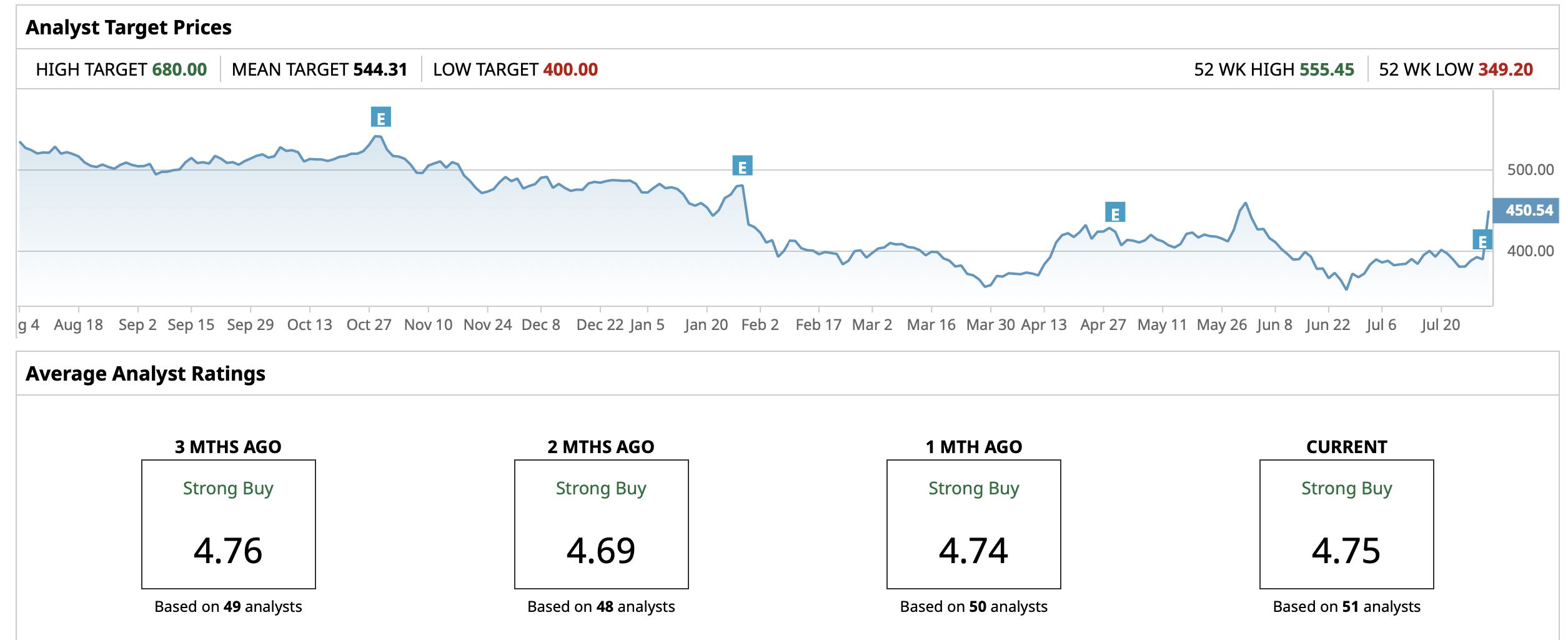
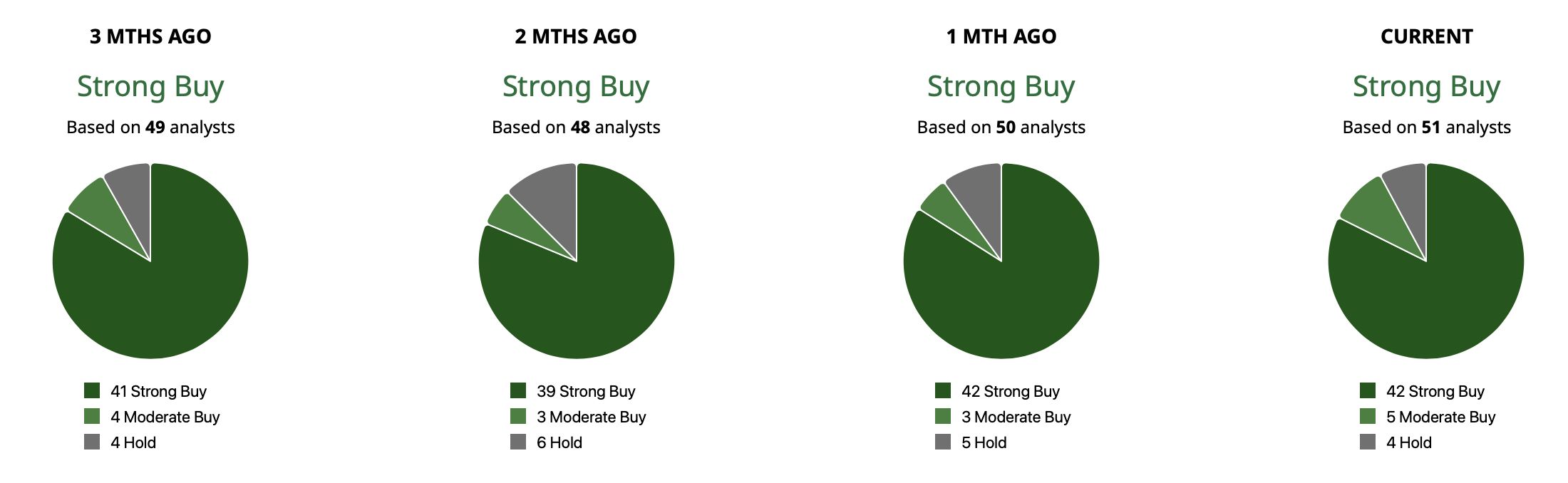
Overall, MSFT stock has a consensus “Strong Buy” rating on Wall Street. Of the 51 analysts with coverage, 42 have a “Strong Buy” rating, five have a “Moderate Buy” rating, and four have a “Hold” rating. The mean price target of $547.45 implies potential upside of 18% from current levels. Meanwhile, the high price target of $680 implies a possible 46% climb from here.
 www.barchart.com
  www.barchart.com
 On the date of publication, Ian Cooper did not have (either directly or indirectly) positions in any of the securities mentioned in this article. All information and data in this article is solely for informational purposes. For more information please view the Barchart Disclosure Policy here.
More news from Barchart
Microsoft’s AI Cybersecurity Push Could Become a Major Growth Driver for MSFT Stock Visa Stock Looks Attractive After Layoffs, Strong Earnings Google Piles On Off-Balance-Sheet Risk to Fuel Its AI Chip Push Hoping for Lower Prices at the Gas Pump? After Exxon Doubles Profits, CEO Darren Woods Says ‘I Wouldn’t Hold My Breath.’