

Over the last week, three brokerages, namely Citi, Jefferies, and DZ Bank, have upgraded Ford (F) stock to a “Buy” equivalent. Two of these upgrades came after the Blue Oval’s Q2 2026 earnings, while Jefferies raised it a day before the confessional. Notably, while Tesla (TSLA) has sagged this year and is down 29%, making the Elon Musk-run company the worst-performing constituent of the “Magnificent 7,” Detroit automakers have looked strong.
The divergence was on full display during the recently concluded Q2 earnings calls. While Ford and GM posted stellar beats on the bottom line and raised their annual adjusted earnings and free cash flow guidance, Tesla missed on adjusted profits. The company raised its artificial intelligence (AI) capital expenditures guidance—a figure that's making markets increasingly wary.
More Top Stocks Daily: Go behind Wall Street’s hottest headlines with Barchart’s Active Investor newsletter.
Meanwhile, despite the post-earnings rally, F stock is trading 19% below its 2026 highs. In my previous article, I noted that while Ford was a buy after the 20% drop in a month, it was unlikely that the stock would revisit its 2026 highs this year. Now, let's revisit the stock’s forecast after an impressive Q2 performance.
Ford Q2 Earnings
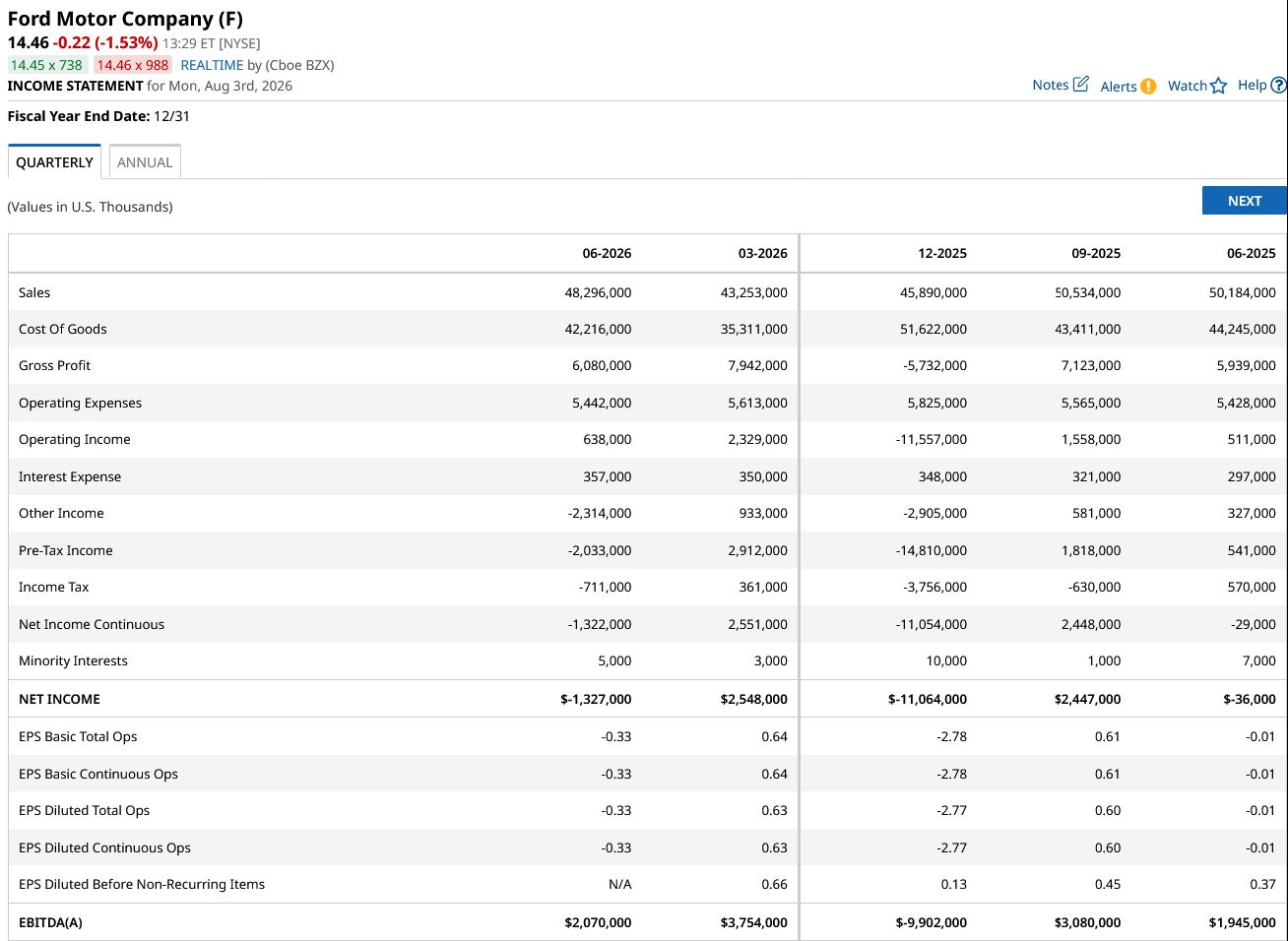
Ford’s Q2 revenues fell 3.8% year-over-year (YoY) to $48.3 billion, which fell short of the $49.6 billion that analysts were modeling. The company attributed the fall in revenues to the discontinuation of some models and the impact of the Novelis fire, which took a toll on its production. The company’s adjusted earnings per share (EPS), however, rose 13.5% to 42 cents, ahead of the 35 cents expected by analysts. It also raised its 2026 adjusted earnings and free cash flow guidance by $1 billion at the midpoint.
 www.barchart.com
 Ford’s 2027 Forecast: Key Headwinds and Tailwinds to Watch
During the Q2 earnings call, Ford understandably did not provide earnings guidance for 2027 as it was “a little bit early to talk about it in detail.” However, the company did provide a lot of color on what investors can expect.
On the positive side, there won’t be the $1.5 billion headwind from the Novelis fire incident. The company also expects continued improvement in materials and warranty costs next year. The growth in its high-margin software and subscription business is also a structural tailwind.
On the flipside, there won’t be the $1.3 billion tariff refund benefit that Ford received this year. While the company’s electric vehicle (EV) business should continue to see gradual narrowing of losses on the current portfolio, launch costs associated with the Universal EV (UEV) platform, whose first model would be a $30,000 electric pickup, would be a headwind. Launch costs associated with the energy storage business, which is part of Model e, the company’s business segment housing the EV business, would also dent profitability. On commodity inflation, Ford is bracing for an impact in all four quarters next year versus the three quarters of impact it witnessed this year.
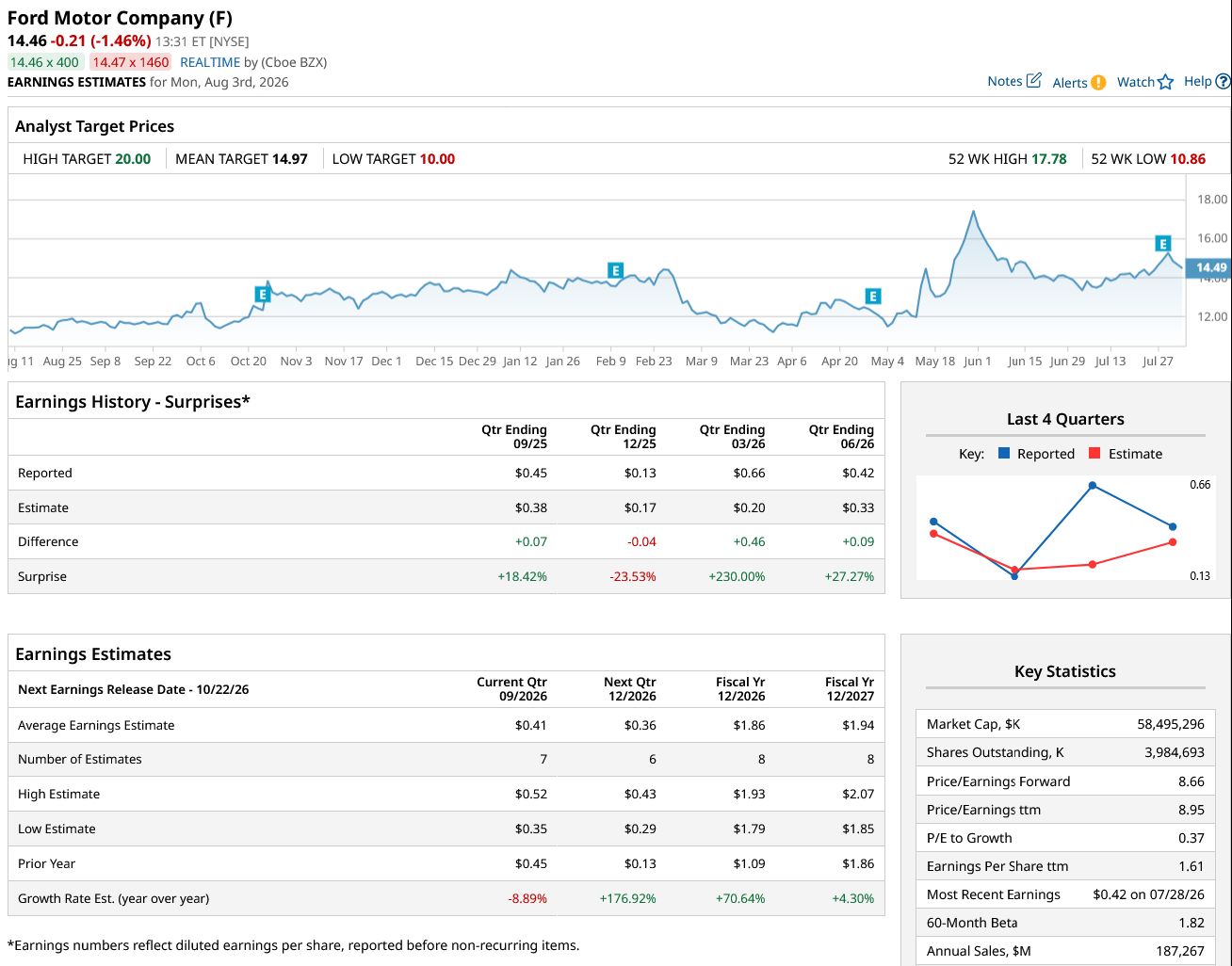
Consensus estimates call for a mere 4.3% increase in Ford’s 2027 EPS, but I believe the growth should be higher given where things stand today.
 www.barchart.com
 For Ford, the upcoming UEV is a major bet, and the company has touted it as the “next Model T” moment. The model would come at a time when legacy automakers, Ford included, have scaled back their EV bets, booking billions of dollars in charges in the process.
Ford’s energy storage business could also be a long-term earnings driver, and Morgan Stanley analyst Andrew Percoco expects Ford's energy storage business to generate pre-tax profits of $588 million at 20 GWh annual production, at which point he predicts it would have a $10 billion enterprise value based on his assumption of a pre-tax earnings multiple of 17.5 times.
After having burnt its fingers with the EV pivot, Ford is taking a measured approach in the energy storage business, and during the Q2 call, the company emphasized that its battery energy storage segment has a “very short payback.” The comments should be seen in the light of the billions of dollars Ford’s EV segment has lost and continues to post quarterly adjusted pre-tax losses of around $1 billion.
Is F Stock a Buy?
F stock trades at a forward price-to-earnings (P/E) multiple of 8.66x, which is at a premium to Detroit rival GM, whose CFO Paul Johnson believes the stock is a “bargain.” Notably, Ford and GM have a divergent capital allocation policy, and while the former has been prioritizing dividends and boasts a healthy dividend yield of over 4%, the Mary Barra-led company has been aggressively repurchasing shares. In the process, it has lowered its outstanding share count by 35% over the last three years, which has boosted its EPS.
All said, I continue to hold both GM and Ford but am relatively more bullish on the former given the mouthwatering valuations.
On the date of publication, Mohit Oberoi had a position in: F , GM , TSLA . All information and data in this article is solely for informational purposes. For more information please view the Barchart Disclosure Policy here.
More news from Barchart
Analysts Have Discovered Lost Love for Ford, But Don’t Rush to Buy F Stock for 2027 Investors Pile Into Long-Dated Microsoft Call Options in Unusual Volume - Bullish on MSFT Stock Microsoft Just Posted the Largest One-Day Market Cap Gain in U.S. History. More Gains Are Likely Still Ahead. Microsoft’s Data Center Leases Crossed $100 Billion In Q4. What This Means for MSFT Stock Here.