

For years, the electric vehicles (EVs) conversation has revolved around Tesla (TSLA). While Tesla captured headlines with rapid sales growth, industry-leading battery technology, and an ever-expanding lineup of EVs, legacy automakers like General Motors Company (GM) and Ford Motor Company (F) were seen trying hard to catch up. Today, as Tesla prioritizes its bold AI ambitions, its core automotive business is under pressure. Meanwhile, General Motors and Ford have quietly accelerated their own EV strategies. Both companies have invested billions in new platforms, expanded their EV portfolios, and are emerging as serious competitors in the U.S. EV market.
But only one of these legacy players is poised to win the EV race.
More Yield, Less Trap: Sign up free to get Barchart’s daily Dividend Investor newsletter straight to your inbox.
The Case for General Motors
With a market cap of $77.9 billion, General Motors is one of the world's largest automakers, with a portfolio spanning Chevrolet, GMC, Cadillac, and Buick. For years, GM was criticized for moving too cautiously in the EV business while Tesla stormed ahead. But management repeatedly argued that the company would scale its EV business only if it improved its long-term profitability. Its recent Q2 earnings show that the strategy is beginning to pay off.
 www.barchart.com
 Its EV portfolio now includes the Chevrolet Equinox EV, Blazer EV, Cadillac LYRIQ, and the GMC Hummer EV, giving the company a presence across both mass-market and luxury segments. The initial phases of the EV boom rewarded companies that launched vehicles fast into the market. But this phase of EVs is more about which company is actually making money by selling them. And that is precisely what GM is trying to do. Instead of quickly ramping up production, GM has spent the past year restructuring its EV operations to better match actual consumer demand.
The restructuring effort has been expensive for the company. Since the second half of 2025, GM has incurred $10.9 billion in EV-related charges. However, management indicated that going forward GM will now operate with a smaller and more efficient EV manufacturing footprint. These lower EV losses resulted in North American adjusted EBIT growth of 40% year-over-year (YoY) to $3.4 billion, while margins improved to 8.6%, comfortably returning to GM's long-term target range of 8% to 10%.
In the first half of 2026, the company generated $92 billion in revenue, $8.2 billion in adjusted EBIT, and $6.3 billion in adjusted automotive free cash flow (FCF). This FCF enabled GM to continue investing in EVs while also rewarding shareholders. The company now expects EV losses to improve by $1 billion to $1.5 billion this year. The company has roughly realized $500 million of that improvement during the first half of 2026. Management also stated that wholesale EV production will only increase modestly during the second half, depending on consumer demand.
Meanwhile, its legacy automotive business continues to provide solid financial backing for the transition. GM maintained more than 42% of the U.S. full-size pickup market during the first half of the year. Instead of rushing ahead in the EV battle with high production goals, GM took a different route. Its strategy of minimizing losses, boosting manufacturing efficiency, increasing software revenue, and protecting overall business profitability appears to be working well.
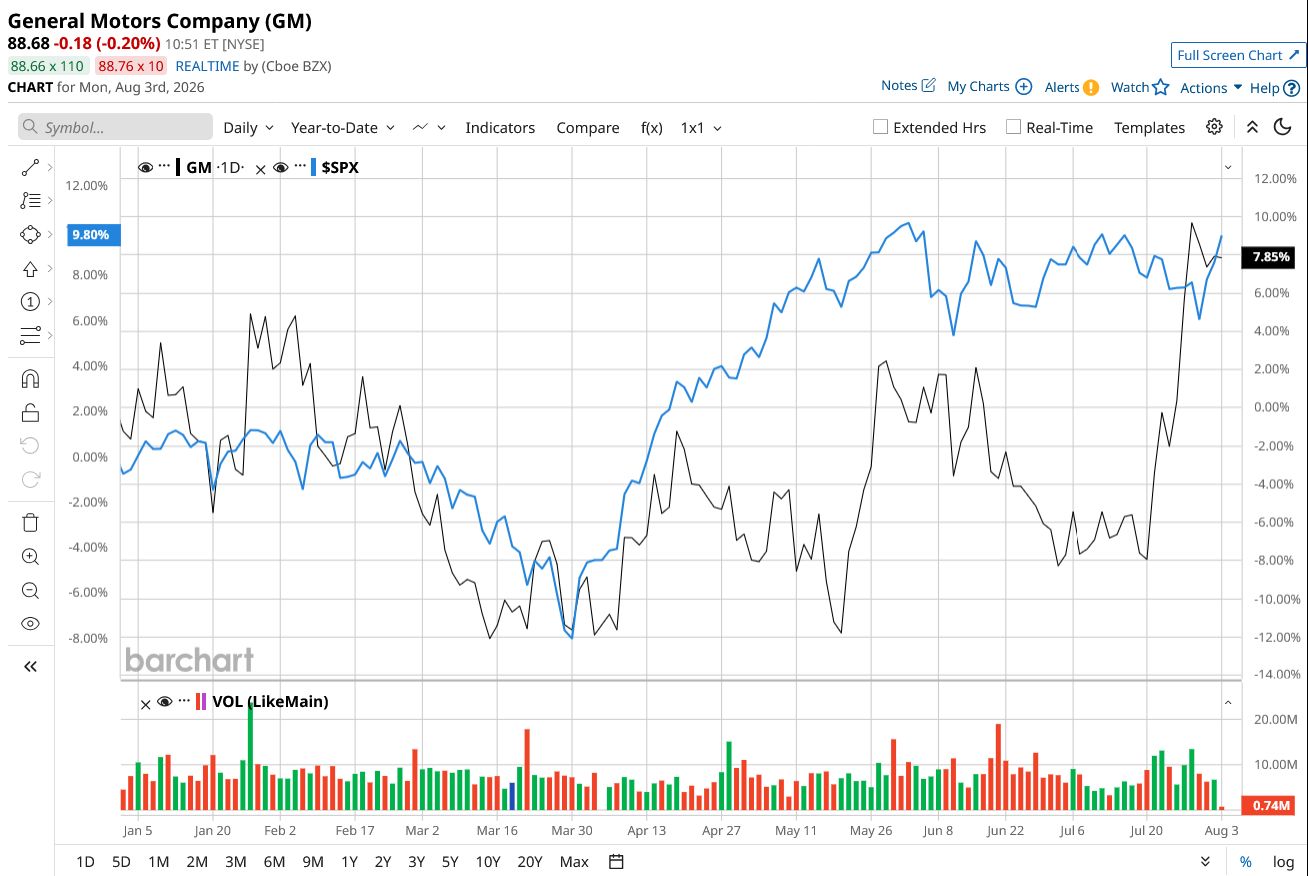
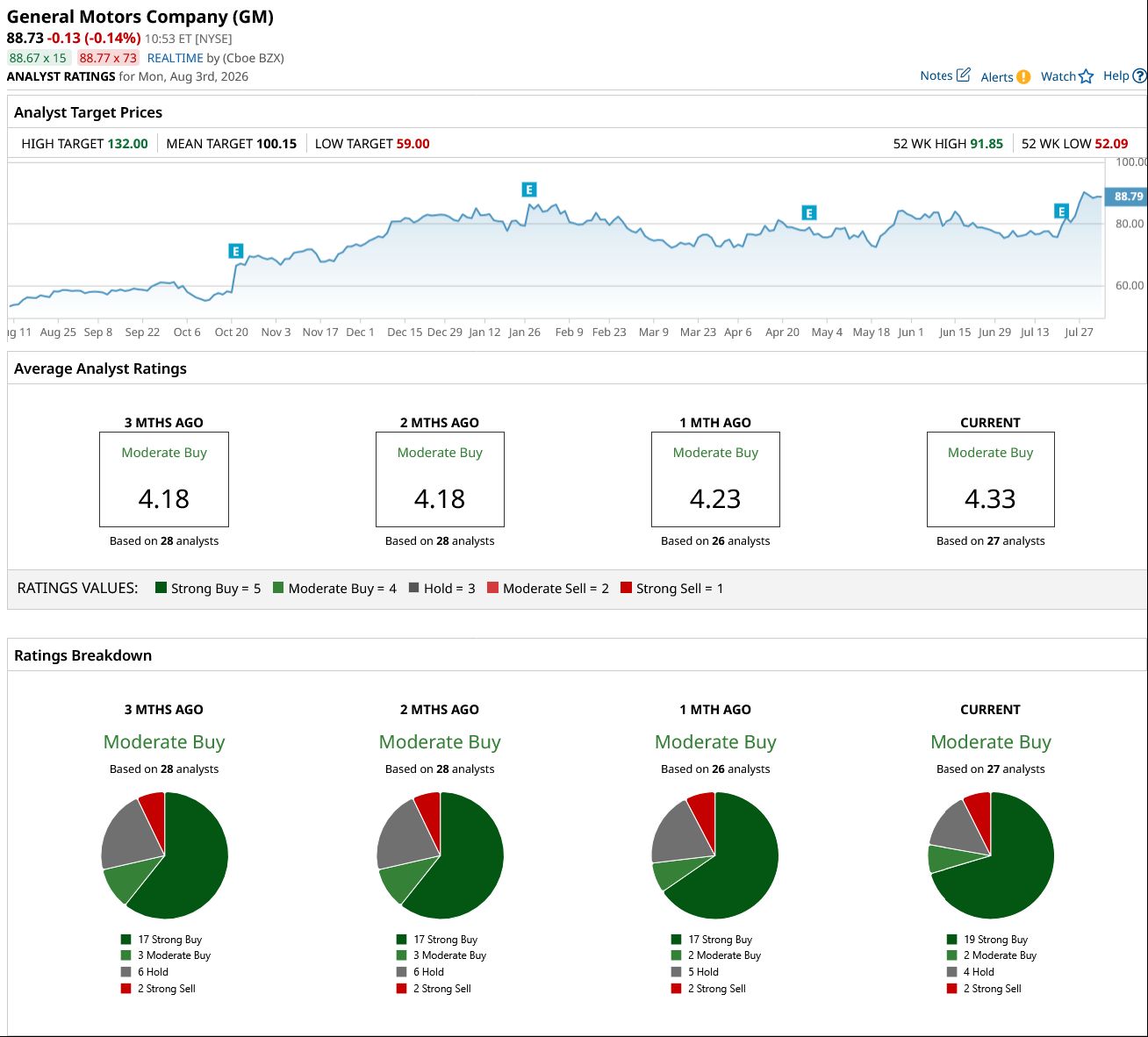
GM stock has gained 9% year-to-date (YTD), but analysts expect the stock to climb by 13% from current levels if it hits its average target price of $100.15. Plus, the high price estimate of $132 implies 49% upside over the next 12 months. Overall, on Wall Street, GM stock is a consensus "Moderate Buy." Out of the 27 analysts who cover the stock, 19 rate it a "Strong Buy," two suggest a "Moderate Buy," four rate it a "Hold," and two say it is a “Strong Sell.”
 www.barchart.com
 The Case for Ford
Valued at a market cap of $58.5 billion, Ford is one of America’s iconic automakers, best known for its F-Series pickup trucks, Mustang sports cars, Bronco SUVs, and Transit commercial vans. With a forward dividend yield of 4%, the company is also a favorite among income investors.
 www.barchart.com
 Ford entered the EV race with enormous momentum. Its EV lineup includes the Mustang Mach-E, F-150 Lightning, and E-Transit, which quickly became the best-selling EVs. However, in the recent Q2 earnings call, management specified that Ford now wants to build a profitable EV business by focusing on cost reductions, capital discipline, and preparing for the next generation of affordable EVs.
Although Model e reported an EBIT loss of $919 million in Q2, the company stated that it was a 31% YoY improvement, marking the third consecutive quarter of improvement. Ford plans to invest roughly $1 billion into its next-generation Universal Electric Vehicle (UEV) platform and the rapidly expanding Ford Energy business in 2026. Despite the investments, the company expects its first-generation EV business to improve EBIT by roughly 40% YoY in 2026. Furthermore, Ford is planning for the next stage of EV adoption. Deliveries from its Louisville plant, which has been retooled for the new UEV platform, will begin next year. The first model, with a starting price of roughly $30,000, is designed to target the heart of the U.S. EV market.
Specifically, the affordable EV segment remains significantly underpenetrated in North America. Management believes that rather than competing head-on with premium EVs, which have become increasingly crowded, Ford's new platform will be a differentiated offering for customers. That said, Ford is not fully reliant on EVs to maintain profitability. It is also beefing up its hybrid lineup, particularly the F-150 Hybrid and Maverick Hybrid, which fared well in Q2. Notably, Ford generated $48.3 billion in revenue and $2.5 billion in adjusted EBIT, encouraging management to revise full-year adjusted EBIT expectations to between $10 billion and $11 billion.
Currently, Ford has more than 14 million connected vehicles, and paid subscriptions were up 50% YoY to 1.6 million in Q2, including over 900,000 Ford Pro Intelligence subscribers. These high-margin software services are creating a growing stream of recurring revenue beyond vehicle sales. Undoubtedly, Ford has made meaningful progress, but it is still laying the groundwork for the next generation of affordable EVs. The company still has a long way to go on its EV profitability journey.
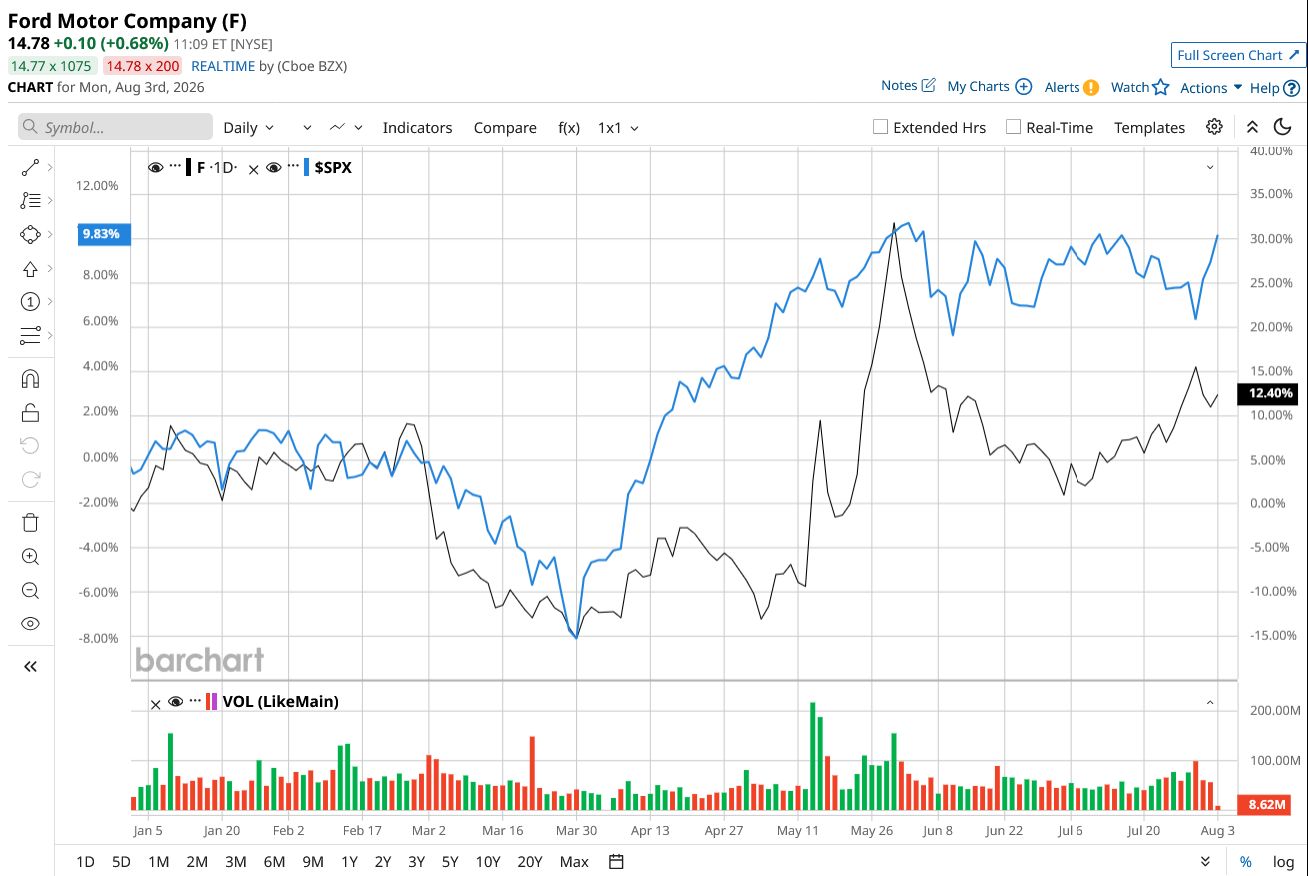
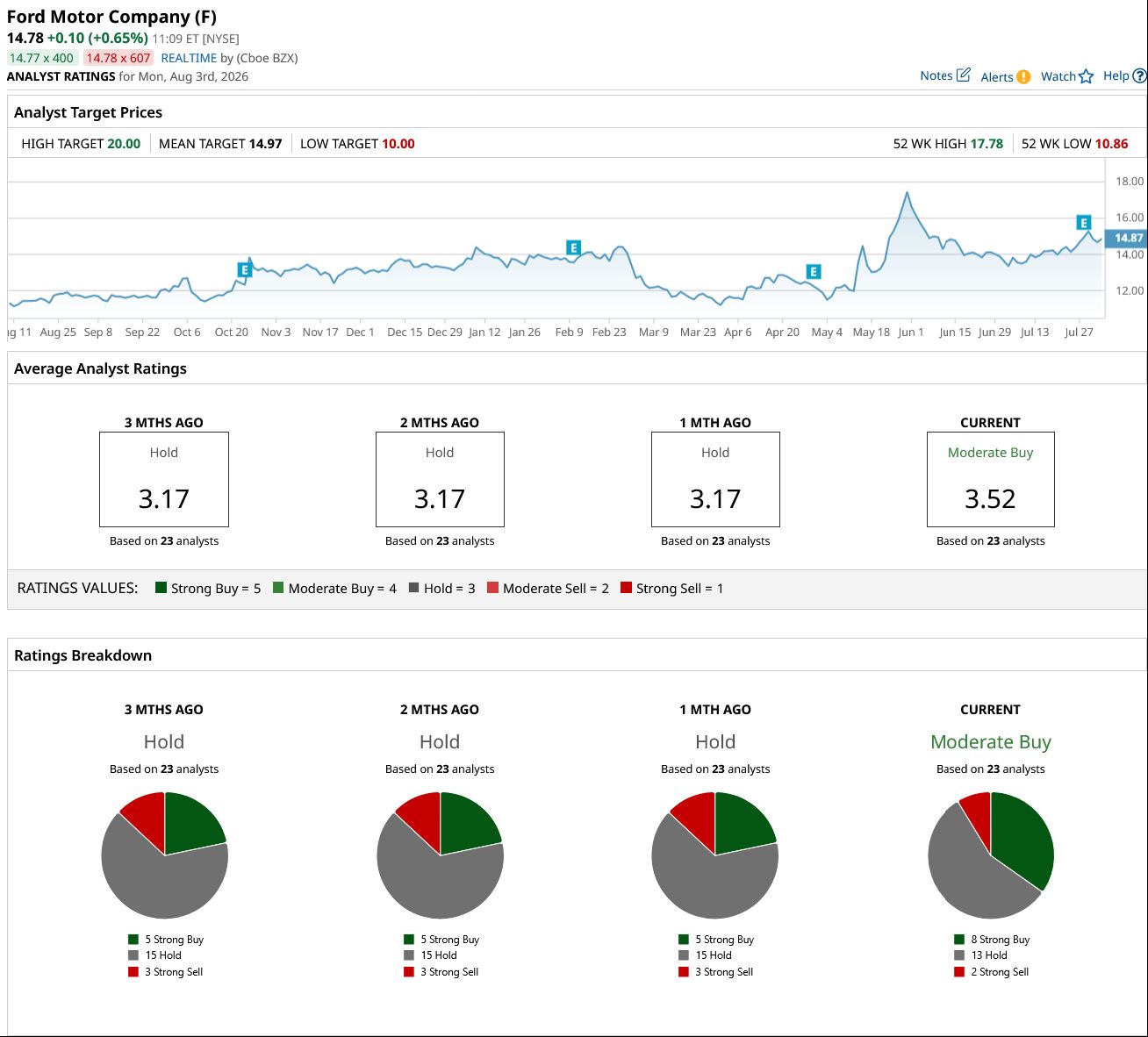
On Wall Street, Ford remains a consensus “Moderate Buy.” Of the 23 analysts that cover F stock, eight rate it a “Strong Buy,” 13 say it is a “Hold,” and two recommend a “Strong Sell.” With Ford's stock up 13% YTD, shares are trading close to the mean target price of $14.97. However, the high price estimate of $20 implies the stock can climb by 35% from current levels.
The One Auto Giant That Is Winning the EV Race
General Motors and Ford are both making meaningful progress in EVs, even though they are different paths. But at this stage, General Motors appears to be the stronger and more sustainable player, as it has begun turning its EV restructuring into stronger margins, healthier cash flow, and improving profitability.
 www.barchart.com
 On the date of publication, Sushree Mohanty did not have (either directly or indirectly) positions in any of the securities mentioned in this article. All information and data in this article is solely for informational purposes. For more information please view the Barchart Disclosure Policy here.
More news from Barchart
General Motors vs. Ford: 1 Auto Giant Is Winning the EV Race Amazon Just Surpassed $3 Trillion Market Cap. What Comes Next for AMZN Stock. The $400 Billion Reason Bristol-Myers Squibb (BMY) Stock Is Up Today Why Analysts Are Divided Over Circle (CRCL) Stock