

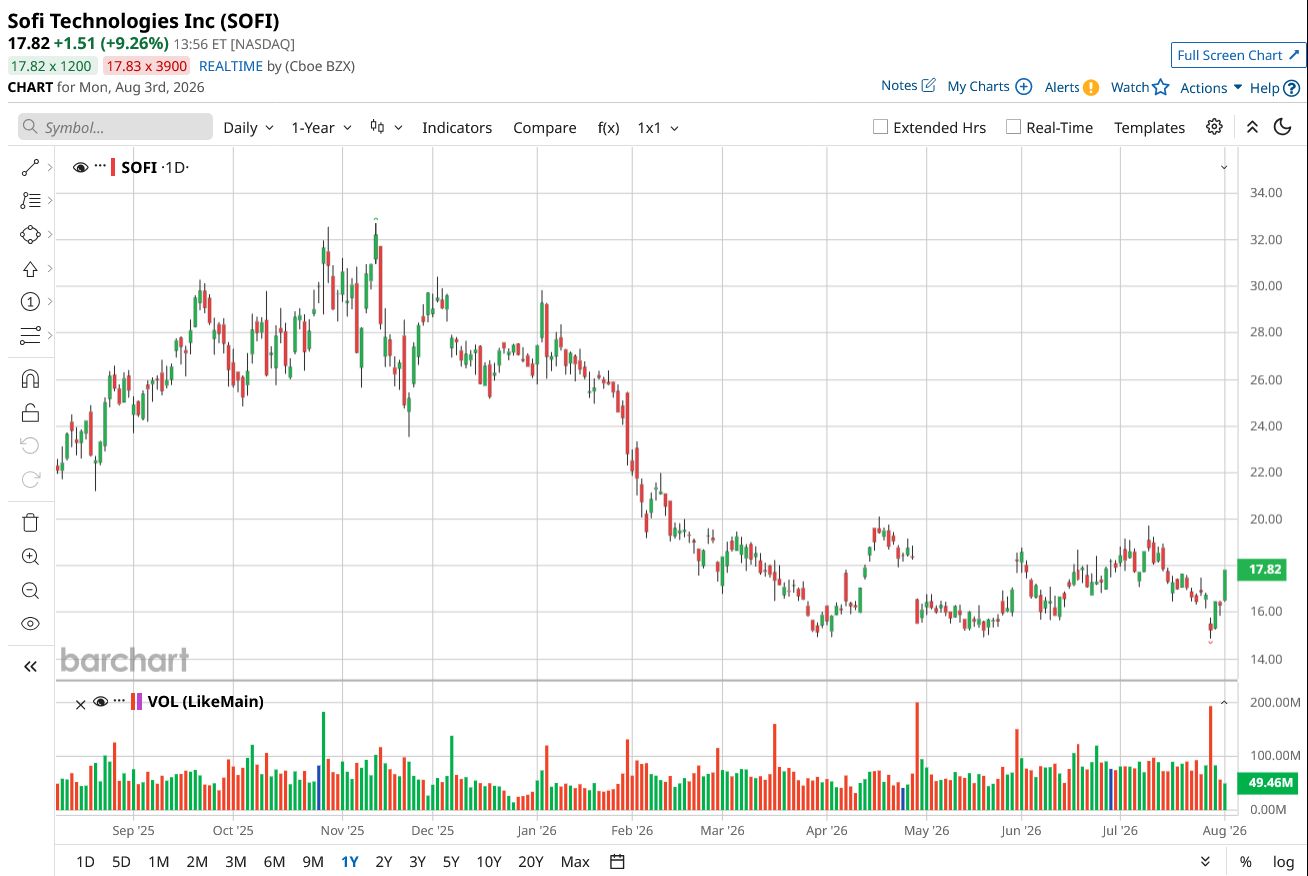
SoFi Technologies (SOFI) has lost nearly half of its value from its 52-week high, but the sharp selloff hasn't been enough to turn most Wall Street analysts bullish.
The market's concern isn't simply about slowing growth. Instead, the market is becoming increasingly cautious as SoFi relies more heavily on its lending business, a segment that requires significantly more capital and exposes the company to credit risk.
More Top Stocks Daily: Go behind Wall Street’s hottest headlines with Barchart’s Active Investor newsletter.
 www.barchart.com
 Revenue Mix Is Shifting Back Toward Lending
Investor optimism around SoFi has been driven by its push into fee-based, asset-light businesses such as Financial Services and the Technology Platform. These segments are seen as more scalable and less reliant on the company's balance sheet, making them attractive drivers of long-term growth.
However, the company's revenue mix has started to shift. Lending is once again growing faster than its non-lending segments, making SoFi's business more capital intensive and raising concerns about future profitability.
The latest earnings highlight this trend. In the second quarter, SoFi reported adjusted net revenue of $1.2 billion, up 40% year-over-year (YoY). Meanwhile, its Financial Services and Technology Platform businesses generated $551 million, accounting for 46% of total adjusted net revenue.
Although those non-lending businesses continue to expand, lending remains the primary growth engine. To maximize earnings, SoFi is retaining more loans on its balance sheet. While that strategy can boost interest income, it also ties up more capital and increases exposure to potential credit losses.
Stronger Revenue Isn't Yet Driving Higher Profits
Another concern is that the stronger revenue growth isn't translating into higher profitability. Management raised its full-year revenue guidance but left its EBITDA outlook unchanged, signaling that increased investments are likely to offset much of the additional revenue.
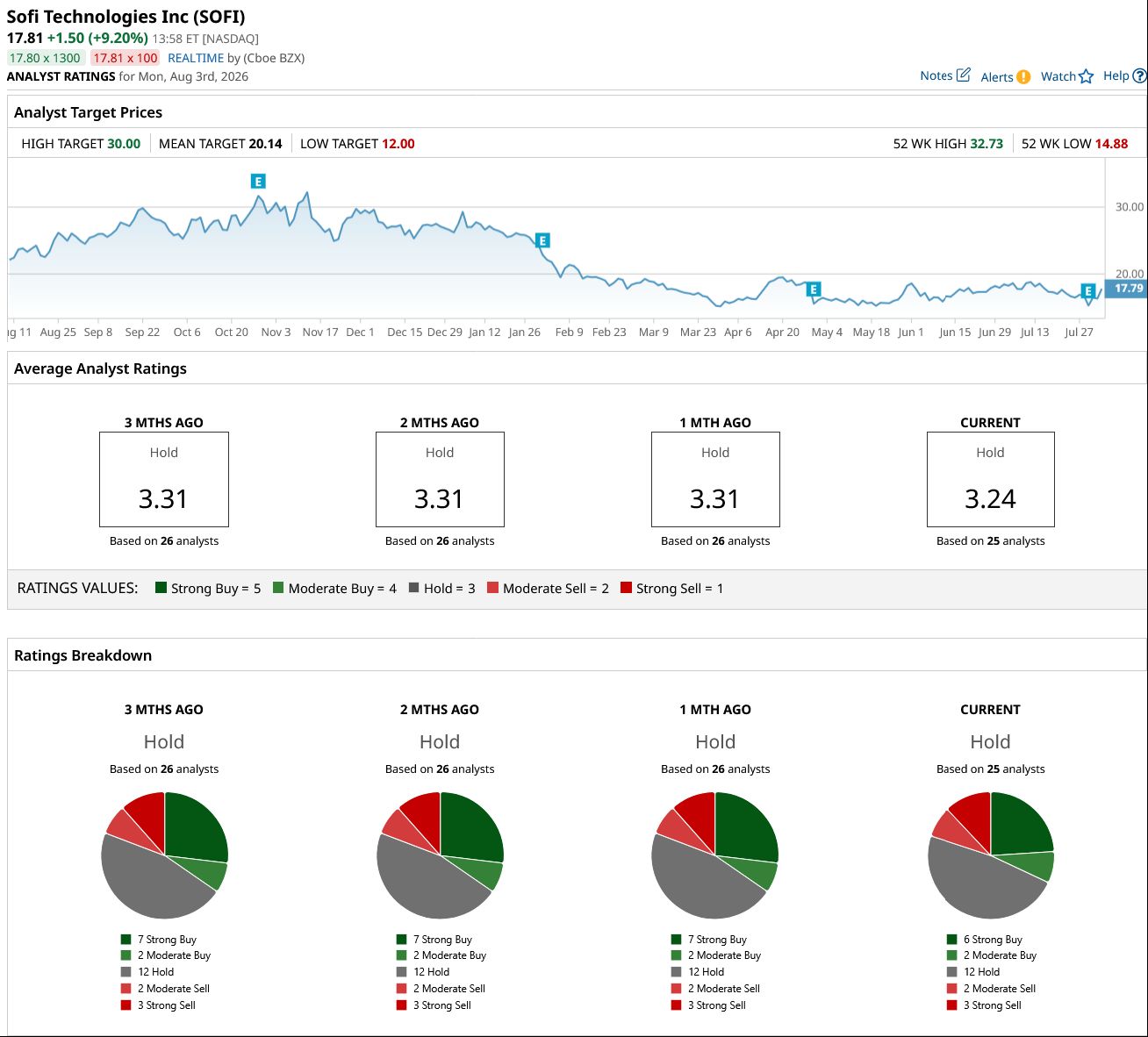
As a result, many analysts remain cautious on SoFi despite the stock's steep decline. While the valuation is now considerably lower than it was at its peak, Wall Street appears to be waiting for clearer evidence that the company's faster-growing lending business can deliver stronger earnings without significantly increasing risk.
What’s Next for SoFi?
While analysts maintain a “Hold” consensus rating on SOFI stock, the notable decline presents a buying opportunity for long-term investors. The company continues to expand its member base while increasing the lifetime value of each customer, supporting its long-term growth prospects.
During the second quarter, SoFi added approximately 1.1 million new members, lifting its total membership to 15.8 million, a 35% increase compared with the same period last year. Product adoption also remained robust, with the company adding a record 2.2 million new products, bringing the total to 24.4 million, representing 42% YoY growth.
These results indicate that SoFi is deepening relationships with its existing customer base. As more members adopt multiple products, customer lifetime value improves while acquisition costs become increasingly efficient, creating a favorable operating dynamic.
SoFi’s cross-selling strategy continues to strengthen. More than 51% of products opened during the quarter were by existing members, compared with 43% in the previous quarter. This steady increase in cross-product adoption highlights growing customer engagement and loyalty, reinforcing SoFi's competitive positioning.
Although lending remains a significant contributor to revenue, SoFi's focus remains on building a more diversified revenue base. In the second quarter, fee-based revenue reached $472 million, accounting for 39% of total revenue. After adjusting for SoFi Technology Solutions (STS), this segment expanded 22% sequentially and roughly 38% YoY, supported by stronger loan origination fees, continued expansion of its loan platform business, higher interchange income, increased brokerage activity, and contributions from its technology platform.
Looking ahead, management expects these less capital-intensive, fee-driven businesses to contribute more than half of total revenue over time. As this revenue mix shifts away from lending, SoFi should benefit from a more capital-efficient business model, improved earnings quality, and greater resilience across economic cycles.
SOFI Stock Could Be in for a Solid Recovery
Despite SOFI stock's nearly 50% decline from its 52-week high, Wall Street remains cautious because the company's near-term growth is increasingly dependent on its capital-intensive lending business. That said, SoFi's rapidly expanding member base, improving cross-selling metrics, and growing fee-based businesses continue to strengthen its long-term investment thesis.
If SoFi successfully shifts its revenue mix toward higher-margin, asset-light operations over the coming quarters, the stock could see a solid recovery.
 www.barchart.com
 On the date of publication, Amit Singh did not have (either directly or indirectly) positions in any of the securities mentioned in this article. All information and data in this article is solely for informational purposes. For more information please view the Barchart Disclosure Policy here.
More news from Barchart
SoFi Stock Sinks 50%, But Most Analysts Still Aren’t Bullish Covered Call Screener Results for August 4th Nasdaq Futures Climb as Tech Rally Continues on Palantir Boost, U.S. JOLTS Report and SpaceX Earnings on Tap General Motors vs. Ford: 1 Auto Giant Is Winning the EV Race