

Valued at a market cap of $27 billion, Halliburton Company (HAL) is one of the world's largest providers of oilfield services and energy technology, serving exploration and production (E&P) companies across the upstream oil and gas industry. Headquartered in Houston, Texas, the company operates in more than 70 countries, offering products and services that help customers locate, drill, evaluate, complete, and produce oil and natural gas wells.
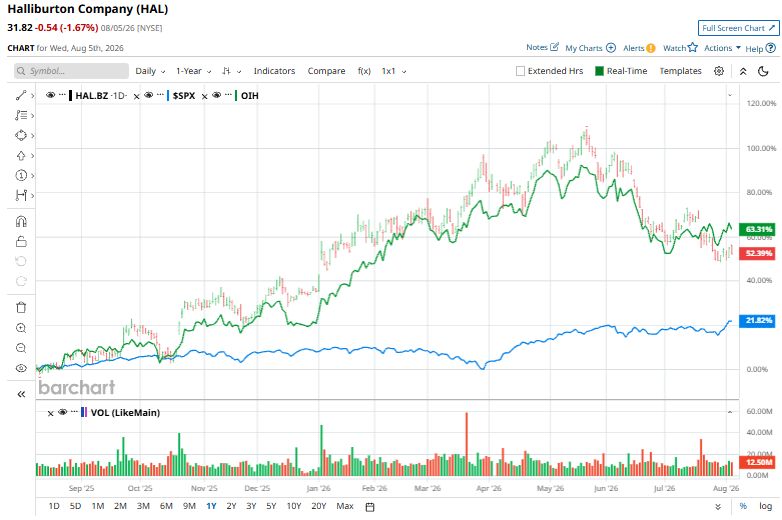
Halliburton has significantly outperformed the broader market over the past year, reflecting renewed optimism around the energy services sector. Shares of HAL have rallied 46.8% over this time frame, while the broader S&P 500 Index ($SPX) has gained 22.6%. Moreover, on a YTD basis, the stock is up 12.6%, compared to SPX’s 12.8% rise.
More Top Stocks Daily: Go behind Wall Street’s hottest headlines with Barchart’s Active Investor newsletter.
Looking closer, HAL has also outpaced the VanEck Oil Services ETF (OIH), which rose 34% over the past year.
 www.barchart.com
 On July 21, Halliburton reported mixed Q2 FY2026 results, with the stock falling 5.4% after investors focused on a cautious near-term outlook despite an earnings beat. The oilfield services provider posted revenue of $5.71 billion, up 3.7% year over year and ahead of expectations, while adjusted EPS of $0.55 narrowly topped consensus estimates.
Management highlighted record second-quarter international revenue in more than a decade and improving North American activity, but warned that ongoing weakness in the Middle East and softer third-quarter revenue expectations could weigh on near-term performance.
For the current fiscal year, ending in December, analysts expect HAL’s EPS to decline 3.3% year over year to $2.34. The company’s earnings surprise history is promising. It topped the consensus estimates in each of the last four quarters.
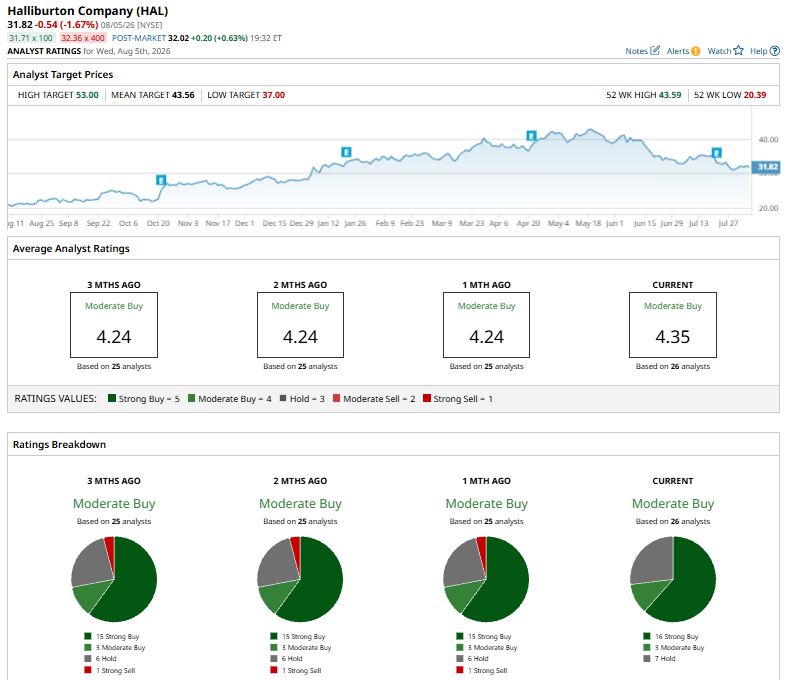
Among the 26 analysts covering the stock, the consensus rating is a "Moderate Buy,” which is based on 16 “Strong Buy,” three “Moderate Buy,” and seven "Hold.”
 www.barchart.com
 The configuration is more bullish than a month ago, with 15 analysts suggesting a "Strong Buy” rating.
On Jul. 27, UBS modestly lowered its price target on Halliburton to $39 from $40 after updating its forecasts following the company's Q2 earnings report, while maintaining a "Neutral" rating on the stock.
The mean price target of $43.56 suggests a 36.9% premium to its current levels, while its Street-high price target of $53 implies a 66.6% potential upside from the current price levels.
On the date of publication, Kritika Sarmah did not have (either directly or indirectly) positions in any of the securities mentioned in this article. All information and data in this article is solely for informational purposes. For more information please view the Barchart Disclosure Policy here.
More news from Barchart
Nasdaq Futures Slip as Western Digital and Sandisk Sink on Disappointing Guidance This Dividend King Yields Over 4% and Trades Near Its 52-Week Lows, But Don’t Rush to Buy the Dip Amazon’s AI Story Is Bigger Than You Think. Here Are 3 Reasons Why. Piper Sandler Just Cut Its Price Target on SpaceX Stock. Here's Why.