

SpaceX (SPCX) just gave Wall Street its first look at the books, and the numbers tell two very different stories at once. Revenue nearly doubled from a year ago, the loss shrank sharply, and every part of the business beat expectations. Yet SPCX stock still fell after hours. The reason sits in one number that overshadowed all the good news.
SpaceX spent about $18.4 billion in the second quarter of 2026, well over twice what it earned in revenue. What made this particularly interesting is that most of the spending did not go toward rockets. Of the $18.4 billion, roughly $15.8 billion went into artificial intelligence (AI). The company is spending heavily to fund the compute infrastructure behind xAI, the business SpaceX absorbed earlier this year. So, the firm famous for landing rockets is now mostly an AI company on paper, allocating more than 85% of its investment to artificial intelligence. CEO Elon Musk told analysts that the goal is to have 20 gigawatts of AI compute running by the end of next year, with Nvidia (NVDA) set to supply a large share of the chips.
More Top Stocks Daily: Go behind Wall Street’s hottest headlines with Barchart’s Active Investor newsletter.
The outlook reflects the classic Elon Musk pattern: Spend enormous sums now, absorb the losses, and trust that a much larger future makes it all worthwhile. Management reaffirmed a plan to reach a $100 billion annual revenue run rate by the end of this year. It also pulled forward its extraordinary internal target of reaching $1 trillion in annual revenue by one year to 2030. On the spending concerns, management stated that the AI investment will pay for itself in under a year, significantly faster than its launch business. For SpaceX, Starlink is a genuine, profitable business that is now helping fund an AI bet with an uncertain payoff.
Investors have always given Musk room to spend on faith. This first public earnings report from SpaceX is an early test of how long that goodwill lasts, now that every dollar of spending is out in the open.
About SpaceX Stock
SpaceX is a space technology company. It provides satellite-based broadband services and operates through three segments: Space, Connectivity, and Artificial Intelligence. The Space segment designs, manufactures, and launches reusable rockets to provide access to space. The company’s Connectivity segment operates a broadband data and communications network using various Starlink satellites in low-Earth orbit, delivering connectivity to various consumers. Finally, the AI segment develops AI products and infrastructure, including the Grok large language model (LLM), AI solutions for consumers, the X social media platform, and computing systems that support AI development. Founded in 2002, SpaceX is headquartered in Starbase, Texas.
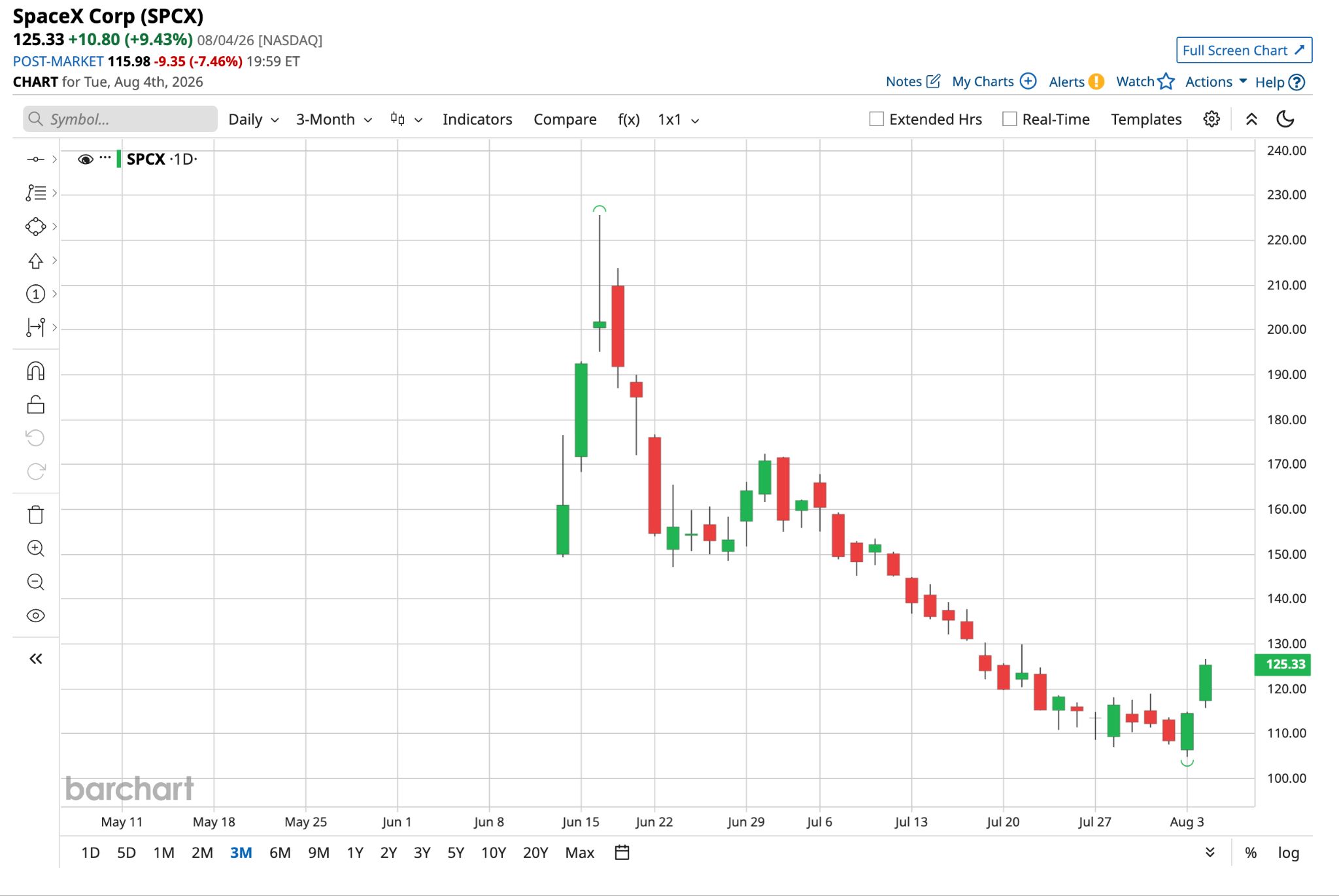
Since going public in June, SPCX stock has fallen 23%, underperforming the iShares U.S. Aerospace & Defense ETF’s (ITA) roughly 5% gain during the same period. The performance gap highlights the stock’s volatility compared with relatively stable performance. After trading near $152 on July 9, SPCX stock declined approximately 29% to around $108 by July 31. Since then, shares have recovered some losses and currently trade near $115.
 www.barchart.com
 SpaceX is one of the hardest companies to assess based on valuation. The company is still losing money, making its forward price-to-earnings (P/E) ratio meaningless. The price-to-sales (P/S) ratio of 75.8 times also has no historical average to compare against, since the company only went public in June. Nonetheless, that P/S ratio is steep by almost any measure.
What justifies the high multiple is the EPS outlook. Analysts expect growth of 543% in fiscal 2027 as the AI and Starlink businesses scale. That is an exceptional number, and helps explain why the market is tolerating aggressive spending right now. SpaceX holds $23.7 billion in cash against $30.6 billion in debt. The resulting net debt of roughly $7 billion seems insignificant for a company worth $1.5 trillion. The debt figure, though, will likely ramp up as SpaceX continues to invest heavily in AI.
In the end, the valuation comes down to investors’ patience and trust in the company. It hinges on whether they are willing to pay a rich price for SPCX stock today in hopes that the heavy spending will eventually pay off.
SpaceX Targets $100 Billion ARR by Year-End
SpaceX reported earnings for Q2 2026 on Aug. 4. The release was the company’s first-ever public earnings report. Revenue rose 92% from a year earlier to $7.8 billion, comfortably beating the Wall Street consensus of $6.81 billion. This was driven by strong growth across all major segments. Space segment revenue was $962 million, up 29% year-over-year (YOY), while Connectivity revenue was $4.3 billion, up 66% YOY. The company’s capital expenditures were about $18.4 billion, including roughly $15.8 billion in spending for AI compute infrastructure. On a positive front, Chief Operating Officer Gwynne Shotwell said that the company added more than 1.7 million Starlink subscribers globally during the quarter.
Going forward, the company expects to end this year with more than 2 gigawatts of compute, up from 1.4 GW at the end of Q2. Moreover, management expects to reach a $100 billion annualized revenue run rate by the end of 2026, based on expected December revenue. Its internal projection for $1 trillion in revenue has moved up from 2031 to 2030, with a “non-zero chance” of reaching that level in 2029, according to Musk. On the earnings call, CFO Bret Johnsen also noted that the company secured an additional $6.7 billion in cloud services contracts during the first weeks of Q3. Revenue from these deals is expected to begin ramping up in October 2026 and will be recognized over the following six months.
What Do Analysts Expect for SpaceX Stock?
Following earnings, analysts updated their financial models and issued new price targets for SpaceX. On Aug. 5, Goldman Sachs analyst Eric Sheridan reiterated a “Buy” rating and set a price target of $220 on SPCX stock. This reflects impressive potential upside of 91% from current levels. In addition, Clear Street maintained a “Buy” rating with a price target of $217 per share.
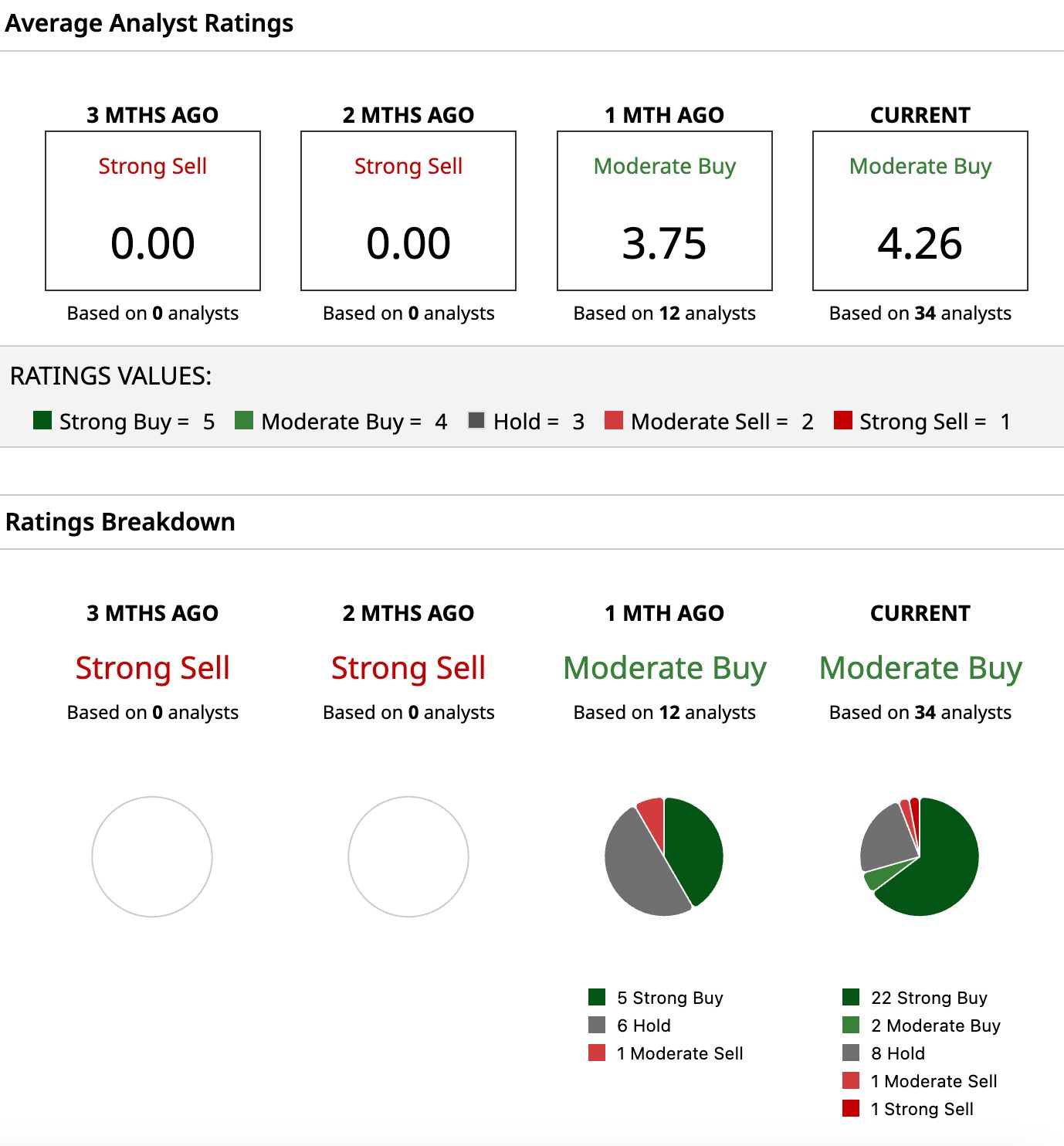
Based on 34 Wall Street analysts with coverage, SpaceX holds a consensus “Moderate Buy” rating with a mean price target of $222.78, indicating 94% potential upside from here. The lowest target for SPCX stock is $75, while the highest price target is $800 per share.
 www.barchart.com
 On the date of publication, Jabran Kundi did not have (either directly or indirectly) positions in any of the securities mentioned in this article. All information and data in this article is solely for informational purposes. For more information please view the Barchart Disclosure Policy here.
More news from Barchart
Netflix Looks Attractive to Short-Put Players - a 2.0% One Month Income Yield Elon Musk Is Asking Investors to Trust Him Again as SpaceX Focuses on More Than Just Space The Curious Case of Oracle Stock: The Better the Business Gets, the More Investors Worry Here’s The Real Reason Wall Street Cut ON Semiconductor Stock’s Price Target