


Stablecoin issuer Circle (CRCL) has communicated in its latest earnings call that its blockchain operating system Arc Mainnet will be launched next month on Sept. 16. The operator of the world's second-largest stablecoin, USDC, also revealed that it has entered into partnerships regarding Arc Mainnet, key among them being with the Depository Trust & Clearing Corporation (DTCC) and the world's largest asset manager, BlackRock (BLK).
About Circle
Founded in 2013, Circle is best known for being the issuer of USDC. Today, USDC has become one of the most widely used digital dollars globally. Further, Circle provides APIs for businesses to issue wallets, send payments, accept stablecoin payments, convert fiat currency to stablecoins, and build blockchain financial applications.
Join 200K+ Subscribers: Find out why the midday Barchart Brief newsletter is a must-read for thousands daily.
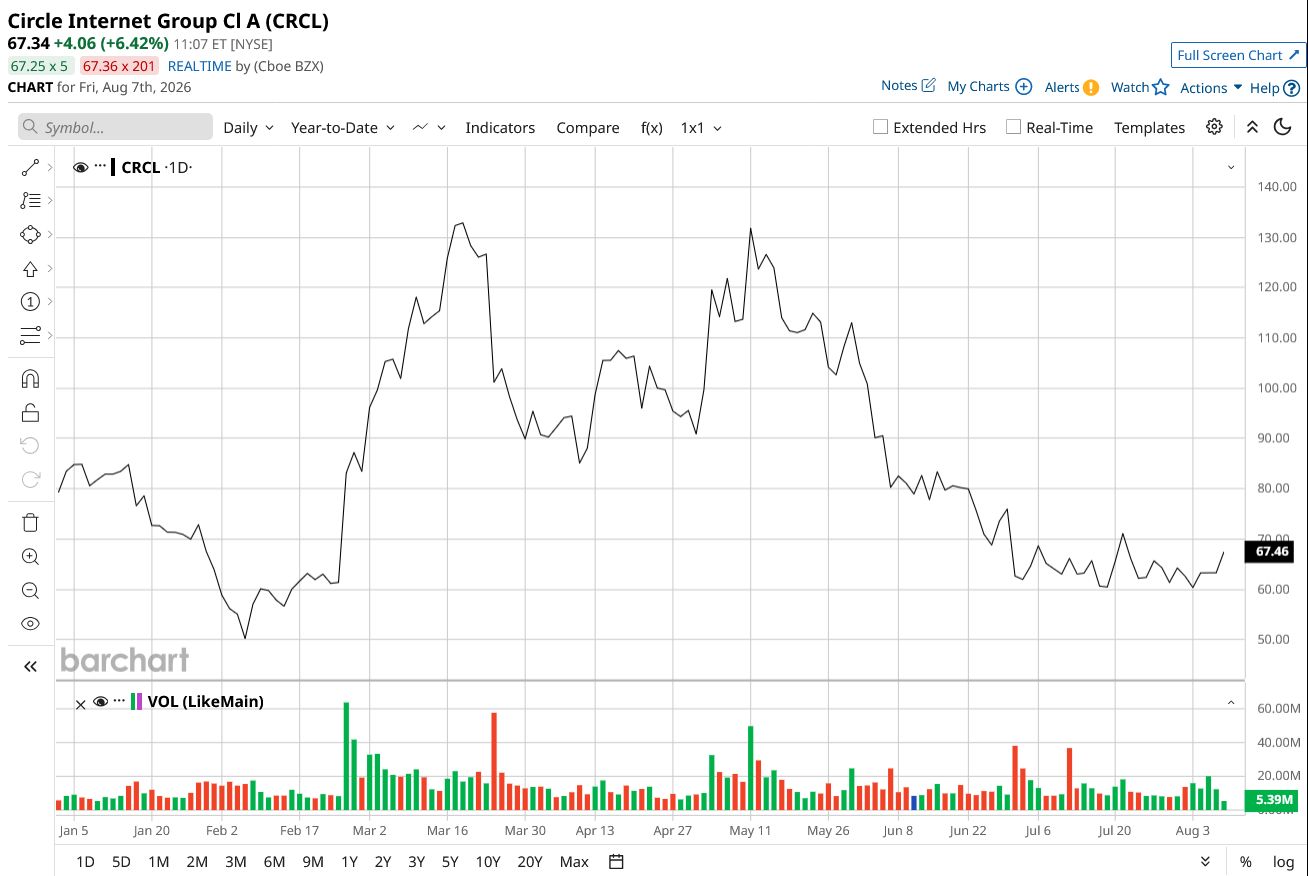
Valued at a market cap of $15.7 billion, CRCL stock is down 14% on a year-to-date (YTD) basis. However, since its IPO in June 2025, the share price has doubled.
So, can Arc Mainnet be the catalyst for another upmove? Let's find out.
 www.barchart.com
 What Is Circle's Purpose With Arc Mainnet?
Before diving into what Arc Mainnet is and how it will bring value to Circle, it must be acknowledged that for an issuer of a leading stablecoin like USDC, a blockchain seems like a natural progression. With Arc Mainnet, Circle is looking to build the infrastructure to make USDC the preeminent currency of the internet economy.
Arc is an open Layer-1 blockchain built by Circle specifically for stablecoin-native financial applications. Unlike Ethereum (ETHUSD) or Solana (SOLUSD), which are general-purpose blockchains, Arc is purpose-built for financial use cases such as payments, foreign exchange, treasury management, lending, capital markets, and tokenized real-world assets.
But if Arc is the blockchain, what is Mainnet? Mainnet is the stage where a blockchain goes live after testing by developers and selected participants. This phase is called the testnet. Notably, Arc has already completed its development and public testnet phases. Circle's roadmap then moves through a private mainnet before opening a public mainnet to everyone.
Meanwhile, the purpose behind building its own blockchain is that Circle wants to reduce reliance on third-party blockchains such as Ethereum, Solana, and Polygon (POLUSD), among others. Here, Circle has no control over the ecosystem or the transaction fees. Thus, by creating Arc, Circle retains control of the core infrastructure while continuing to support the broader multichain ecosystem.
But why would businesses adopt Arc? Well, there are some notable reasons. First, it eliminates the need to hold a volatile cryptocurrency for transaction fees by allowing USDC itself to be used as the native gas token, making transaction costs predictable in dollar terms.
Second, it offers deterministic settlement finality in under one second, reducing settlement risk and enabling near real-time payments. It also provides opt-in privacy, allowing sensitive financial transactions to remain confidential while preserving auditability for compliance purposes. Beyond this, Arc is fully EVM-compatible, enabling developers to deploy existing Ethereum smart contracts with minimal changes while benefiting from native integration with Circle's ecosystem, including USDC, EURC, USYC, CCTP, and developer APIs.
Early adoption trends at the testnet phase have been encouraging as well. Circle reported that over 100 companies joined the testnet ecosystem, representing organizations that collectively manage hundreds of trillions of dollars in assets. During its first 90 days, Arc's public testnet processed more than 150 million transactions, attracted nearly 1.5 million transacting wallets, and maintained average settlement times of roughly 0.5 seconds, demonstrating that the platform can handle high transaction volumes.
However, despite its advantages, risks are there. Key among them is competition. For instance, Open USD, a stablecoin backed by heavyweights such as Shopify (SHOP) and Circle partner Coinbase (COIN), is designed as an open, interoperable stablecoin framework backed by a consortium of major crypto companies rather than a single issuer. If exchanges, wallets, fintechs, and decentralized finance (DeFi) applications broadly adopt OpenUSD, it could reduce reliance on USDC as the default dollar-backed stablecoin.
Also, success will depend on developers and enterprises choosing Arc over established blockchains, while at the same time Circle has to ensure that scalability increases do not come at the altar of security and compliance.
Q2's Mixed Earnings, but Look Beyond That
When compared to Street expectations, Circle's Q2 2026 was mixed, with revenues missing but earnings surpassing estimates. However, it was far from a disaster.
Total revenue and reserve income for the quarter came in at $701 million, up 7% from the previous year as USDC in circulation moved up by 19% on a year-over-year (YoY) basis to $73.3 billion. Onchain transaction volume almost tripled to $14.8 trillion in the same period.
Encouragingly, the company moved into the black in Q2 2026 as EPS was at $0.18 per share, higher than the Street consensus of $0.16 per share. Notably, this was the fourth consecutive quarter of earnings beat from the company. Further, Revenue Less Distribution Costs margin, a key indicator of profitability for the company, expanded by 3.02% from the prior year to 41%. Circle also increased guidance for this for FY 2026 to 41.7%-43.7% from 38%-40% earlier.
Overall, Circle closed the quarter with a cash balance, including the balance segregated for corporation and stablecoin holders, of $75.78 billion, wherein deposits from stablecoin holders were at $72.9 billion.
Analyst Opinion on CRCL Stock
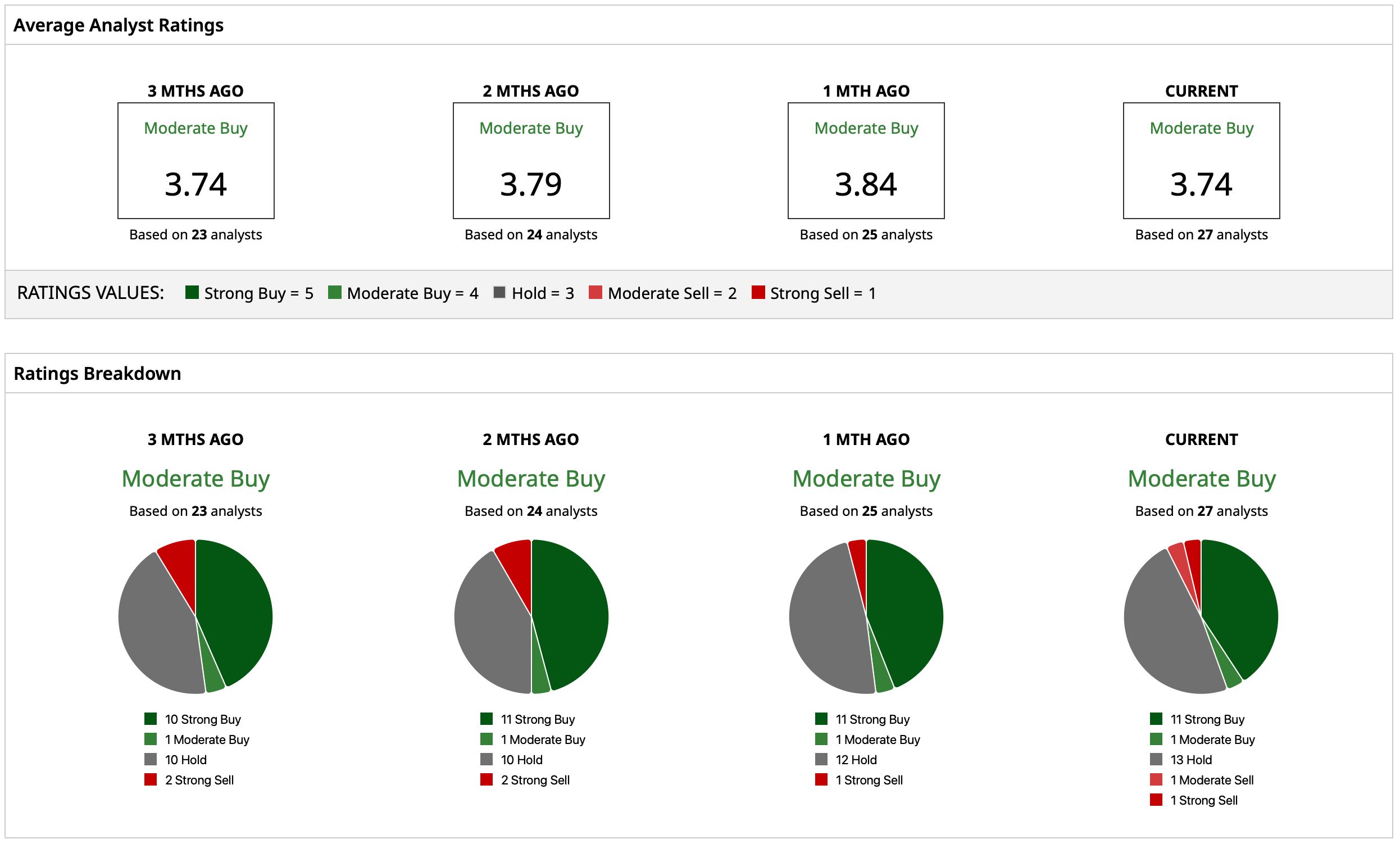
Considering this, analysts have earmarked a consensus rating of “Moderate Buy” for CRCL stock with a mean target price of $101.70, which indicates an upside potential of about 51% from current levels. Out of 27 analysts covering CRCL, 11 have a “Strong Buy” rating, one has a “Moderate Buy” rating, 13 have a “Hold” rating, one has a “Moderate Sell” rating, and one has a “Strong Sell” rating.
 www.barchart.com
 On the date of publication, Pathikrit Bose did not have (either directly or indirectly) positions in any of the securities mentioned in this article. All information and data in this article is solely for informational purposes. For more information please view the Barchart Disclosure Policy here.
More news from Barchart
Dear Circle Stock Fans, Mark Your Calendars for September 16 Bitcoin Accidentally Delivered on Its Big Promise. Why That’s Bad News for Crypto ‘Hodlrs.’ Why Analysts Are Divided Over Circle (CRCL) Stock Circle’s Trust Charter Approval Sends a Key Signal to Wall Street