

Nvidia (NVDA) just extended its grip on artificial intelligence (AI) computing with plans to go where no chipmaker has gone before: orbit. On Aug. 4, SpaceX (SPCX) and Nvidia announced they are partnering to design the compute payload for the Starmind AI1 satellite, which will run heavy AI workloads from space using Nvidia’s newest hardware. The plan is not a one-off. SpaceX has outlined a long-term vision that could eventually scale to as many 1 million AI satellites. Together, these satellites would work as one giant data center circling the Earth.
Even more than the spectacle, what stands out for Nvidia is the commitment behind this partnership. SpaceX CEO Elon Musk said bluntly that the company has agreed to exclusively use Nvidia GPUs because “the Vera Rubin architecture is the best architecture.” That is about as strong an endorsement as it gets, especially because it comes from the one customer with every reason to build his own chips or look for alternatives.
More Top Stocks Daily: Go behind Wall Street’s hottest headlines with Barchart’s Active Investor newsletter.
Why This Matters for Nvidia
This deal also shows how fast Nvidia’s newest push is gaining ground. When the company launched its space computing platform back in March, it named six partners, and SpaceX was not one of them. After just a few months, the most ambitious space company in the world has now signed on as well.
The hardware at the center of this news is Nvidia’s Vera Rubin platform. The company says it delivers up to 25 times the AI performance of its H100 chips in orbit. This matters because the opportunity could be enormous. Futurum Research estimates orbital computing could become a $1 trillion market by 2030, driven by falling Starship launch costs and the power limits choking data centers on the ground. If that plays out, Nvidia is positioned as a prime beneficiary.
The logic behind moving compute to space is more practical than it sounds. AI data centers on Earth are running into hard limits on power, land, and cooling. In orbit, satellites get constant solar energy and natural cooling for free, avoiding the very bottlenecks holding back data centers on Earth.
For Nvidia investors, the near-term payoff is small. Space chips ship only later this year, and a 1-million-satellite network is a long way off. The real value today is in what the deal signals. Nvidia isn’t just winning on Earth anymore — it is being chosen first for a market that hasn’t even been built yet.
About Nvidia Stock
Founded in 1993 and based in Santa Clara, California, Nvidia designs and sells advanced computer chips and software used in AI data centers, gaming, and networking. The company also provides computing systems and technologies for robotics, autonomous vehicles, and other high-performance computing applications.
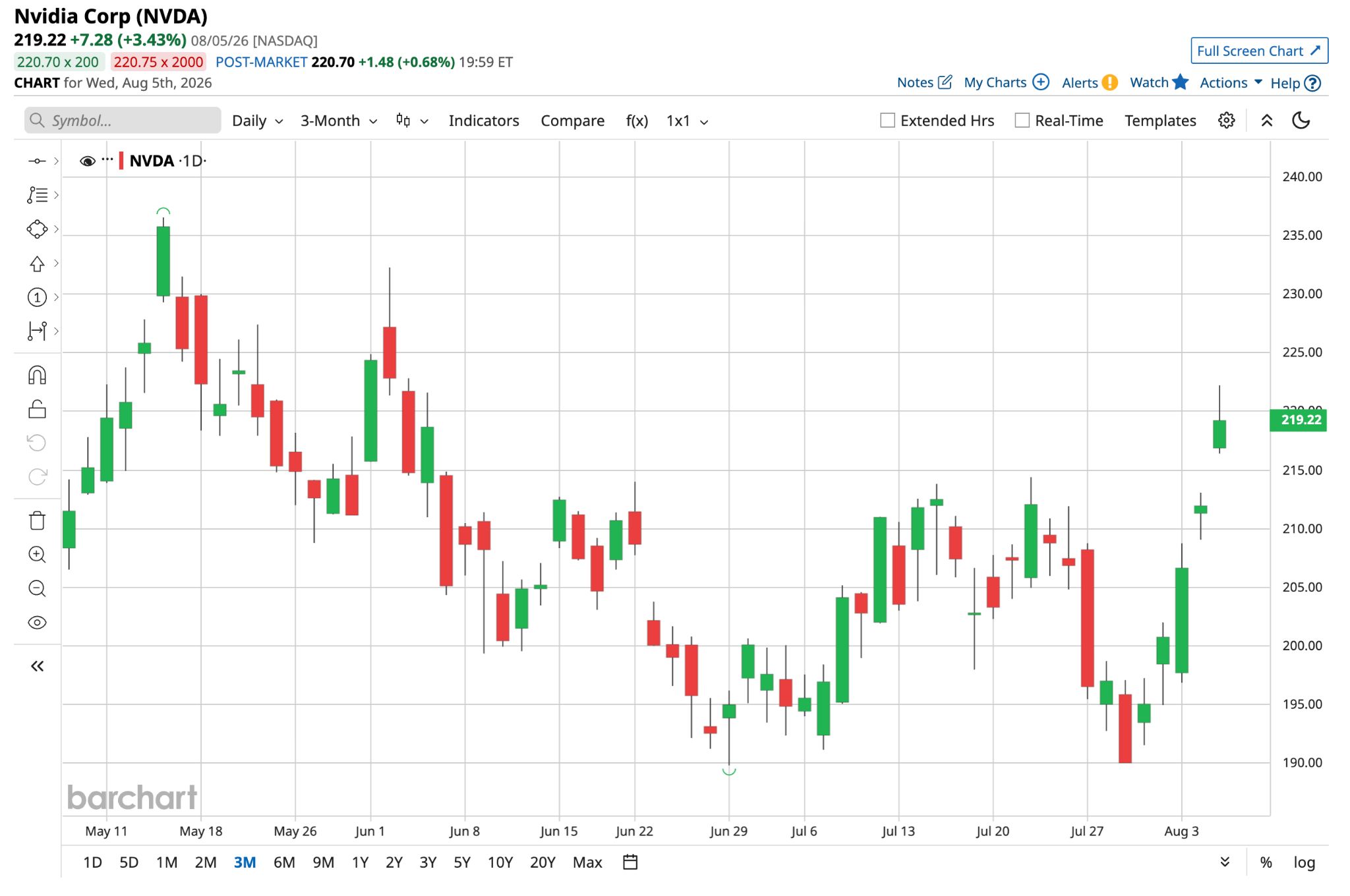
NVDA stock has posted a 24% gain over the past year, but its performance has fallen short of the broader semiconductor sector. The iShares Semiconductor ETF (SOXX) has more than doubled during the same period, significantly outperforming Nvidia stock. A similar pattern is true for 2026, with Nvidia up approximately 20% on a year-to-date (YTD) basis versus an 80% rise for the exchange-traded fund (ETF).
 www.barchart.com
 Nvidia is currently the most valuable company in the world, with a market capitalization of roughly $5.4 trillion. NVDA is the defining stock of the AI era, yet the valuation looks surprisingly reasonable. The forward price-to-earnings (P/E) ratio of 24.9 times sits well below the five-year average, while the price-to-sales (P/S) ratio of 24.5 times is above its historical norm.
The discount is really the market hedging its bets. Many investors suspect today’s demand is tied to an AI boom that could eventually cool, so they are unwilling to pay the premium Nvidia once commanded. This is where a deal like Starmind matters. By pushing into an entirely new market, Nvidia is reducing the fear that its growth depends on a single wave that might break. This same fear shows up in the earnings outlook. Analysts expect growth of 92% in fiscal 2027, followed by lower growth of 38% in fiscal 2028.
The balance sheet strengthens the valuation further, however. Nvidia holds roughly $53 billion in cash against just $13 billion in debt. The resulting net cash of around $40 billion gives the company the flexibility needed to comfortably invest in new frontiers like space. For investors, the low multiple is really a question about durability, and deals like Starmind are how Nvidia answers it.
Nvidia Guides Q2 Revenue of $91 Billion
Nvidia reported first-quarter earnings on May 20, showing revenue of $81.6 billion, up 85% year-over-year (YOY). Data-center revenue surged 92% YOY to $75.2 billion, driven by AI and hyperscale demand. Non-GAAP EPS came in at $1.87, comfortably beating the Wall Street consensus estimate of $1.77 per share. The company also reported record free cash flow of $48.6 billion in Q1.
Looking forward, Nvidia provided optimistic guidance. The firm expects continued growth in its AI and data-center segments. Total revenue is expected to be $91 billion in Q2, with GAAP and non-GAAP gross margins expected to be 74.9% and 75%. For the full year, the company expects gross margins to be similar in the mid-70% range, while operating expenses growth is anticipated to be somewhere in the upper-40% range.
Nvidia has announced significant investments in AI infrastructure and new product launches, including the Vera CPU and Rubin GPU systems, which are expected to contribute to future revenue growth. However, geopolitical uncertainties, particularly in China, could affect future revenue streams.
What Do Analysts Expect for Nvidia Stock?
Bernstein analyst Varun Govindaraj recently reiterated a “Buy” rating on Nvidia with a price target of $315. This price target reflects 41% potential upside from current levels. Overall, the AI tailwind has driven a bullish view among analysts, with others also assigning positive ratings. Wells Fargo analyst Aaron Rakers also has a “Buy” rating and a price target of $315 for NVDA stock.
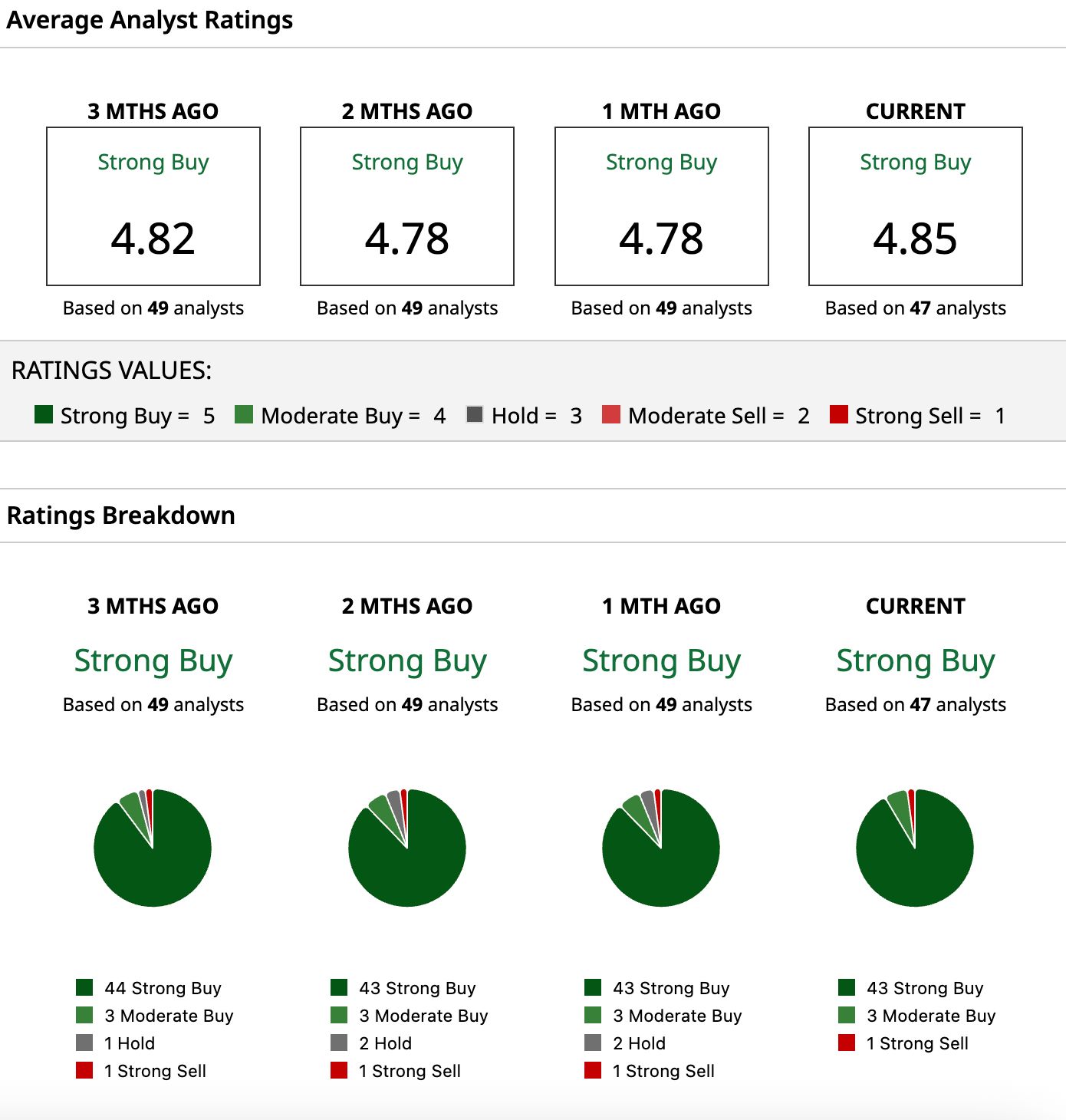
Based on 47 Wall Street analysts with coverage, NVDA stock holds a consensus “Strong Buy” rating. Out of those analysts, 43 have a “Strong Buy” rating, three have a “Moderate Buy” rating, and one has a “Strong Sell” rating. The mean price target of $304.32 implies potential upside of 36% from here, reflecting strong confidence in Nvidia’s long-term growth prospects.
 www.barchart.com
 On the date of publication, Jabran Kundi did not have (either directly or indirectly) positions in any of the securities mentioned in this article. All information and data in this article is solely for informational purposes. For more information please view the Barchart Disclosure Policy here.
More news from Barchart
Nvidia Is Going to Space With Elon Musk's Million-Satellites Plan. Here's Why It Could Be the Start of a Trillion-Dollar Cycle. Dear Circle Stock Fans, Mark Your Calendars for September 16 The Nvidia-SpaceX Deal Is Sending a Clear Signal on AI Dominance Inflation Date, Earnings Momentum and Other Key Things to Watch this Week