

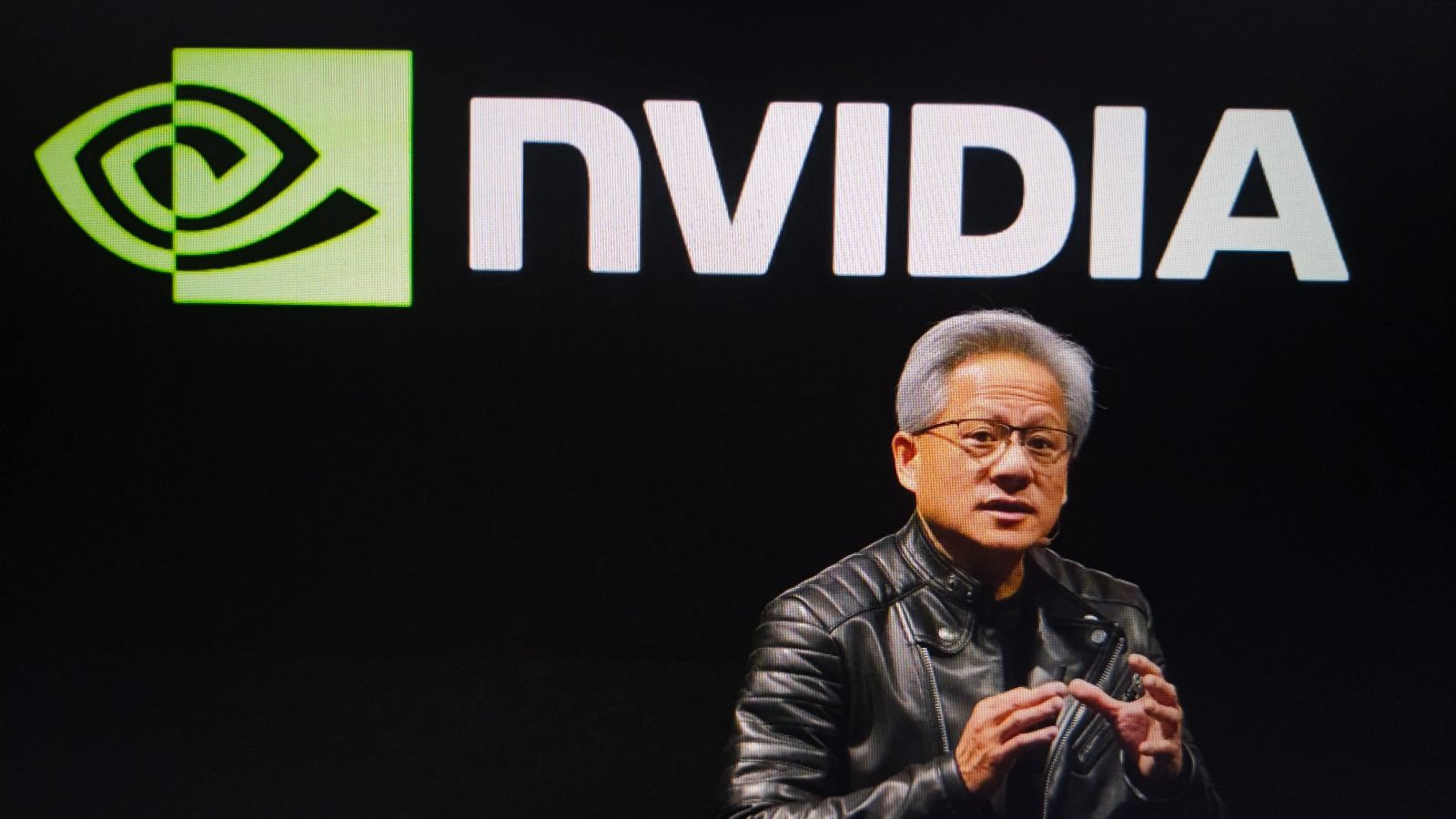
Semiconductor giant Nvidia's (NVDA) $1.5 billion equity investment in SB Energy, announced earlier today, represents a strategic deepening of the chipmaker's involvement in physical AI infrastructure beyond its traditional role as an advanced chip supplier.
The investment makes Nvidia a shareholder in SB Energy alongside SoftBank Group (SFTBY) and OpenAI, positioning it at the center of what is being developed as one of the largest AI data center projects ever conceived — the PORTS-Pike Technology Campus in Pike County, Ohio.
More Top Stocks Daily: Go behind Wall Street’s hottest headlines with Barchart’s Active Investor newsletter.
The rationale behind the investment is fundamentally about securing long-term demand for Nvidia's computing systems by locking in the physical prerequisites that constrain the deployment of AI at scale.
“AI is becoming infrastructure – the foundation for intelligence in every industry – and land, power and shell have become vital in the age of AI. Now is the time to scale the AI infrastructure that will power the next industrial revolution,” said Nvidia CEO Jensen Huang in the company’s press release. “We are securing long-lived infrastructure for NVIDIA compute so OpenAI can deploy the most productive AI factories that can be upgraded repeatedly with each new generation delivering more intelligence and better economics.”
Huang has previously articulated that the constraints on deploying AI factories have shifted from chip availability to the scarcity of powered, permitted data center sites. By investing directly in SB Energy and providing up to $105 billion in lease and power payment guarantees, Nvidia is ensuring that its exclusive computing platform will be deployed at a site capable of supporting 4.25 gigawatts initially, with options for expansion to 8 gigawatts total.
The financial logic is compelling from Nvidia's perspective. Each generation of AI systems deployed at PORTS-Pike is estimated to involve approximately 1.5 million Nvidia GPUs, translating into $150 billion to $200 billion in revenue per hardware refresh cycle.
Over the 20-year lease period with OpenAI as tenant, multiple upgrade cycles are anticipated – and when combined with OpenAI's broader infrastructure commitments through 2030, the total opportunity could reach approximately $600 billion in Nvidia compute revenue from a single customer relationship. This transforms what appears to be a $1.5 billion outlay into a mechanism for securing hundreds of billions in future chip sales.
The deal structure reveals Nvidia's disciplined approach to managing the tension between growth acceleration and balance sheet risk. After initial reports of a potential $250 billion guarantee caused a 5% stock decline, Nvidia scaled back its initial exposure to under $120 billion, covering only the first phase of the buildout.
The guarantee is structured as a residual-value backstop rather than a direct financing of OpenAI's obligations — meaning Nvidia would only face payment if OpenAI defaulted and SB Energy could not find a replacement tenant or sell the property at a value above the guaranteed minimum. Huang has explicitly rejected characterizations of circular financing, arguing that Nvidia is applying the same supply-chain discipline it uses for chip components to secure critical physical infrastructure when it has visibility into customer demand.
This investment fits within Nvidia's expanding role as both the technology provider and financial enabler of the AI buildout. Last week, Nvidia partnered with BlackRock (BLK), Apollo (APO), Goldman Sachs (GS), KKR (KKR), Blackstone (BX), and Brookfield (BAM) to create financing platforms targeting over $500 billion in third-party capital for AI infrastructure, with Nvidia offering to backstop up to 25% of individual transactions. The SB Energy investment complements this by giving Nvidia direct equity exposure to infrastructure development, not merely chip sales.
The timing also coincides with SB Energy's planned IPO, potentially as early as September, where Nvidia may invest an additional $1.5 billion, and where the infrastructure developer could raise at least $5 billion from public markets.
This article was created with the support of automated content tools from our partners at Sigma.AI. Together, our financial data and AI solutions help us to deliver more informed market headline analysis to readers faster than ever.
On the date of publication, Sarah Holzmann did not have (either directly or indirectly) positions in any of the securities mentioned in this article. All information and data in this article is solely for informational purposes. For more information please view the Barchart Disclosure Policy here.
More news from Barchart
Why Nvidia Is Teaming With OpenAI on a Massive Ohio Data Center — ‘Now Is The Time To Scale The AI Infrastructure That Will Power The Next Industrial Revolution’ Tesla Is Finally Getting Ready to Demo a Flying Roadster. It May Not Stop the Sell-Off in TSLA Stock. Mark Cuban Says 61% of Americans Are ‘Part Of The Healthcare Problem’ — If You Own Stocks in Insurance Companies You’re Putting Profit Over People A $600 Million Reason Intuitive Machines (LUNR) Stock Is Up Today