

Today, massive put option trading in Bank of NY Mellon (BNY) shows that some investors are earning a 3.33% 150-day short-put yield. That could imply investors are shorting these puts to establish a potential lower buy-in point for BNY stock ahead of its upcoming earnings, especially if BNY dips.
BNY is at $163.44 in midday trading, and the strike price of this huge volume of BNY puts is $150.00, expiring on Jan. 15, 2027. The chart below shows that BNY stock has been on a 3-month upward trek.
Can’t Get Enough Options?: Join the list for Barchart’s daily unusual options report, delivered free.
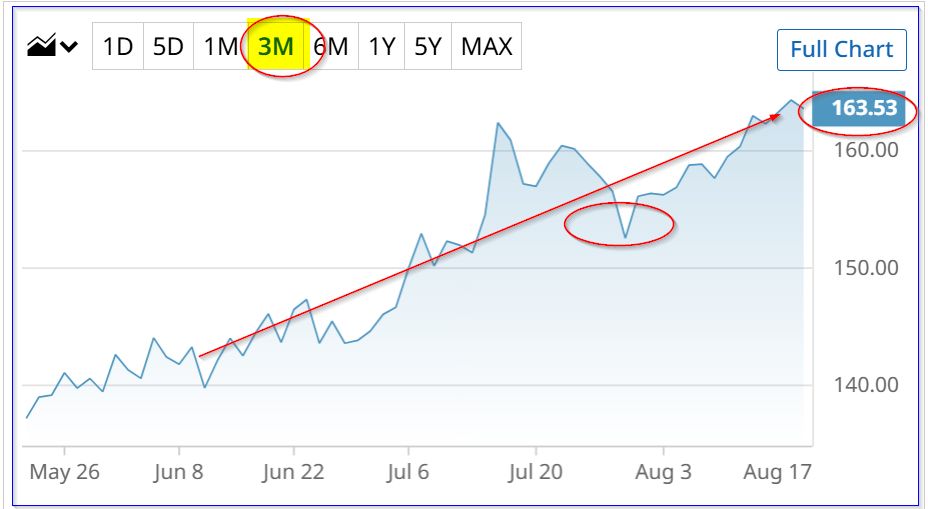
So, this huge put volume, especially at this strike price, is highly unusual. It's almost as if the buyers are waiting for a dip, given this runup. However, short-sellers are happy to take advantage of the high premium.
In other words, the strike price is over 8% below today's trading price (i.e., $150 / $163.44 -1 = -8.2%). Since investors shorting these puts earn the premium received immediately, their actual breakeven point will be even lower.
The Barchart Unusual Stock Options Activity Report today shows that over 15,000 put contracts have traded at this $150.00 put strike price. That is over 124 times the prior number of contracts outstanding at this strike price and the Jan. 15, 2027, expiration date.
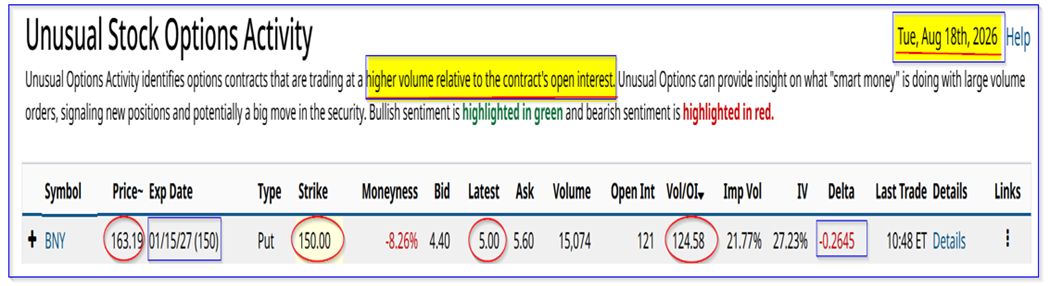 BNY puts expiring Jan. 15, 2027 - Barchart Unusual Stock Options Activity Report - Aug. 18, 2026
 In fact, it is the top-ranking unusual put volume in Barchart's report today. This implies some institutional investors are likely the initiators of these trades.
Note that the $5.00 midpoint premium represents 3.33% of the $150.00 strike price. That means that short sellers make a 3.33% yield over the next 5 months.
Moreover, the company will have likely reported earnings twice since then, as its Q4 report will likely come out on Jan. 15. In other words, this gives plenty of time for the stock to falter.
So, is BNY stock set to drop significantly by Jan. 15, 2027? Not likely.
Strong Outlook for BNY Stock
On the one hand, BNY has delivered strong returns in the past two quarters, implying a good outlook. On the other hand, analysts' price targets are not significantly higher for BNY stock.
For example, earnings per share (EPS) have risen 26.94% and 41.77% YoY in Q2 and Q1, respectively, driven by strong net interest income growth and other fees. Moreover, its return on equity has been 17.2% and 16.1% in Q2 and Q1 as well, respectively.
That led to a huge 18.86% increase in its dividend per share (DPS) last month to $0.63 quarterly (up from $0.53). As a result, BNY stock now yields 1.54% (i.e., $2.52 annual DPS /$163.44).
That is higher than its historical 5-year yield average of 2.61%, according to Yahoo! Finance, and 2.40% according to Morningstar.
That could imply the stock is somewhat overvalued. However, over the past 12 months its trailing 12-month (TTM) yield has been 1.35%, according to Morningstar.
So, with this higher DPS, BNY might have some upside:
$2.52 / 0.0135 = $186.67 price target (PT)
$186.67 / $163.44 price today = 1.142 - 1 = +14.2% upside
Analysts have lower upside price targets. Yahoo! Finance says its survey of 16 analysts has an average PT of $167.33 (i.e., +2.38%). The same with Barchart's mean survey PT ($171.19, +4.7%).
The bottom line is that BNY does not look overvalued, and could be significantly undervalued, especially if its strong earnings and ROE results persist.
That is why today's huge put volume is likely initiated by investors shorting these high-premium BNY put options.
On the date of publication, Mark R. Hake, CFA did not have (either directly or indirectly) positions in any of the securities mentioned in this article. All information and data in this article is solely for informational purposes. For more information please view the Barchart Disclosure Policy here.
More news from Barchart
Massive Put Options Trading in Bank of NY Mellon - Out-of-the-Money 3.33% Yield QQQ Just 'Gamma Flipped' as Market Makers Were Forced to Sell. Here’s What Our Top Chart Expert is Tracking Next. Terrible Nike Stock Historically Offers a Near-Term Bounce When Things Are This Bad Analysts Keep Hiking Intel's Revenue Forecasts and Price Targets - Is INTC Still a Buy?