

Intel Corporation (INTC) is giving investors a reason to take a fresh look at its turnaround story. After years of losing ground to rivals, the chipmaker has staged a triple-digit rally over the past year and into 2026, as investors grow increasingly confident in CEO Lip-Bu Tan’s efforts to put Intel back on a stronger footing. And the latest developments have only added fuel to that optimism. Intel raised $23 billion last week through a share sale to investors, a move that GF Securities said could point to progress in the company’s all-important foundry business and potentially an expanding customer base.
For a company that has made rebuilding its manufacturing edge a key part of its comeback strategy, that could be an important sign. And now, Lip-Bu Tan is putting some of his own money behind the turnaround. According to a filing with the Securities and Exchange Commission, Intel’s CEO purchased about 105,623 shares at $95 per share on Aug. 11. The fact that Tan also participated in Intel’s latest capital raise makes the purchase even more notable, potentially signaling that he sees further room for the stock to climb.
More Top Stocks Daily: Go behind Wall Street’s hottest headlines with Barchart’s Active Investor newsletter.
With Intel’s turnaround story gaining momentum, its foundry ambitions coming into focus and its CEO showing confidence with his own investment, INTC has plenty to keep investors watching.
About Intel Stock
Intel’s comeback story is quickly becoming one of the more closely watched turnarounds in the semiconductor industry. Once synonymous with the processors powering personal computers, the chip giant is now trying to reinvent itself for an era dominated by AI, advanced computing and increasingly sophisticated semiconductor manufacturing.
Founded in 1968 and headquartered in Santa Clara, California, Intel has expanded well beyond its traditional PC roots. Its business now spans client computing, data center and artificial intelligence (AI) processors, networking and edge computing, as well as Intel Foundry Services (IFS), its contract manufacturing business. The strategy represents a major shift for a company that is aiming to compete not only as a chip designer but also as a leading semiconductor manufacturer.
However, the transformation comes after a difficult stretch. Slowing growth, shrinking margins and weaker earnings weighed on Intel for years, while rivals such as Nvidia Corporation (NVDA) and Advanced Micro Devices (AMD) gained ground in AI. Intel is now attempting to close that gap while simultaneously rebuilding its manufacturing capabilities, a massive undertaking with potentially significant implications for its future.
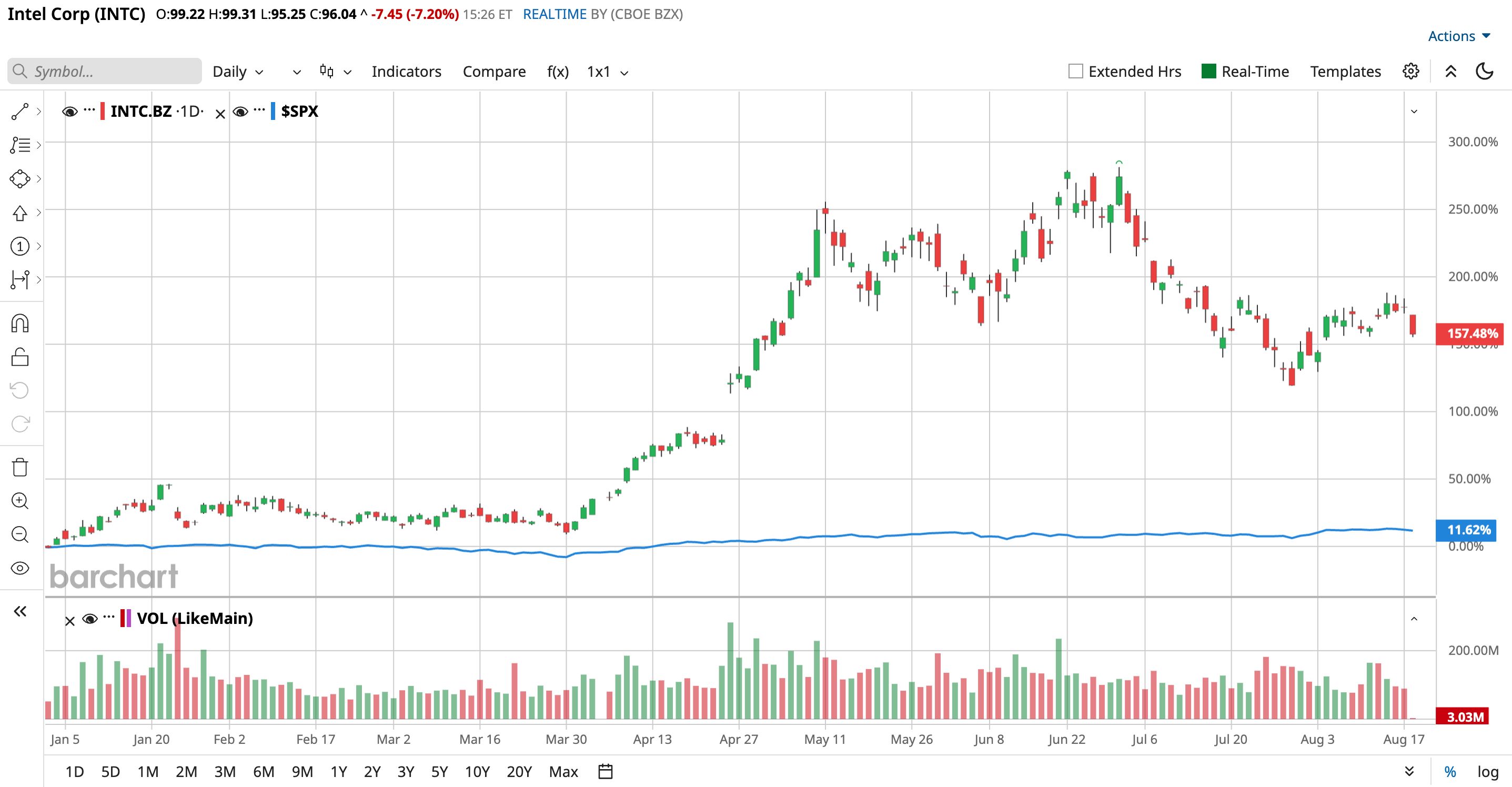
Investors appear to be increasingly willing to give the turnaround a chance. Intel now commands a market capitalization of about $547 billion, while its shares have soared a remarkable 305.3% over the past year, dramatically outpacing the 19.4% gain for the S&P 500 Index ($SPX). The momentum has been even stronger in 2026, with INTC up 159.9%, compared with a 12.5% advance for the broader market. But a rally of this magnitude comes with a higher bar for execution. Intel shares hit a record $142.35 on June 30 before retreating 32.5% from that peak.
 www.barchart.com
 Intel’s Q2 Earnings Snapshot
Intel’s latest earnings report offered investors plenty of excitement. The chipmaker’s fiscal 2026 second-quarter results, released on July 23, came in well ahead of Wall Street’s expectations, with revenue jumping 25% year-over-year (YOY) to $16.1 billion. That marked Intel’s strongest pace of revenue growth in more than 15 years and comfortably exceeded the $14.43 billion consensus estimate. Management pointed to faster execution, greater accountability and a stronger focus on customers as key factors behind the performance.
The earnings recovery was even more striking. Non-GAAP EPS reached $0.42, almost twice Wall Street’s $0.22 estimate and a major improvement from the $0.10 non-GAAP loss Intel reported a year earlier. Beneath the headline numbers, several parts of the business showed meaningful momentum. Intel’s Client Computing Group, which supplies PC processors, remained its largest business, with revenue increasing 13% to $8.9 billion.
However, the data center business was the real growth engine, with revenue soaring 59% to $6.3 billion. Strong enterprise hardware demand and solid adoption of the Xeon 6+ lineup helped the segment generate $2.5 billion in operating profit.
Intel’s manufacturing ambitions also continued to gain traction. Intel Foundry revenue rose 31% YOY to $5.8 billion, while the company stayed on schedule with its next-generation manufacturing roadmap. Intel 18A-P entered risk production as planned and remained aligned with the timeline previously communicated to customers and partners.
And, Intel is enhancing the platform with improvements aimed at performance, power efficiency and thermal resistance. The quarter also showed a notable improvement in Intel’s underlying financial performance. Non-GAAP gross margin climbed to 41.8%, more than 12 percentage points above the level recorded in the second quarter of 2025. Meanwhile, Intel generated $7 billion in cash from operations, adding another layer of strength to the quarter.
According to Intel CFO Dave Zinsner, strong demand was complemented by better execution, including higher factory yields and faster cycle times. Those improvements helped the company unlock additional production volume and capitalize on demand. And AI is increasingly shaping where Intel is putting its money. Zinsner said the company is seeing continued strength in AI-driven computing, prompting Intel to significantly increase spending on equipment, clean room capacity and substrates.
The investments are intended to support anticipated growth across both Intel’s product businesses and foundry operations this year and into next year. Intel is carrying that momentum into the next quarter, with management forecasting fiscal 2026 Q3 revenue of $15.8 billion to $16.8 billion. The company expects non-GAAP gross margin of 42% and adjusted EPS of $0.38.
How Do Analysts View Intel Stock?
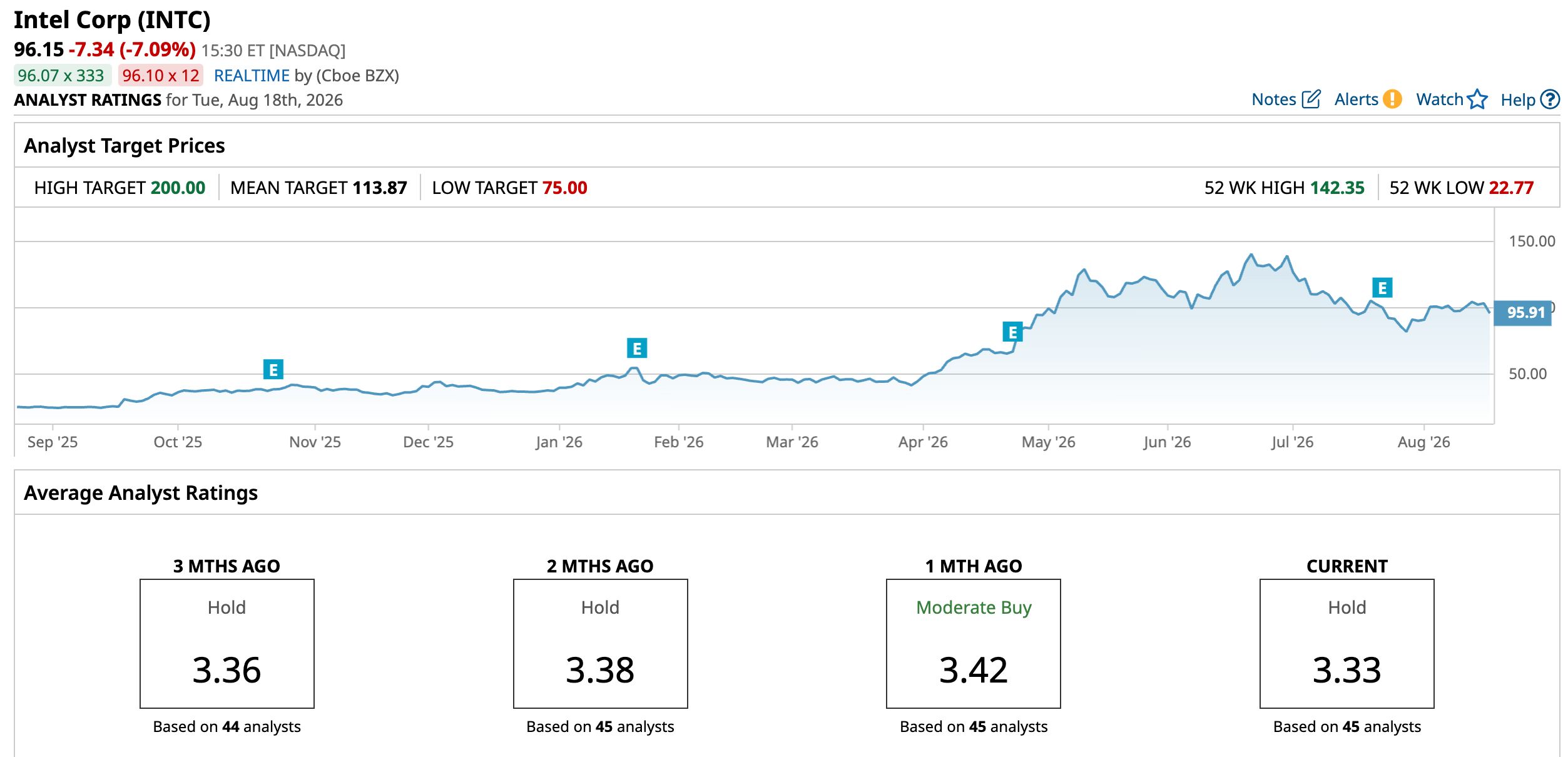
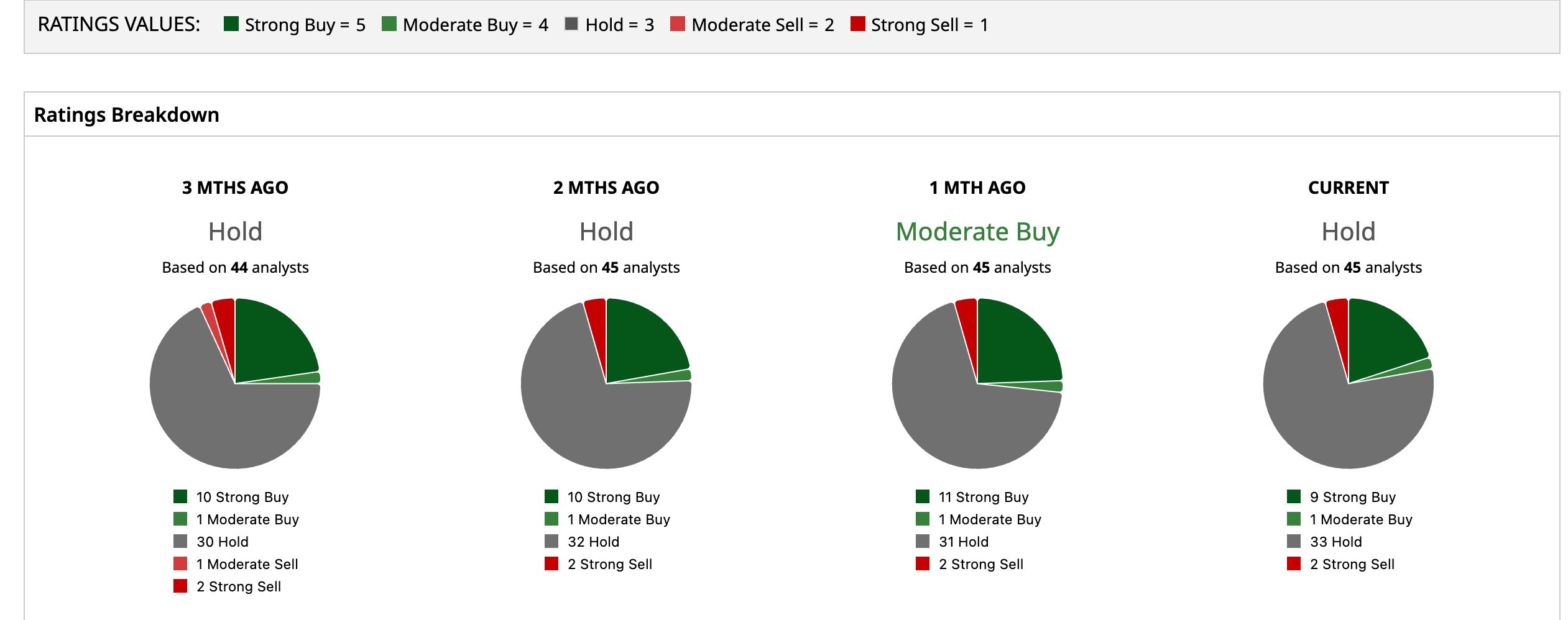
Overall, Wall Street remains cautious on Intel, with the stock carrying a consensus “Hold” rating despite its powerful rally. Of the 45 analysts covering the semiconductor giant, nine recommend “Strong Buy,” one gives a “Moderate Buy,” 33 rate it “Hold,” and two advise “Strong Sell.” Still, the price targets suggest that some analysts see considerable room for the stock to run.
The average price target of $113.87 implies 18.4% upside, while the Street-high target of $200 points to a potential 108% gain from current levels. The wide range of expectations reflects the uncertainty surrounding Intel’s turnaround. But it also highlights the potentially significant upside if the company delivers on its ambitious plans.
 www.barchart.com
  www.barchart.com
 On the date of publication, Anushka Mukherji did not have (either directly or indirectly) positions in any of the securities mentioned in this article. All information and data in this article is solely for informational purposes. For more information please view the Barchart Disclosure Policy here.
More news from Barchart
1 Hidden Options Level That Can Change How a Stock Trades Anthropic Just Gave This Bitcoin Miner a Contract Bigger Than the Whole Company What to Know as Guggenheim Ups Its Price Target on MongoDB Stock CEO Lip-Bu Tan Just Bought Another 105,000 Shares of Intel Stock