

When investors think about artificial intelligence (AI) stocks, the usual names that come to mind are chipmakers powering the AI boom, cloud providers building the infrastructure, and companies developing the large language models (LLMs) behind the technology. Duolingo (DUOL), the company behind the world’s most popular language-learning app, is rarely part of that conversation. Yet AI could prove to be just as important to Duolingo’s future as it is to the companies at the center of the AI boom. The company initially found itself caught between two competing narratives.
On one hand, investors worried that increasingly capable AI translators and conversational models could eventually make language-learning apps unnecessary. On the other, Duolingo’s own push toward an “AI-first” strategy sparked backlash from users, particularly after the company began replacing human contractors with AI. But while AI has created legitimate challenges for the business, it has also become a powerful tool for expanding what Duolingo can offer. One of the clearest benefits has been course creation.
More Top Stocks Daily: Go behind Wall Street’s hottest headlines with Barchart’s Active Investor newsletter.
By using generative AI, Duolingo has been able to dramatically accelerate the production of new learning content, allowing the company to scale its course offerings far more efficiently than it could through traditional methods. At the same time, user growth has remained strong, suggesting that fears of AI making the platform obsolete may be overstated, or at least premature. That resilience came into sharper focus on Aug. 19, when Duolingo inadvertently disclosed daily active user (DAU) growth figures during an Aug. 18 meeting with investors at its offices.
According to a company filing, the data showed estimated DAU growth of 27.4% on Aug. 17 from a year earlier, with similar estimated growth rates recorded during the previous days of August. The disclosure was significant because it pointed to user momentum that may be accelerating well beyond what investors had previously expected. Rather than showing signs of being disrupted by AI, Duolingo appears to be continuing to attract users at a strong pace while using AI itself to expand its content and capabilities.
Wall Street’s reaction was swift. Duolingo shares rose nearly 4.6% on Aug. 19 as investors digested the stronger-than-expected user growth signal. Against this backdrop, here’s a closer look at Duolingo stock and whether its latest momentum signals a bigger opportunity for investors.
About Duolingo Stock
What began as an ambitious mission to make language learning free and accessible to everyone has evolved into one of the world’s largest mobile education platforms. Founded in 2011 by Luis von Ahn and Severin Hacker, Duolingo launched its flagship app in 2012 with a simple but powerful goal to develop the best education in the world and make it universally available.
Since then, the company has transformed language learning into a global, gamified experience while increasingly leveraging technology and AI to push far beyond its original roots. The scale of Duolingo’s reach is a testament to the distance the vision has come. As of the second quarter of fiscal 2026, the platform had 58.7 million daily active users and 12.7 million paid subscribers, giving it a massive global audience.
Its flagship app has become the world’s most popular way to learn languages and the top-grossing education app on both Google Play and Apple’s App Store. At the core of that success is Duolingo’s ability to make learning highly engaging, combining gamification, learning science, personalization, data, and AI to make lessons feel more like playing a game than sitting in a traditional classroom. AI is also dramatically expanding what Duolingo can deliver.
In 2025, the company used generative AI and automation to launch 148 new language courses, more than doubling its course offering and allowing it to scale educational content at a pace that would have been difficult to achieve through traditional methods. But Duolingo’s ambitions now extend well beyond language learning. The company has expanded into Math, Music, and Chess, while its Duolingo English Test is helping establish the company in language assessment as well.
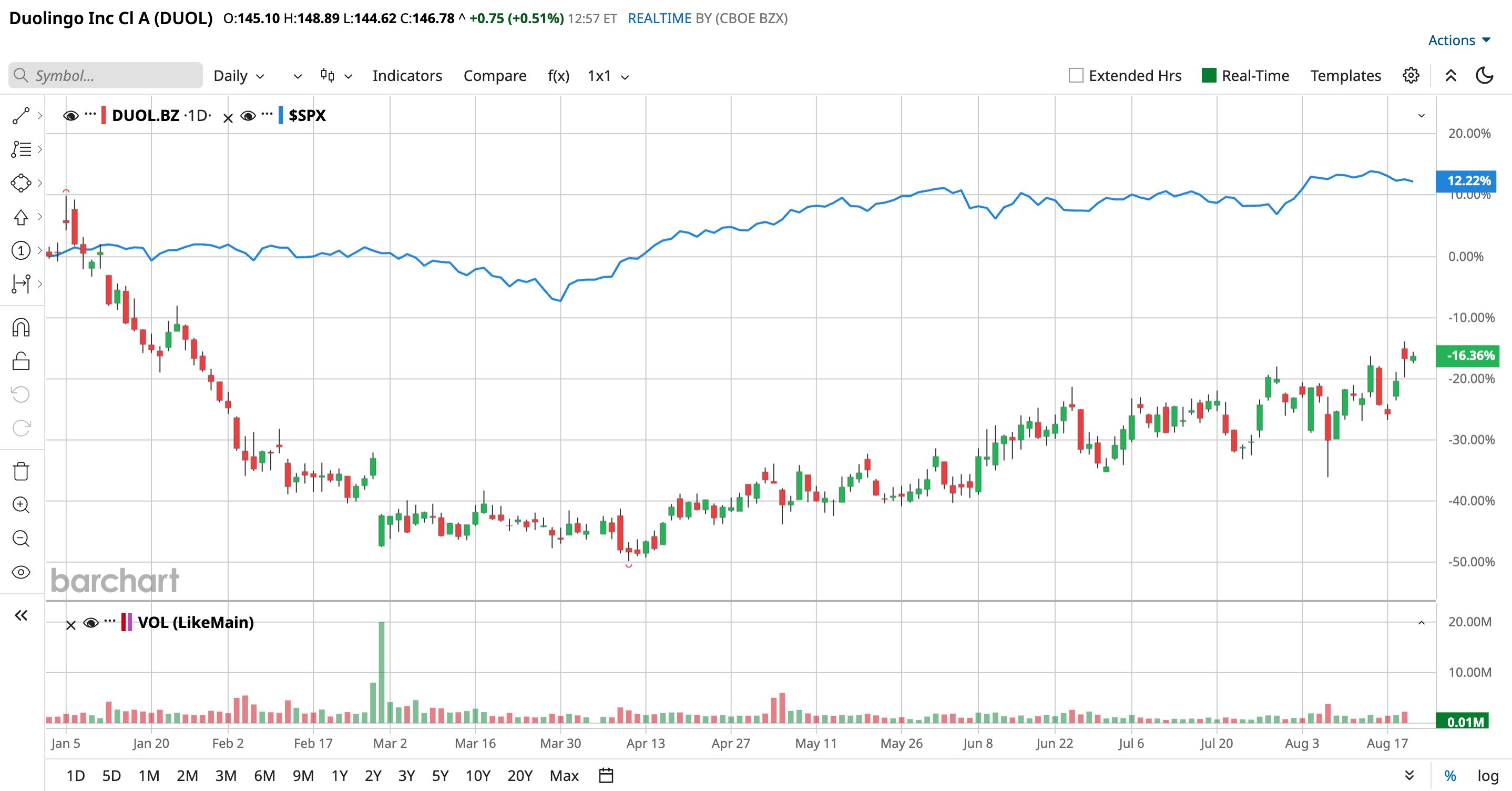
Yet, Duolingo’s leadership in language learning has not translated into leadership on the stock market. While the platform continues to dominate its category, investors have grown increasingly cautious about the impact of rapidly advancing AI on the language-learning industry. That concern has weighed heavily on Duolingo’s shares. With a market capitalization of $6.83 billion, the stock has fallen 56.84% over the past year and 16.7% so far in 2026. By comparison, the broader S&P 500 Index ($SPX) has delivered gains of 20.1% over the past year and 12.2% in 2026.
 www.barchart.com
 Inside Duolingo’s Q2 Earnings Report
Duolingo’s second-quarter results offered investors a timely reality check. Despite growing concerns that AI could disrupt the language-learning industry, the company continues to deliver strong user growth and beat expectations. Reported in early August, the company’s fiscal 2026 second-quarter revenue rose an impressive 18% year-over-over (YOY) to $298.45 million, surpassing Wall Street’s $295.54 million estimate, as expanded monetization efforts continued to support the top line.
Adjusted EPS came in at $0.66, ahead of the $0.61 consensus estimate, helped by disciplined cost management, greater operating scale, and lower costs associated with integrating generative AI. The company’s user growth provided an even stronger signal. DAUs climbed 23% YOY to 58.7 million, accelerating by two percentage points sequentially, while MAUs increased 10%, a four-percentage-point acceleration from the previous quarter.
At the same time, paid subscribers grew 17% YOY to 12.7 million, highlighting Duolingo’s ability to turn its expanding audience into paying customers. Total bookings rose 8% from a year earlier to $289.1 million, further supporting the company’s growth trajectory. Importantly, Duolingo is also showing that its AI strategy does not necessarily have to come at the expense of margins. Gross margin improved slightly to 72.6% from 72.4% a year earlier, beating management’s expectation of approximately 71%.
The improvement reflected the company’s measured approach to rolling out AI-powered features, such as Video Call, as well as efficiencies in AI-related costs. Rather than aggressively increasing AI spending, Duolingo appears to be scaling the technology while becoming more efficient in how it deploys it. The company also ended the quarter with a strong financial cushion, holding approximately $1.3 billion in cash and short-term investments.
Net cash provided by operating activities was approximately $88.3 million, while free cash flow reached approximately $78.6 million, representing a solid 26.3% free cash flow margin. For the full year, management continues to target 10% to 12% YOY bookings growth and 15% to 18% YOY revenue growth. Plus, Duolingo raised its full-year adjusted EBITDA margin outlook by nearly one percentage point to approximately 26.5%.
How Do Analysts View Duolingo Stock?
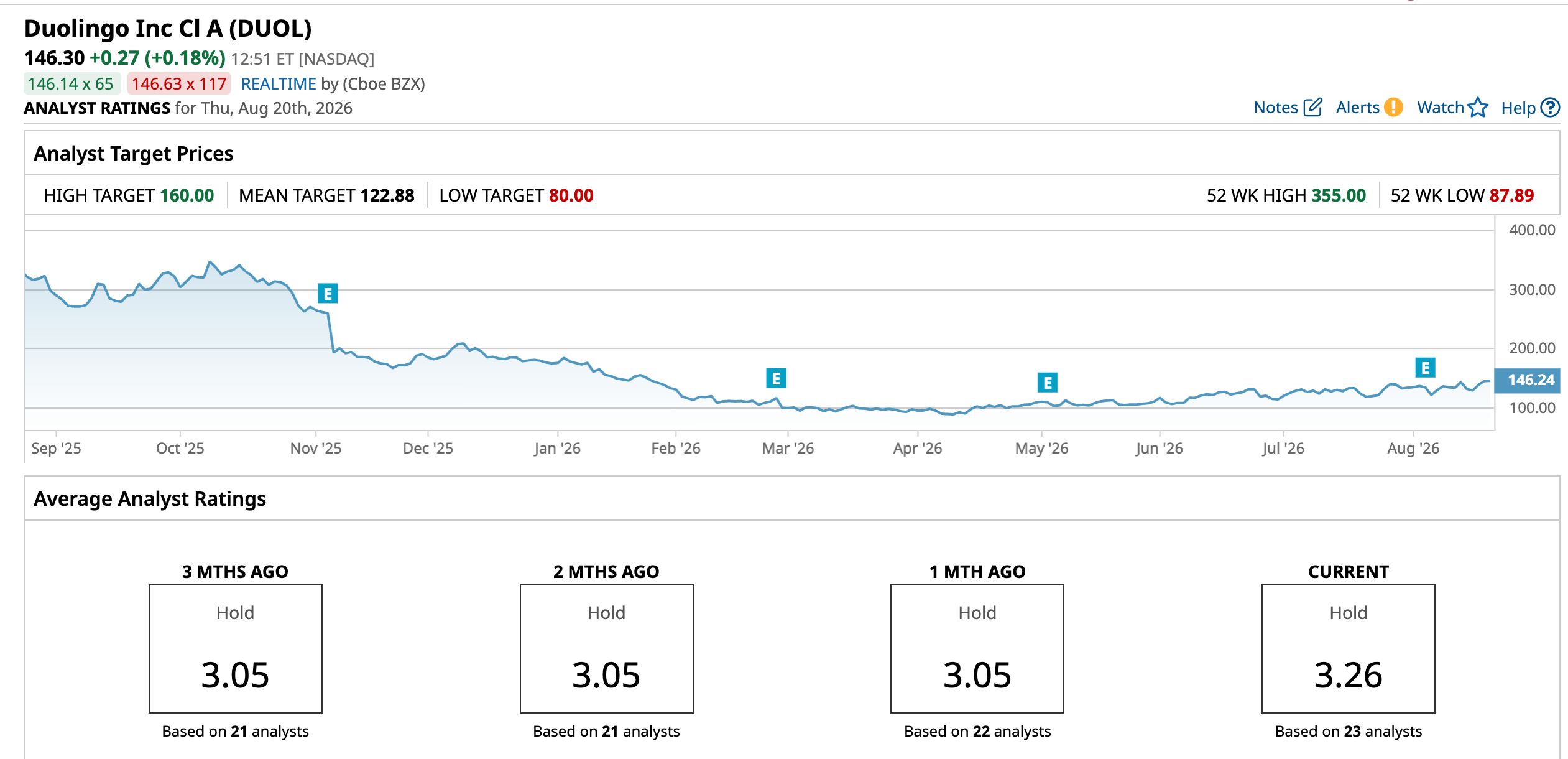
Duolingo’s strong second-quarter results have begun to shift Wall Street’s view of the stock, although the broader analyst community remains cautious. The latest boost came on Aug. 18, when DA Davidson upgraded Duolingo to “Buy” from “Neutral” and assigned a $160 price target. The firm’s bullish case centers on what it sees as an underappreciated improvement in Duolingo’s product development, marketing strategy and continued refinement of its monetization engine.
DA Davidson believes daily active user growth could continue accelerating, with bookings eventually catching up with that momentum. The firm also acknowledged that the market had, until now, effectively priced in concerns surrounding slowing user growth and potential monetization challenges. However, it believes Duolingo could be approaching a turning point, as stronger user momentum and improvements across the business begin to challenge those earlier concerns. Still, the upgrade has not been enough to turn Wall Street broadly bullish.
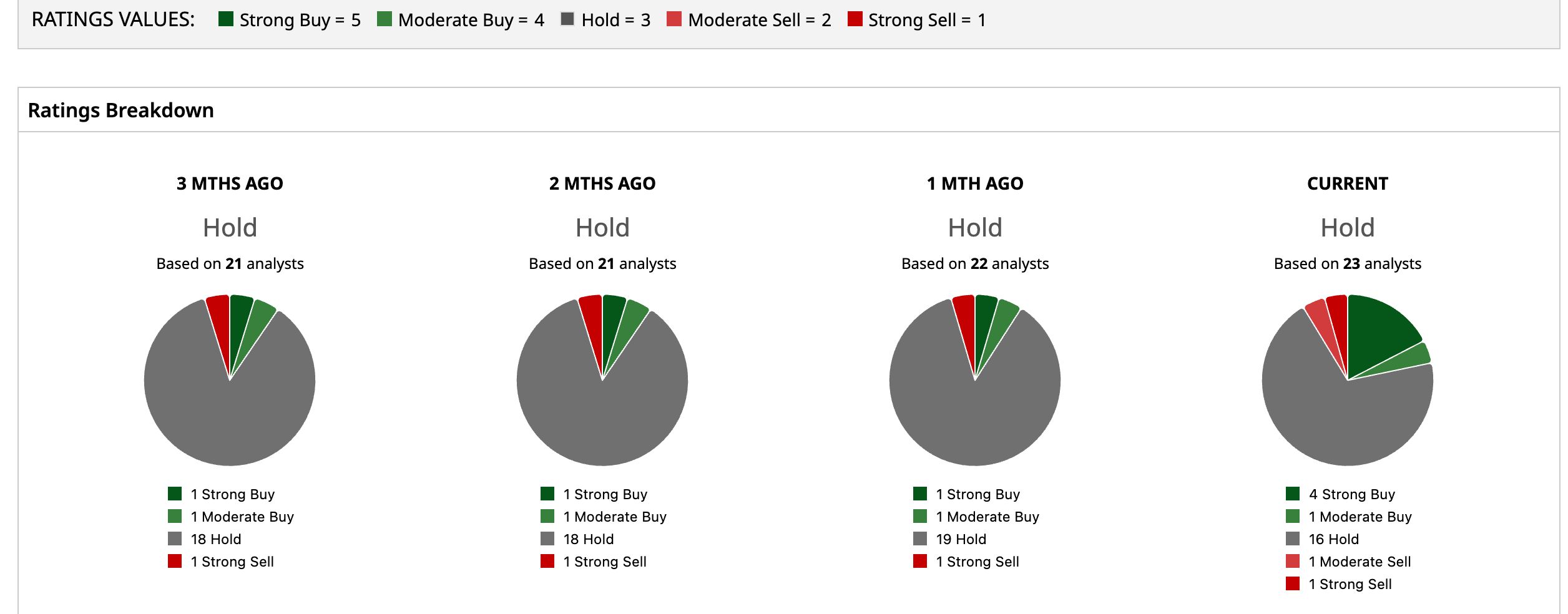
Duolingo currently carries a consensus “Hold” rating among analysts. Of the 23 analysts covering the stock, four rate it “Strong Buy,” one recommends “Moderate Buy,” 16 maintain a “Hold” rating, one has a “Moderate Sell” recommendation and one rates the stock a “Strong Sell.” Duolingo shares are already trading above the average analyst price target of $122.88, suggesting that much of Wall Street remains unconvinced about the stock’s near-term upside. Even so, the $160 Street-high target from DA Davidson leaves room for DUOL shares to climb as much as 9.4% from current levels.
 www.barchart.com
  www.barchart.com
 On the date of publication, Anushka Mukherji did not have (either directly or indirectly) positions in any of the securities mentioned in this article. All information and data in this article is solely for informational purposes. For more information please view the Barchart Disclosure Policy here.
More news from Barchart
Nvidia Stock Is Treading Water Ahead of Earnings This Week - What's the Best NVDA Play? Duolingo Stock Is Shaking Off AI Fears 500 Reasons to Buy Einride Stock Today Nvidia Q2 Preview: Strong Earnings and Low Valuation Set the Stage for Upside