

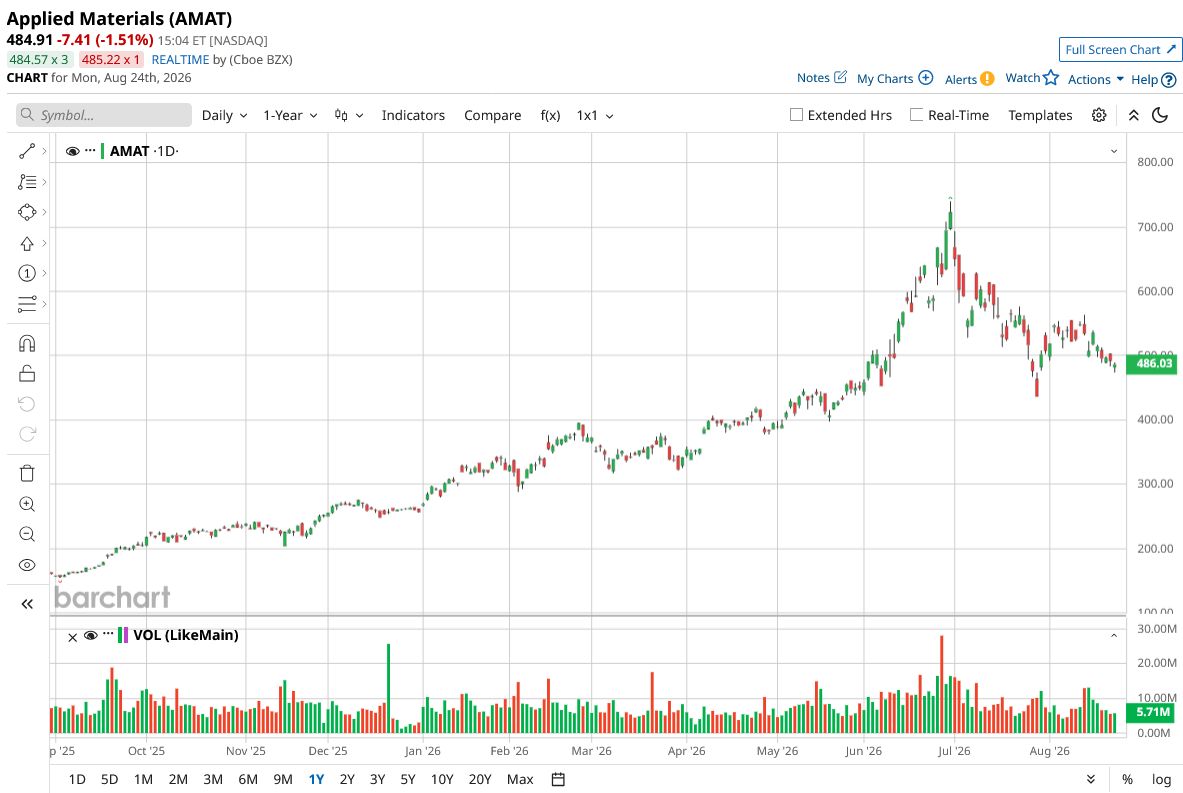
Applied Materials (AMAT) shares have fallen more than 34% from their 52-week high, largely reflecting profit-taking after a strong rally. While the stock has dropped significantly, the pullback has created an attractive entry point for investors.
The key reason for the bullish case is the strong AI-led demand environment. As AI adoption accelerates, semiconductor manufacturers are committing significant capital to developing more advanced chips and expanding production capacity. This investment cycle is creating a favorable demand environment for Applied Materials, whose equipment and engineering solutions are critical to semiconductor manufacturing.
More Top Stocks Daily: Go behind Wall Street’s hottest headlines with Barchart’s Active Investor newsletter.
Applied Materials is also investing in additional manufacturing capacity to support strong demand through the end of the decade. These investments suggest the company is positioning itself to capitalize on strong demand for semiconductor equipment.
 www.barchart.com
 Applied Materials Positioned for Sustained Growth
Applied Materials is delivering solid growth. Its Q3 revenue reached a record $9.1 billion, up 15% sequentially and 25% year over year. Adjusted gross margin rose to 50.4%, while adjusted operating margin expanded to a record 34%. Adjusted EPS increased 22% sequentially and 41% year-over-year (YoY) to $3.50. Strong revenue growth and expanding margins suggest Applied Materials is scaling efficiently, with earnings growing faster than operating expenses.
Looking ahead, AMAT’s growth outlook remains strong, strengthening the company’s bullish case. The broader demand environment has strengthened for Applied Materials. Cloud service providers continue to increase spending on AI infrastructure, while improving returns on these investments are giving them greater confidence to sustain capital spending. This creates a potentially durable demand cycle for Applied Materials.
At the customer level, most leading-edge logic and DRAM facilities are operating at high utilization. Demand also remains strong in AI-related applications such as power and optical chips. Further, as semiconductor capacity expansion broadens, Applied Materials is likely to deliver solid growth.
The company has raised its expectations for Semiconductor Systems revenue in calendar 2026 and expects to outperform the broader semiconductor equipment market. More importantly, management sees the strength continuing into fiscal 2027, supported by improved visibility into customer demand.
The primary growth driver is the rapid expansion of AI infrastructure. Rising AI demand is increasing investment in advanced chips, memory, and semiconductor manufacturing capacity, creating a favorable environment for Applied Materials. Management expects record performance to continue through the second half of the calendar year, driven particularly by a sharp increase in DRAM and leading-edge foundry-logic revenue.
AMAT’s Margin Expansion Strengthens the Growth Case
Applied Materials’ growth outlook is supported not only by rising revenue but also by its ability to expand margins. The company’s value-based pricing strategy is enabling it to capture higher prices across both new and existing products, helping offset elevated input costs and supporting profitability. At the same time, ongoing cost-efficiency initiatives are creating additional support for margins.
The company also appears to be benefiting from improving operating leverage. Applied Materials is accelerating new-product development while becoming more efficient across its support functions, with general and administrative expenses falling to their lowest share of operating expenses in the company’s history. This suggests that the business is generating greater efficiency as it scales.
The key implication is that margin expansion could become an important second driver of earnings growth. If revenue continues to grow faster than the company’s cost base, incremental sales should translate into stronger operating profit growth. This combination of revenue growth, pricing power, and operating leverage strengthens the overall investment case and creates potential upside to earnings.
The Bottom Line
The 33% decline in AMAT stock does not automatically make it a bargain, but it does make the risk-reward profile more compelling. The combination of rising AI-driven semiconductor demand, stronger revenue expectations for 2026, and continued growth anticipated in 2027 provides a compelling foundation for the bull case.
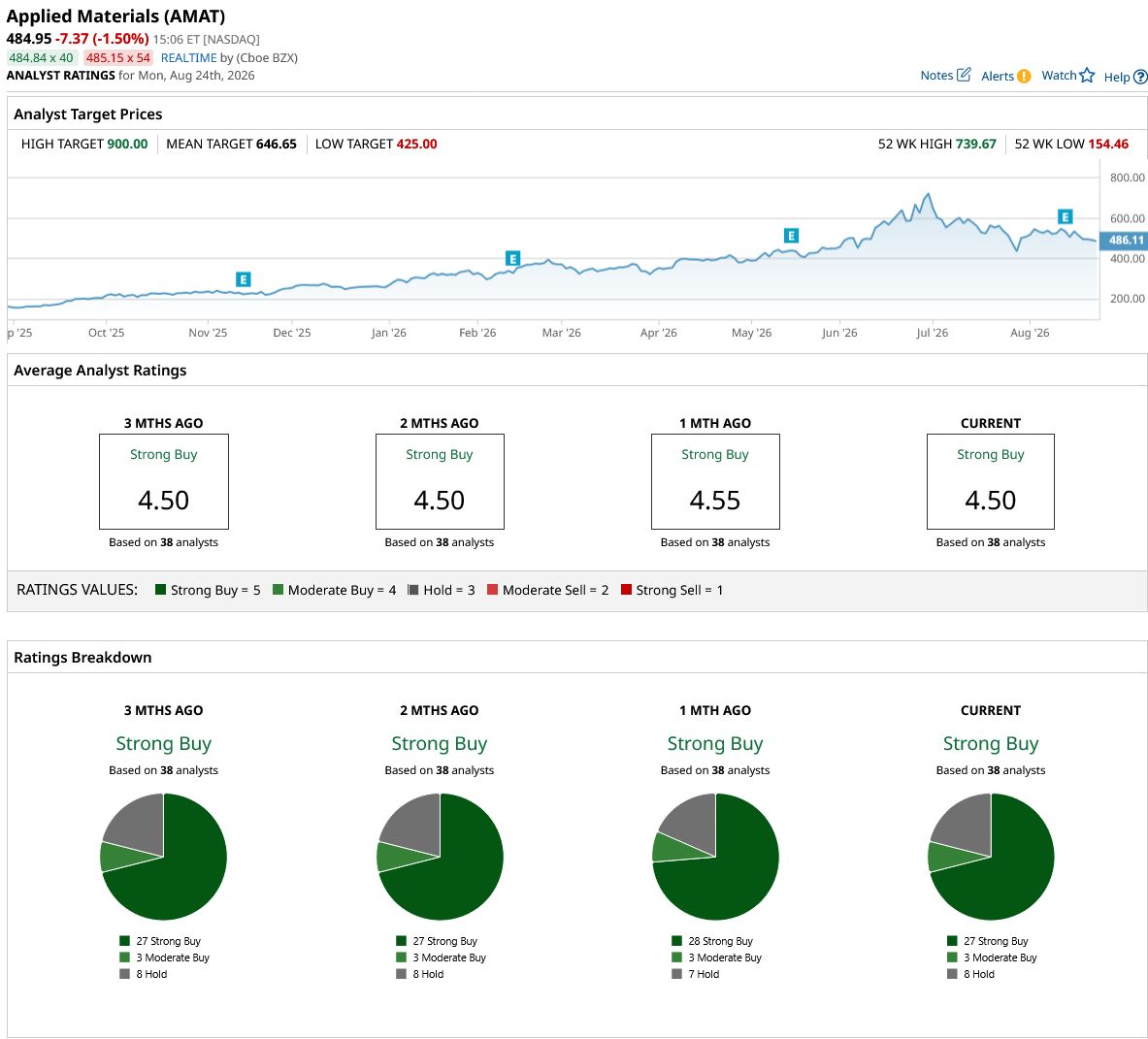
Analysts remain optimistic, with a “Strong Buy” consensus rating on AMAT stock.
 www.barchart.com
 On the date of publication, Amit Singh did not have (either directly or indirectly) positions in any of the securities mentioned in this article. All information and data in this article is solely for informational purposes. For more information please view the Barchart Disclosure Policy here.
More news from Barchart
Why Wolfe Research Just Named Nvidia Stock Its Top AI Pick Michael Burry Says He Would Buy Alibaba Stock When It Crashes 50%. You Shouldn’t Wait That Long. Nvidia Scored an H200 Win in China, But These Analysts Warn It May Not Be a Reason to Buy NVDA Stock Applied Materials Drops 34%. Here’s Why You Should Buy the Dip in AMAT Stock.