


Not long ago, dividend stocks were the clear income champions. In July 2016, nearly two-thirds of S&P 500 ($SPX) companies (about 63.4%) offered a higher dividend yield than the 10-year Treasury. That was the peak of a post-financial-crisis era when ultra-low rates made equities the go-to source of cash flow for yield-hungry investors.
Today, that picture has completely flipped. As of late August 2026, fewer than 4% of S&P 500 stocks (16 stocks) yield more than the 10-year Treasury, the lowest share since May 2007.
More Yield, Less Trap: Sign up free to get Barchart’s daily Dividend Investor newsletter straight to your inbox.
Mega-caps like Nvidia (NVDA), Apple (AAPL), and Alphabet (GOOG) (GOOGL) sit among the 118 large companies whose dividends now lag the 10-year Treasury. What was once a reliable edge for dividend stocks has turned into a decisive disadvantage.
So in a market where “risk-free” government paper now out-yields almost every dividend stock, what’s the smartest way for income-focused investors to adapt? Let’s dive in.
How Treasuries Took Back the Yield
The yield reversal began with a sharp change in the bond market. Throughout much of the 2010s and the post-pandemic low-rate period, Treasury yields were too low to satisfy many income investors. The 10-year Treasury yield spent long stretches below 3%, and it fell below 1% during the pandemic-era market shock.
That structure has reversed because Treasury yields have reset much higher while broad-market dividend yields have stayed low. On Aug. 20, the 10-year Treasury yield ($TNX) was about 4.69%, close to the 4.71% level reached two days earlier.
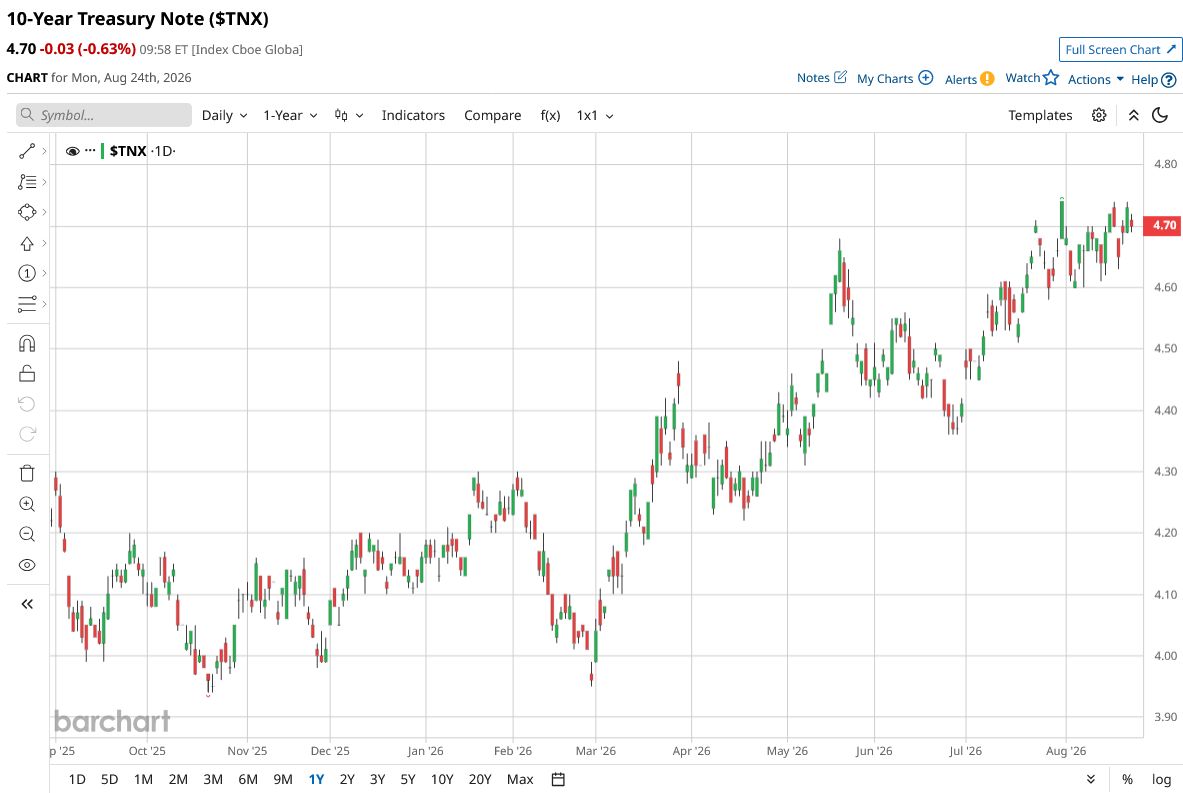 www.barchart.com
 The 30-year Treasury yield had climbed to 5.23%, levels not seen since 2007. By comparison, the State Street SPDR S&P 500 (SPY) has sat near 1%, meaning a 10-year Treasury offered more than four times the income yield available from the broad U.S. equity benchmark.
The rise in long-term yields reflects more than Federal Reserve policy. Investors are demanding a higher return to absorb a growing supply of government debt. U.S. government debt exceeded $40 trillion on Aug. 19, after crossing $39 trillion in April, while Macquarie estimated that roughly $550 billion of Treasury issuance would need to be absorbed during the quarter. In simple terms, larger borrowing needs mean more bonds are coming to market. If demand does not rise by the same amount, Treasury prices fall, and yields rise.
Second, inflation uncertainty has resurfaced. Brent crude rose to $93.78 a barrel on Aug. 20 amid uncertainty around Persian Gulf oil flows. Higher energy prices can filter through transport, manufacturing, and consumer prices, making investors less willing to accept low fixed returns. The Federal Reserve’s preferred inflation gauge was running at 3.7% in June, still well above the central bank’s 2% target.
Treasury Secretary Scott Bessent attempted to ease the pressure by saying the Treasury would at least double longer-term bond buybacks to $4 billion per operation. Yields initially fell but quickly rose again, as buybacks do little to change the broader drivers like persistent deficits, heavy issuance, and inflation uncertainty.
Meanwhile, stock prices have risen faster than aggregate dividend payments, compressing equity yields. Many companies have also favored buybacks, debt reduction, and capital spending over larger dividend increases. The result is a far higher hurdle for dividend stocks.
How Income Investors Can Adapt
The reversal does not require investors to abandon dividend stocks. It requires them to separate two different objectives: securing income now and growing income over time. A 10-year Treasury yielding about 4.69% provides a known stream of interest and repayment of principal at maturity if held to term.
A practical first step is to match bond maturities to expected cash needs. Treasury bills can cover spending expected within a year, while a ladder of notes with staggered maturities can lock in current yields and create regular reinvestment dates.
Investors concerned that inflation could erode fixed coupon income can allocate part of that sleeve to Treasury Inflation-Protected Securities, whose principal adjusts with inflation. Interest on Treasury securities is also exempt from U.S. state and local income taxes, an advantage for investors in taxable accounts in high-tax states.
Investors with long-term horizons should also favor dividend growth over static yield. A lower-yielding company with strong cash generation can raise its payout faster than inflation. Finally, evaluate total shareholder yield (dividends plus net buybacks) rather than dividends in isolation.
The strongest approach is often a barbell of Treasuries or investment-grade bonds for dependable current income, paired with a smaller group of financially durable dividend growers for rising future income and long-term total return potential.
Conclusion
The answer is not to dump dividend stocks for Treasuries. Use Treasuries to lock in dependable income, then keep quality dividend growers for inflation protection and long-term upside. With the 10-year yield near 4.7%, shares may struggle to move sharply higher if yields remain elevated, especially in rate-sensitive sectors. The most likely path is that long-term yields stay relatively elevated while inflation and heavy government borrowing remain concerns. That means selective dividend growers should fare better than broad, yield-chasing strategies, especially with the S&P 500 dividend yield near a record low of 1.04%.
On the date of publication, Ebube Jones did not have (either directly or indirectly) positions in any of the securities mentioned in this article. All information and data in this article is solely for informational purposes. For more information please view the Barchart Disclosure Policy here.
More news from Barchart
Treasuries Have Reclaimed the Yield Crown From Dividend Stocks. Here’s How Income Investors Can Adapt. Nvidia Scored an H200 Win in China, But These Analysts Warn It May Not Be a Reason to Buy NVDA Stock New Layoffs Just Hit Apple’s Vision Pro Staff. What That Means for AAPL Stock. Better Than Nvidia: 3 AI Dividend Stocks Leaving It in the Dust