

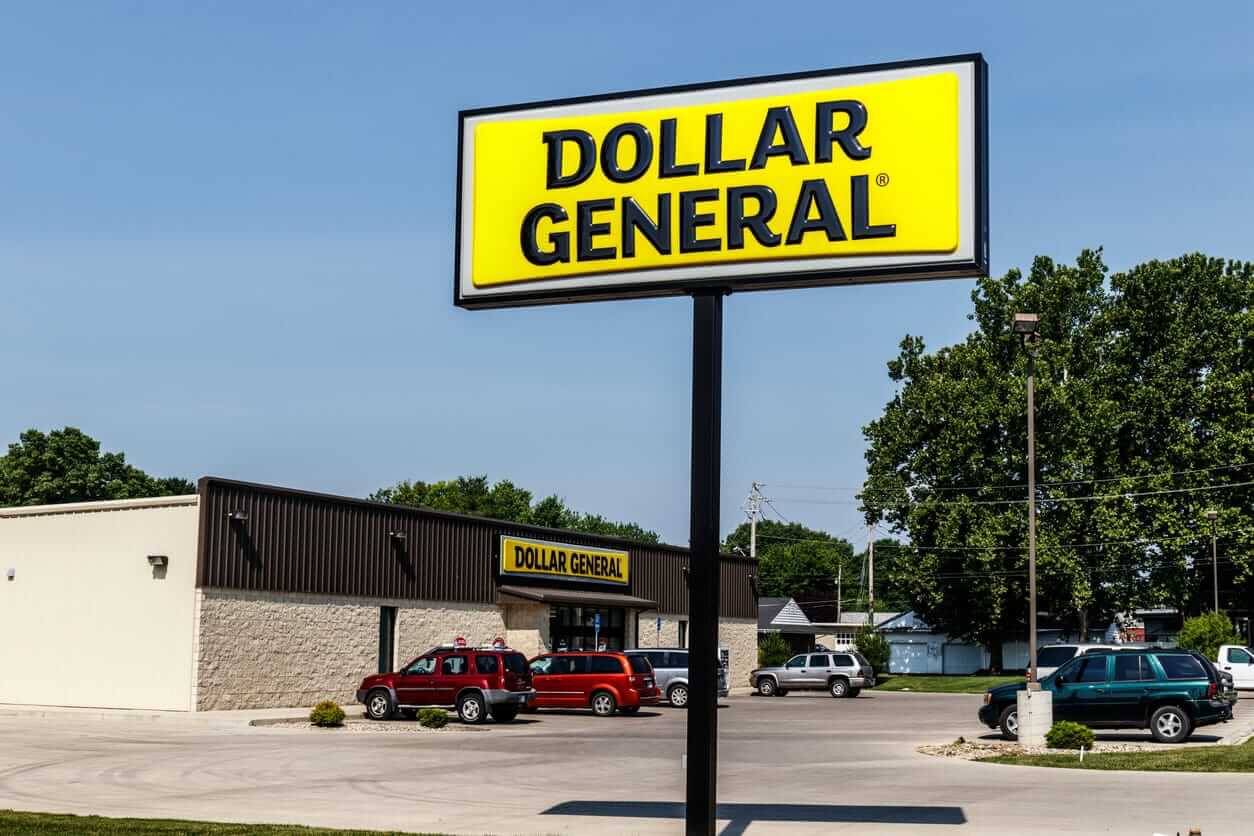
The largest discount retailer in the United States, Dollar General (DG), will be posting its results for the second quarter on Thursday, Aug. 27. Shares of the company have been under pressure this year, and investors would be expecting the results to provide a boost to its fortunes.
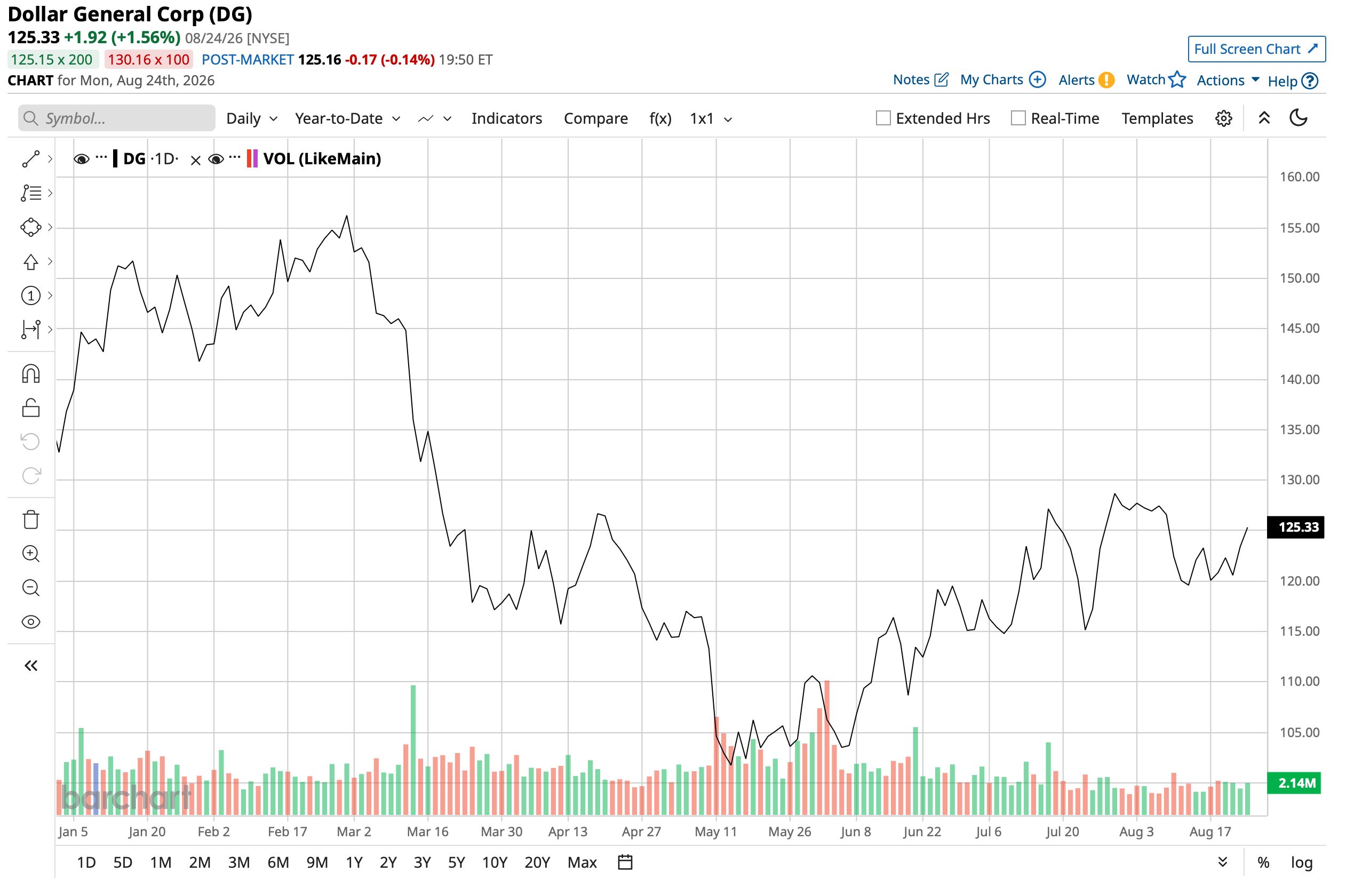
DG stock is up about 19% since its Q1 earnings.
More Yield, Less Trap: Sign up free to get Barchart’s daily Dividend Investor newsletter straight to your inbox.
About Dollar General
Founded in 1939, Dollar General is the largest U.S. discount retailer and, by store count, the largest discount retailer in the United States. As of May 1, 2026, it operated 21,055 stores across 48 U.S. states and Mexico. Its core proposition is offering customers their daily essentials at low prices in convenient locations.
Dollar General's market cap has increased by 31.6% in the past 10 years, with its current market cap being $27.2 billion. Notably, the stock is down 7% on a year-to-date (YTD) basis, offering a dividend yield of 1.96%. The company has a payout ratio of 33.4%, leaving scope for growth in dividends.
Dollar General can be considered to be a safe stock in the current inflationary environment. Yet, does it warrant an investment? Let's analyze.
 www.barchart.com
 A Look Back
Dollar General's performance over the past decade does not inspire much confidence at first glance. The past 10 years have seen the company's revenue and earnings rising at CAGRs of 7.60% and 2.63%, respectively. However, along with a dividend payout, one can argue that a stock like DG is serving its role in an investor's portfolio to the T. It is a relatively non-volatile, defensive exposure to a large section of the U.S. consumer, apt for investors who want a detox from the heady names of the AI and the wider tech industry.
Moreover, Q1 2026 saw Dollar General reporting growth on both the topline and bottom line, although the former missed Street expectations.
Net sales increased by 3.4% on a year-over-year (YoY) basis to $10.8 billion, with a rise in same-store sales by 2%. The upward movement in same-store sales was driven by positive developments such as an increase in customer traffic and average transaction amount. Gross margins improved too, albeit slightly, to 31.6% from 30% in the year-ago period.
Meanwhile, earnings per share rose to $2 from $1.78 in the prior year. Notably, this was the sixth consecutive quarter of earnings beats from the company.
For the full year of 2026, Dollar General expects net sales growth of 3.7%-4.2% and same-store sales growth of 2.2%-2.7%. Encouragingly, the company raised its earnings guidance for the year to $7.20 to $7.45 per share, from $7.10 to $7.35 per share earlier.
Operationally, there was a net store addition of 162 in the quarter, taking the ending store count and average selling square footage to 21,055 and 160.73 million square feet, up 2.3% and 2.4%, respectively.
However, net cash from operating activities fell to $716.2 million from $847.2 million in the year-ago period. An increase in merchandise inventory by $308.2 million is the main culprit. This is worrying because, as this indicates, sales are slowing.
Overall, Dollar General ended the quarter with a cash balance of $1.35 billion, lower than its short-term debt levels of $1.68 billion, raising liquidity concerns.
Valuations-wise, DG stock is trading at reasonable levels. While its forward P/E of 16.71 is just above the sector median of 15.29, forward P/S and P/CF of 0.61 and 10.12 are lower than the sector medians of 1.01 and 10.45, respectively.
Competition and Costs Remain Key Risks
Having said that, a key risk that arises for Dollar General is not from its balance sheet. I reckon it is from private labels from the competition. Competitors such as Aldi and Walmart (WMT) have strong private label programs and greater scale in sourcing. Dollar General’s private label strategy is therefore not a unique advantage. It is more of a defensive move to protect the margin in a difficult environment. If private label growth slows or if customers become more selective, Dollar General could find itself with less pricing power and weaker margins than investors currently expect.
Moreover, increased transportation and raw material costs due to geopolitical tensions can slice margins and hurt the bottom line. Rising gas prices have also been negatively affecting the retailer's core customer base, which was highlighted by CEO Todd Vasos in the company's earnings call when he said, "Notably, during the quarter, many of our core customers reporting cutting back on other household expenses, including food purchases, due to rising gas prices. This pressure has been more pronounced on customers in rural communities as they work to minimize trip distance and make trade-offs in their search for everyday affordability and value."
More color on this aspect will be keenly watched by market participants.
Analyst Opinion on DG Stock
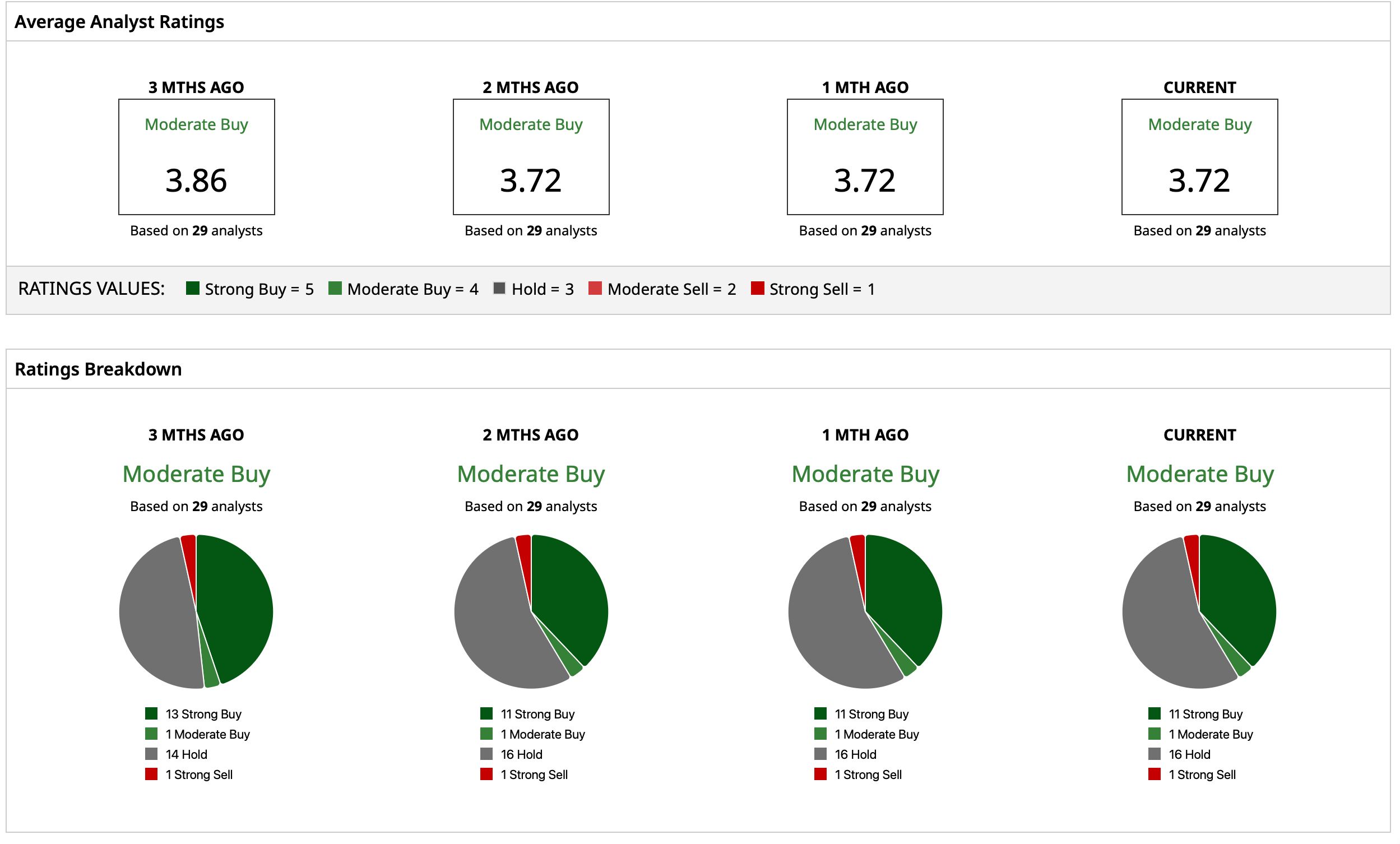
Considering this, analysts remain cautiously optimistic about DG stock, earmarking it a consensus rating of “Moderate Buy.” The mean target price of $133.60 denotes an upside potential of about 7% from current levels. Out of 29 analysts covering the stock, 11 have a “Strong Buy” rating, one has a “Moderate Buy” rating, 16 have a “Hold” rating, and one has a “Strong Sell” rating.
 www.barchart.com
 On the date of publication, Pathikrit Bose did not have (either directly or indirectly) positions in any of the securities mentioned in this article. All information and data in this article is solely for informational purposes. For more information please view the Barchart Disclosure Policy here.
More news from Barchart
Dear Dollar General Stock Fans, Mark Your Calendars for August 27 Dividend Aristocrat or Dividend Cuts: How to Evaluate the NKE Stock Payout as the Nike Turnaround Drags On This Dividend Stock Is Set for Growth and Its Yield Matches the 10-Year Treasury IBM vs. Microsoft: One Has 58% Upside and Nearly 4x the Yield. The Better Buy May Surprise You.