

Oil prices have been all over the place in 2026. Brent crude fell nearly 40% from its year-to-date (YTD) high of $118.35 on March 31 to $71.44 by July 1 after a U.S.-Iran peace deal reopened the Strait of Hormuz. Prices then rebounded more than 16% from that July low after the ceasefire broke down on July 8, helping make energy the best-performing S&P 500 sector ($SPX) during that period.
Shell (SHEL) has used the volatility to reshape its business. The company has sold assets that no longer fit its focus on oil, gas, and LNG, including India’s Sprng Energy for $1.8 billion, Gulf of Mexico stakes for $1.7 billion, and Jiffy Lube International and Premium Velocity Auto for $1.3 billion. It also sold its European onshore renewables portfolio to TotalEnergies SE (TTE) and agreed to acquire Canada’s ARC Resources Ltd. (ARX) in a deal valued at about $13.6 billion.
More Yield, Less Trap: Sign up free to get Barchart’s daily Dividend Investor newsletter straight to your inbox.
Next could be Shell's U.S. chemicals business. The company has reportedly drawn interest from potential buyers, including ExxonMobil Corporation (XOM) and LyondellBasell Industries N.V. (LYB), in a deal that could fetch up to $8 billion.
Is offloading chemicals a smart capital-discipline move that sharpens Shell's focus on its stronger oil, gas, and LNG businesses? Let’s find out.
Shell’s Financial Case for Selling
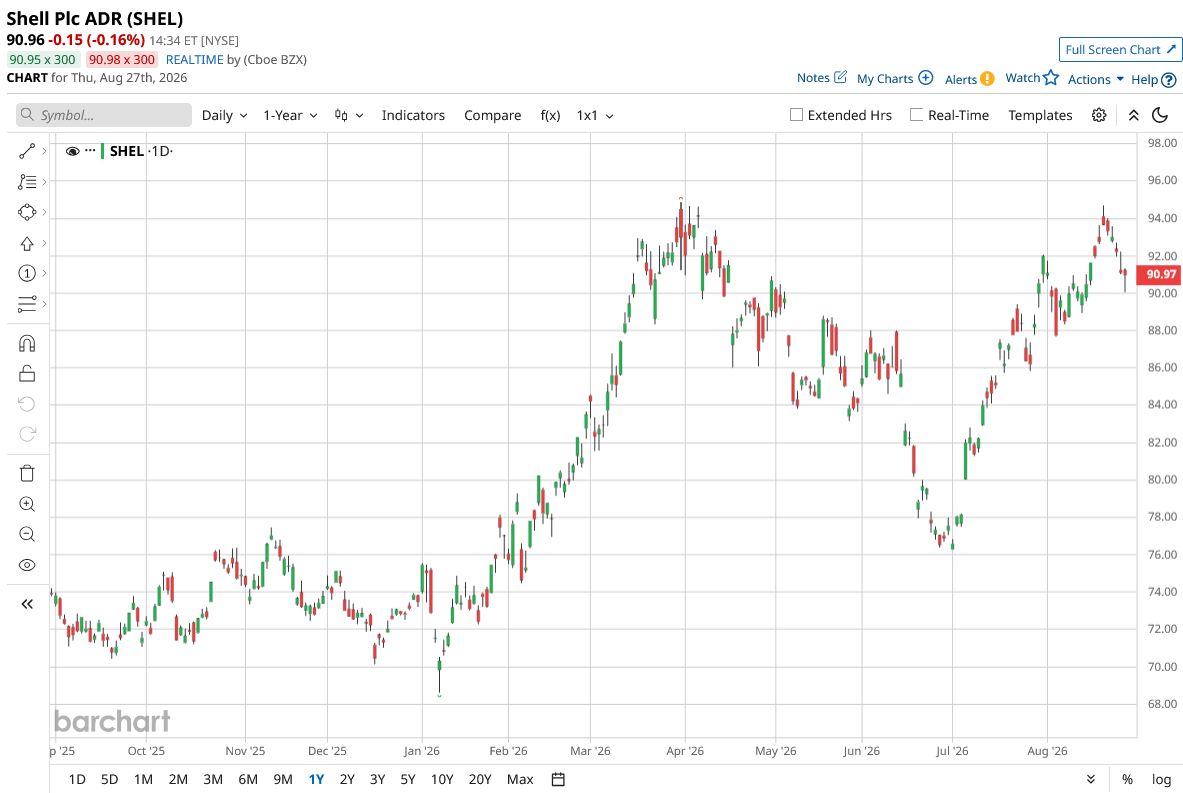
Shell makes money across the energy chain, from oil and gas production to LNG, refining, chemicals, fuel sales, and trading. SHEL stock has gained 22.9% over the past 52 weeks and 23.4% so far this year.
 www.barchart.com
 Yet it still trades at 8.90x forward earnings, below the sector average of 12.69x.
Shell plc also pays shareholders a quarterly dividend. Its annual dividend yield is 3.28%, and the latest ADS dividend was $0.7812 per share, with an Aug. 14 ex-dividend date. That equals $0.3906 per ordinary share. Its forward payout ratio is 33.07%, which gives the company room to invest, pay down debt, and buy back shares. Still, Shell plc has raised its dividend for only two consecutive years.
The company’s Q2 results show why it has room to consider a chemicals sale on its own terms. Adjusted earnings climbed 42% from Q1 to $9.836 billion, while income attributable to shareholders totaled $10.821 billion. Adjusted EBITDA rose 17% to $20.710 billion. Operating cash flow jumped to $21.432 billion from $6.062 billion, helped by a $3.4 billion working-capital inflow, and free cash flow reached $17.5 billion. Capital spending stayed nearly flat at $4.237 billion, while Shell plc kept its 2026 cash-capex forecast at $24 billion to $26 billion, including ARC-related spending. Net debt fell $10.8 billion to $41.8 billion, bringing gearing down to about 19%.
Chemicals Sale Signals Portfolio Discipline
Potential buyers are looking at Shell’s U.S. chemicals business, and investors should see that as part of the company’s effort to sell assets that no longer fit its main priorities. Reports say Exxon Mobil Corporation, LyondellBasell Industries N.V., Apollo Global Management, Inc. (APO), and Kuwait Petroleum Corporation’s chemicals unit made non-binding offers in July for all or part of the business.
The portfolio includes four sites in Louisiana, Texas, and Pennsylvania that make chemicals used in plastics, detergents, and pharmaceuticals. Its Monaca site alone can produce 1.6 million tonnes of polymers a year. The assets could sell for up to $8 billion, though that is far below what Shell plc has invested over time.
This fits Shell’s broader strategy of pruning non-core holdings to fund higher-return growth. Its pending $16.4 billion purchase of ARC Resources Ltd. would add about 370,000 barrels of oil equivalent per day from Canada’s Montney basin and support 4% yearly production growth through 2030. ARC Resources shareholders approved the deal, which is expected to close in H2 2026 after Investment Canada Act clearance. Shell plc expects it to add to free cash flow per share from 2027.
The company is also growing its LNG business through a deal with Metlen Energy & Metals S.A. (MTLN.L.EB), moving ahead with deepwater projects in Nigeria, and returning cash to shareholders. It has completed a $3.5 billion buyback, started another $3 billion program, and sold Jiffy Lube for $1.3 billion.
Analysts Weigh the Strategic Trade-Off
Shell is set to report Q3 results on Oct. 29. Analysts expect earnings of $2.72 per share for the September quarter, up 46.24% from $1.86 a year ago. For all of 2026, Wall Street expects Shell to earn $10.36 per share, a 64.44% increase from $6.30 in 2025.
Analyst views are mostly positive, though not everyone is equally bullish. Scotiabank’s Betty Zhang kept her “Sector Outperform” rating and raised her price target to $122 from $91. Jefferies analyst Mark Wilson also maintained a “Buy” rating and increased his target to $122.40 from $119.70. Wells Fargo’s Sam Margolin was more cautious after Shell’s Q2 report. On July 31, he maintained an “Equal-Weight” rating, though he still raised his target to $105 from $100.
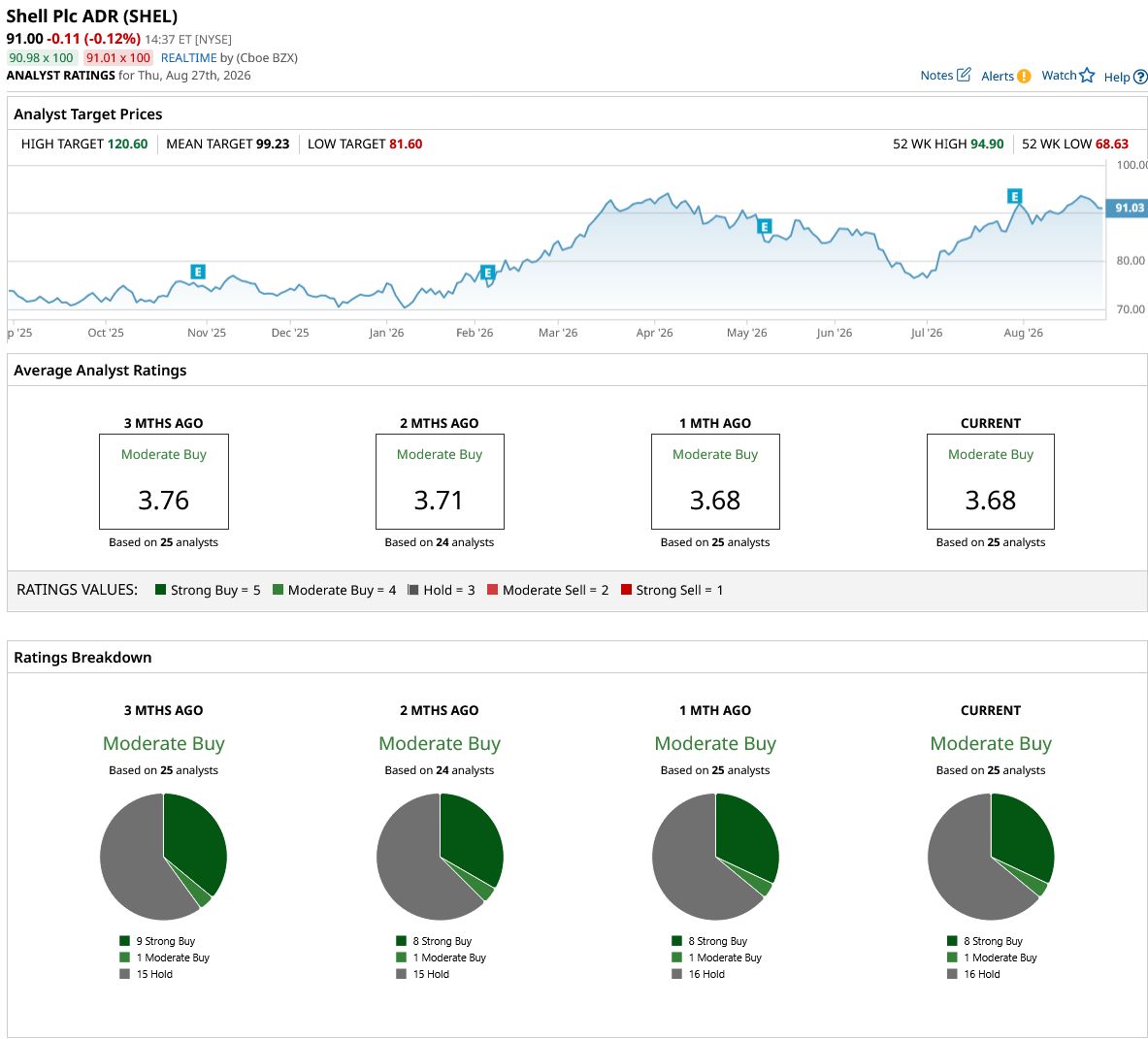
Overall, all 25 analysts surveyed rate SHEL stock a consensus “Moderate Buy,” with an average price target of $99.23. That points to about 9% upside from current levels.
 www.barchart.com
 Conclusion
A chemicals sale looks like a sensible move for Shell if management can secure a price that reflects the assets’ strategic value and direct the proceeds toward higher-return gas, LNG, and upstream opportunities; debt reduction; or shareholder returns. Reported bidder interest gives Shell negotiating leverage, but investors should remain focused on the final valuation, especially since an $8 billion deal would reportedly be well below Shell’s cumulative investment in the facilities. Given Shell’s strong cash flow, lower debt, and growth from ARC, shares appear more likely to trend higher over time, although oil prices and deal execution could keep the path uneven.
On the date of publication, Ebube Jones did not have (either directly or indirectly) positions in any of the securities mentioned in this article. All information and data in this article is solely for informational purposes. For more information please view the Barchart Disclosure Policy here.
More news from Barchart
Potential Bidders Are Looking at Shell’s Chemical Assets. How Investors Should View a Potential Sale. Seagate vs. Western Digital: Which One is The Best AI Storage Play for Dividend Investors? Trump Made Big Trades in This Dividend Growth ETF. You Probably Shouldn’t. Dear Dollar General Stock Fans, Mark Your Calendars for August 27