

The Kroger Co. (KR) is one of the largest U.S. grocery retailers, operating more than 2,700 supermarkets, 1,700 fuel centers, 2,270 pharmacies, and 32 food manufacturing facilities. The company sells groceries, pharmacy products, fuel, and private-label brands while providing affordable food and healthcare services across the United States. Based in Cincinnati, Ohio, Kroger has a market capitalization of approximately $34.8 billion.
Companies valued between $10 billion and $200 billion are generally classified as “large-cap stocks,” and Kroger comfortably fits this category. Its substantial market capitalization reflects its size, influence, and established position within the grocery store industry. Kroger’s strength lies in its scale and ability to serve diverse customer segments. Its procurement power, improving e-commerce profitability, loyal customer base, and experienced new leadership provide opportunities for stronger execution. A long track record of dividend growth also adds appeal for income-focused investors.
More Top Stocks Daily: Go behind Wall Street’s hottest headlines with Barchart’s Active Investor newsletter.
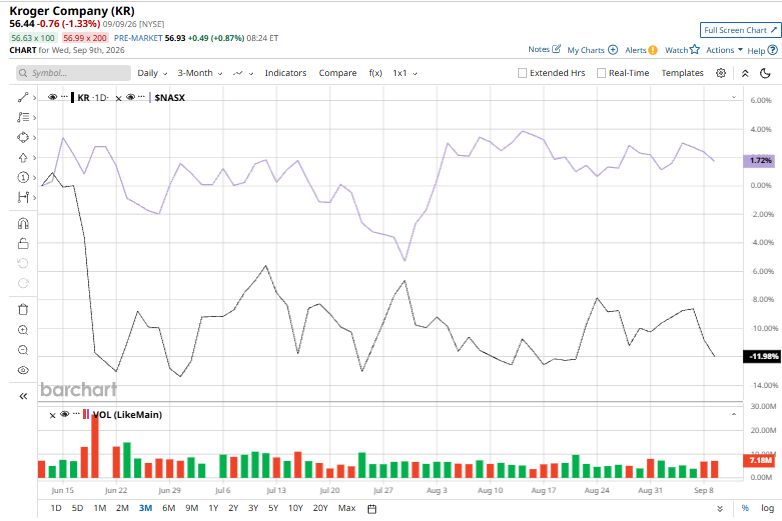
However, KR has slipped 26.3% from its 52-week high of $76.58, reached on March 12, 2026. Over the past three months, KR shares have dipped 10.4%, underperforming the Nasdaq Composite ($NASX), which has gained 2.2% over the same period.
 www.barchart.com
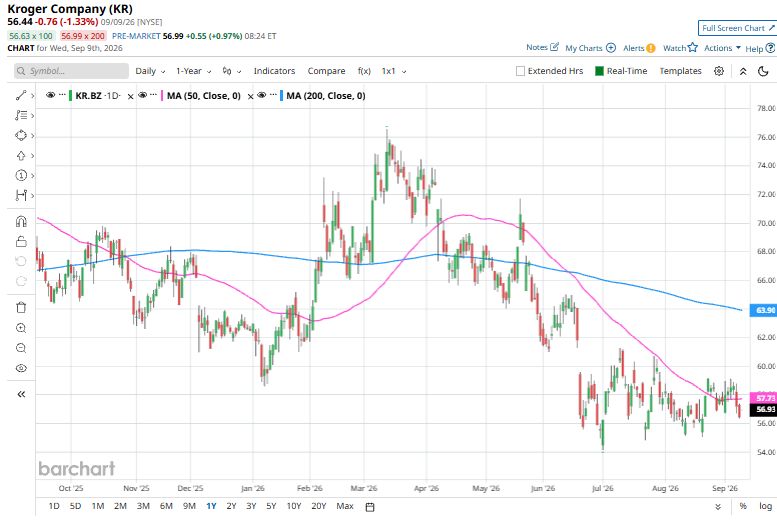
Shares of KR have declined 9.7% year-to-date and 16.6% over the past 52 weeks, significantly underperforming the Nasdaq Composite’s 13% year-to-date gain and 20% return over the same period.
KR has remained below its 50-day moving average since early April and its 200-day moving average since late May, indicating downward momentum.
 www.barchart.com
Kroger’s underperformance over the past year may reflect limited store expansion, weak structural profitability, and declining earnings. The company has kept its store count largely unchanged for two years, while its 23.9% average gross margin suggests limited pricing power. Meanwhile, EPS has declined 20.9% annually over the past three years despite flat revenue, highlighting pressure from its fixed cost base.
However, there are some signs of improvement. KR’s revenue rose 2.2% year over year to $46.12 billion last quarter, while analysts expect 2% growth this quarter. Full-year EPS guidance also slightly exceeded expectations, although the company missed analysts’ gross margin estimates.
Sprouts Farmers Market, Inc. (SFM), one of KR’s key competitors in the grocery retail space, has fared better than KR on a year-to-date basis, declining 8.2%, but has significantly underperformed KR over the past year, falling 46.3%.
Wall Street analysts remain moderately bullish on KR’s prospects. The stock carries a consensus “Moderate Buy” rating from the 21 analysts covering it, while the mean price target of $352.76 implies 35.8% upside from its current price.
On the date of publication, Kritika Sarmah did not have (either directly or indirectly) positions in any of the securities mentioned in this article. All information and data in this article is solely for informational purposes. For more information please view the Barchart Disclosure Policy here.
More news from Barchart
Nvidia CEO Jensen Huang Just Called CrowdStrike Its Top Security Partner. How to Play CRWD Stock Here. Long Straddle Trade Iseas September 10th U.S. Stock Futures Slip as Oil Extends Gains, PPI Data and Oracle Earnings on Tap This High-Yield REIT Just Raised Its Dividend by More Than 6%.