


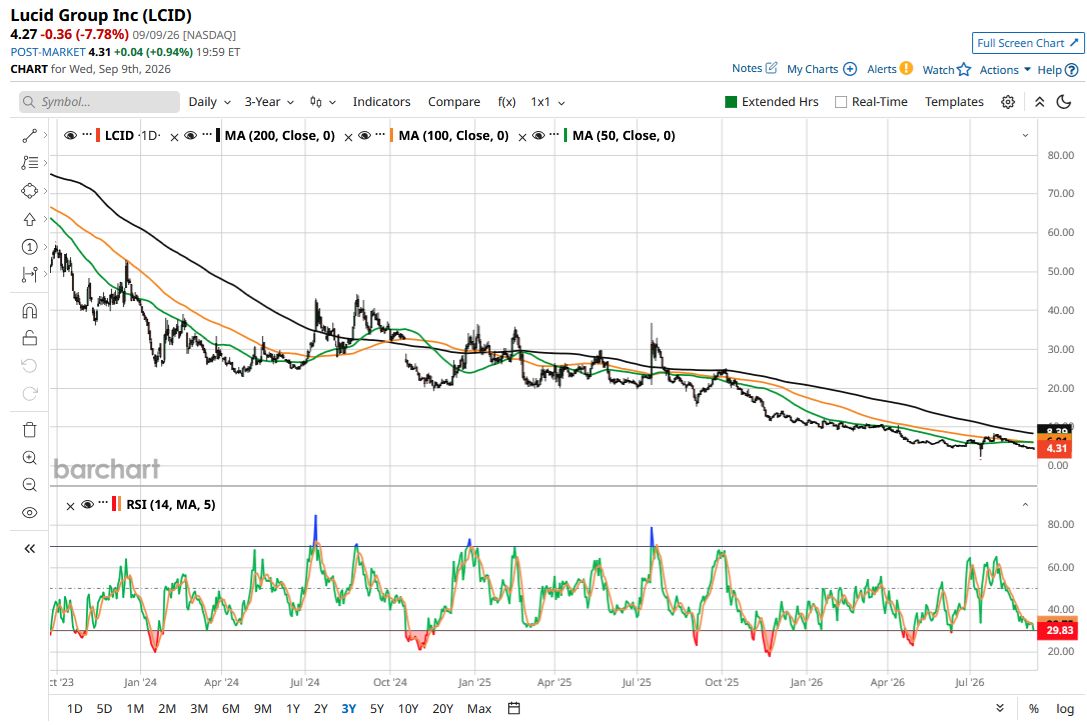
Lucid Group (LCID) stock has whipsawed this year. While it is down nearly 60% for the year, it is up over 80% from the all-time lows that it hit on July 14, amid the bankruptcy rumors. However, the stock couldn’t hold on to the gains following Lucid's denial of those rumors and has shed nearly half of its market capitalization from the late-July highs.
Amid the recent fall, LCID has fallen below $5, which is the SEC’s threshold for penny stocks. This is not the first time the stock has done so, and it has been moving in and out of the category often.
More Top Stocks Daily: Go behind Wall Street’s hottest headlines with Barchart’s Active Investor newsletter.
 www.barchart.com
Lucid Motors Becomes a Penny Stock Again
Incidentally, if not for the 1-for-10 reverse stock split effective Aug. 29, 2025, Lucid would have been a penny stock anyway. It trades at a tiny fraction of its 2021 highs, when it nearly became a $100 billion market-cap company. However, that was a different epoch altogether for the sector, and electric vehicle (EV) stocks are no longer a sought-after asset class. Even U.S. market leader Tesla (TSLA) has positioned itself as an artificial intelligence (AI) play after reporting a decline in EV shipments for two consecutive years. Things have been particularly worrisome for Lucid, and while it has survived the slump unlike many fellow startup EV names that have gone out of business, it hasn’t been able to live up to the faith investors once had in the company. LCID has closed in the red every year since its 2021 listing and now has a market cap of under $2 billion.
Meanwhile, I capitalized on the July rally to exit LCID, and the stock now trades well below the levels where I sold it. In this article, we’ll examine whether LCID is worth the risk now after the recent crash or whether investors are better off staying away from this volatile EV stock.
Why Has Lucid Motors Stock Fallen?
Let’s first analyze why LCID stock has come off its July highs. First and foremost, the stock ran ahead of its fundamentals, and the short squeeze-fueled rally after the brutal crash on bankruptcy rumors wasn’t sustainable. Its Q2 2026 earnings, released in early August, also dampened sentiment, with the company posting a wider-than-expected loss. While the new CEO, Silvio Napoli, said all the right things during the earnings call and admitted to the mistakes the company made, his commentary failed to pass muster with markets.
The recent sell-off in risk assets amid the escalation in the Middle East war hasn’t helped LCID’s cause. Since Saudi Arabia's Public Investment Fund (PIF) is Lucid’s biggest shareholder and has been backing the company through regular equity infusions, the stock tends to be more reactive to geopolitical developments in the region compared to other EV stocks that at least theoretically stand to benefit from rising oil prices, as it could potentially lead to higher EV adoption. Lucid also announced a recall of over 27,000 vehicles in August, its largest ever, further dampened sentiment.
How Do Analysts Rate LCID Stock?
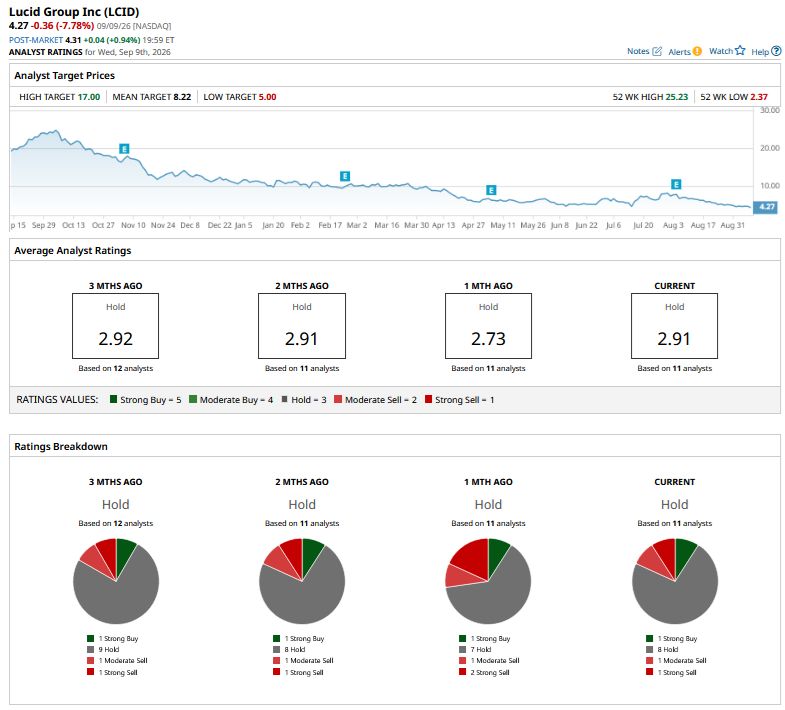
Lucid Motors is not in the best books of sell-side analysts, and brokerages have been lowering its target price. Last month, Citigroup lowered the stock’s target price from $14 to $11 while maintaining its “Buy” rating. It was the second cut in two months from the brokerage, which ironically was the first firm to issue a “Buy” call on LCID in September 2021. Back then, Citi analyst Itay Michaeli set a $28 target price on LCID, which, adjusted for last year’s split, would imply a $280 level. But, as previously discussed, investors and the analyst community had quite different expectations for EV stocks back then.
 www.barchart.com
Is Lucid Stock a Buy Now?
During the Q2 earnings release, Lucid announced an “operational reset” and a transformation plan focusing on “back-to-basics.” Napoli outlined what he said were “must-win projects” for the company. These include a projected $1.4 billion cash flow improvement by year-end, the robotaxi project in collaboration with Nuro and Uber (UBER), the upcoming plant in Saudi Arabia, and the low-cost midsize platform, expected to enter production next year.
From a valuation perspective, while Lucid’s forward price-to-sales multiple might appear attractive at 0.70x, I prefer the enterprise value-to-sales multiple considering the massive debt and convertible notes on its balance sheet. The multiple is 3.13x, which I don't find enticing enough. While the company has the backing of a cash-rich Saudi sovereign fund, it remains a risky bet and a “show-me” story. To make things worse, the operating environment for EV stocks is not expected to improve anytime soon, at least in the U.S. Overall, I would remain on the sidelines in LCID for now and re-enter the stock only when the risk-reward gets more attractive.
On the date of publication, Mohit Oberoi had a position in: TSLA . All information and data in this article is solely for informational purposes. For more information please view the Barchart Disclosure Policy here.
More news from Barchart
Sam Altman Doesn’t Trust Elon Musk’s Cursor, Musk Says He Couldn’t Care Less. Here’s Why He Is Right. How to Play ChargePoint Stock After Its Massive 75% Post-Earnings Surge Crude Oil at $100 Gets All the Attention. Watch These 5 Charts to Track the Energy Market Mechanics Behind the Headlines. Meta Buys Stilla.ai: What the Swedish AI Acquisition Means for META Stock