

International Business Machines (IBM) is building a rather interesting corner of the enterprise artificial intelligence (AI) market. The company has combined its hybrid-cloud expertise with foundation models and deep government and scientific partnerships, while its Prithvi family of open models now spans weather, geospatial, and lunar data.
That gives IBM a credible position in domain-specific AI, particularly where the stakes are too high for generic models to wing it. The latest example is the NASA IBM Lunar Foundation Model, open-sourced on Thursday, Sept. 10, which brings decades of multi-instrument lunar observations into a unified, machine-learning-ready dataset and model.
More Top Stocks Daily: Go behind Wall Street’s hottest headlines with Barchart’s Active Investor newsletter.
More importantly, it outperforms widely used methods by up to 23% in detecting craters, ice deposits, and volcanic features — capabilities that can aid landing-site selection and resource mapping for a sustained Moon presence.
The greater opportunity extends beyond the Moon. By open-sourcing the model, IBM Research can grow its developer ecosystem and open new commercial avenues in geospatial analytics, remote sensing, and government projects. In the long run, this approach could enhance IBM’s reputation for innovation and bolster its positioning in AI infrastructure and hybrid-cloud orchestration markets.
Considering this, let's evaluate if IBM stock provides enough growth potential for investors to consider the journey worthwhile.
About IBM Stock
Headquartered in Armonk, New York, IBM provides integrated technology solutions and services worldwide. Holding a market cap of nearly $226.1 billion, IBM specializes in hybrid cloud, AI, digital transformation, IT infrastructure, and technology consulting, helping organizations modernize applications, manage data, deploy AI solutions, and operate resilient, future-ready technology environments.
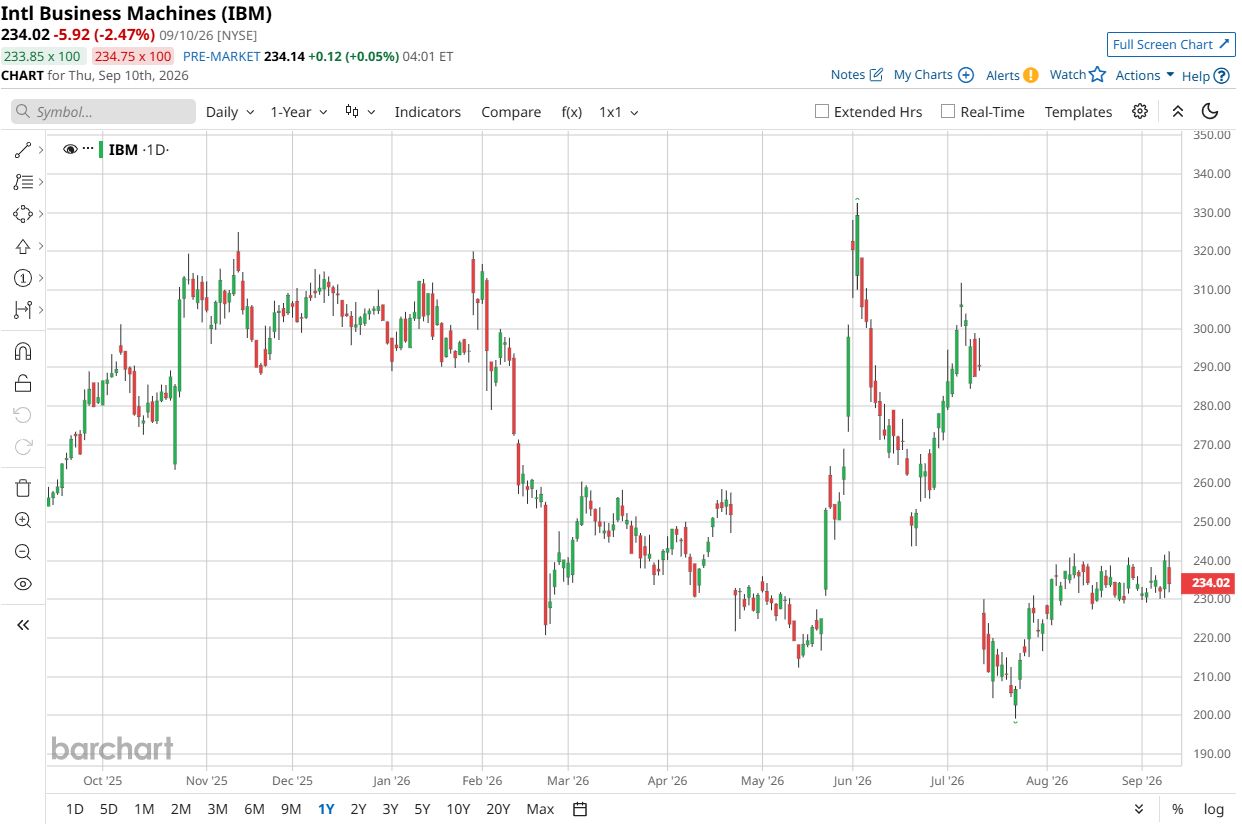
However, IBM stock plunged 8.9% over the past 52 weeks and is down another 21% year-to-date (YTD). The decline has also accelerated recently, with shares down 14.1% over the past three months, largely due to investor concerns about slowing growth, weaker cloud momentum, and uncertainty around IBM’s AI-driven transformation and future earnings prospects.
 www.barchart.com
 From a valuation perspective, IBM stock is trading at 19.47 times forward adjusted earnings and 3.21 times sales. The figures sit below the broader industry average, offering an attractive entry point into the stock.
IBM has grown its dividends for 26 straight years. The company makes an annual payout of $6.76 per share, giving the stock a dividend yield of 2.82%. Its most recent quarterly dividend of $1.69 per share was paid on Thursday, Sept. 10, to shareholders of record as of Monday, August 10.
A Closer Look at IBM’s Q2 Earnings
IBM’s Q2 FY2026 results, reported on July 22, showed total revenue rose 1.1% year-over-year (YOY) to $17.2 billion, but came in below the $17.4 billion analyst estimate. While the top-line miss may raise concerns, the weakness was primarily attributed to a late-quarter shift in client spending priorities rather than a broad deterioration across IBM’s business portfolio.
Software remained the company’s strongest growth engine, with revenue rising 5.1% YOY. Data and Red Hat continued to deliver solid performance, while recurring Software revenue remained healthy. The key weakness came from Transaction Processing, where revenue declined 9% YOY after several large enterprise license agreements were deferred.
Customers redirected spending toward servers, storage, and memory amid supply constraints, delaying transactions that would otherwise have contributed to the quarter. The impact was particularly notable given that approximately 80% of IBM’s Software revenue is recurring, while the postponed deals were concentrated in the more transactional portion of the business.
Infrastructure remained the largest drag on overall performance, with revenue declining 7.4% YOY. However, Distributed Infrastructure provided a meaningful offset, growing 37% YOY on strong demand for Power and Storage. Consulting revenue increased 1% YoY, while GenAI accounted for approximately half of signings, pointing to strengthening demand for AI-led transformation services.
Despite the revenue shortfall, profitability held up well. Operating pre-tax margin expanded 30 basis points, while non-GAAP income from continuing operations increased 5.3% from the last year’s quarter. Moreover, adjusted EPS rose 4.6% from the year-ago value to $2.93, matching analyst estimates of $2.93.
Looking forward, analysts expect Q3 FY2026 EPS to climb 9.4% YOY to $2.90. Full-year FY2026 earnings are projected to rise 6.4% from the previous year to $12.33, followed by another 7.2% increase to $13.22 in FY2027.
What Do Analysts Expect for IBM Stock?
Despite the recent stock price volatility, Matthew Swanson of RBC Capital maintains a “Buy” rating on IBM stock and has set a price target of $270. The view reflects confidence that the company’s recent weakness is primarily related to execution and timing, while IBM’s Software franchise, AI opportunity, and improving cash generation provide a foundation for longer-term earnings growth.
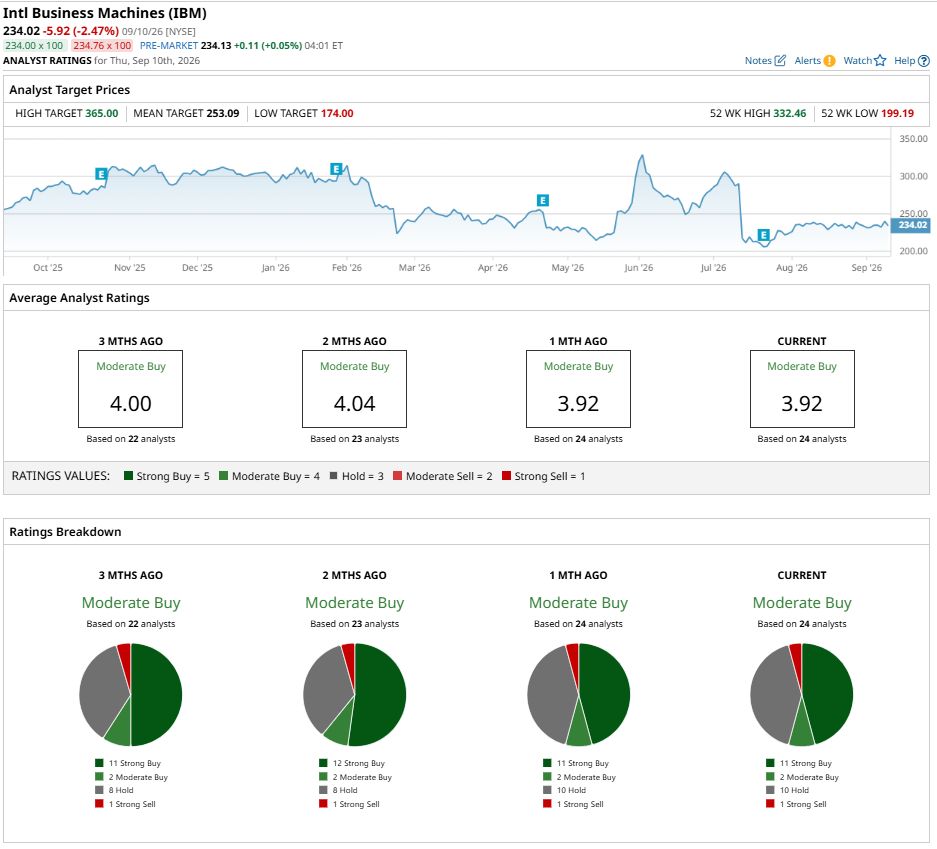
The broader analyst picture is also moderately positive. Analysts have given IBM stock an overall rating of “Moderate Buy.” Of the 24 analysts covering the name, 11 recommend “Strong Buy,” two rate it “Moderate Buy,” 10 advise investors to “Hold,” and one analyst has issued a “Strong Sell” rating.
Price targets tell a similarly optimistic story. The average target price of $253.09 implies an upside of 8.1% from current levels. At the top end, the Street-High target is $365, representing a potential gain of 56%.
 www.barchart.com
 On the date of publication, Aanchal Sugandh did not have (either directly or indirectly) positions in any of the securities mentioned in this article. All information and data in this article is solely for informational purposes. For more information please view the Barchart Disclosure Policy here.
More news from Barchart
How to Play IBM Stock as It Teams Up with NASA to Launch a New Open-Source Model 3 Stocks to Bet Against If You Want to Invest Like Michael Burry You Can’t Spell SPY Without AI: How the Stock Market Became a 1-Way Bet on the Future Dear Nike Stock Fans, Mark Your Calendars for September 21