

Walmart (WMT) recently took another step into restaurant delivery, announcing a national partnership with Inspire Brands that puts it more directly in competition with DoorDash (DASH) and Uber Technologies' (UBER) Uber Eats. But the expansion announced recently is still largely limited to restaurants operating as tenants inside Walmart stores, where the logistics are considerably easier to manage. The bigger question is what happens when the company moves beyond these in-store tenants and takes on the more difficult parts of the restaurant delivery market. Until then, the current expansion says more about Walmart’s ambition than its ability to become a structural competitor to the established players.
Walmart is expanding its restaurant delivery strategy through a new collaboration with Inspire Brands, whose portfolio includes Arby's, Jimmy John's, Dunkin, Baskin-Robbins, and Sonic. The partnership will bring restaurant delivery into Walmart’s app. Dunkin’ will be the first brand to launch, starting with 150 in-store tenant locations. Walmart and Dunkin’ then plan to expand the offering to most of Dunkin’s roughly 10,000 U.S. restaurants, including locations outside Walmart’s stores. The broader opportunity is built around Walmart’s existing physical footprint. A customer could place a restaurant order alongside a Walmart purchase and receive both through the same delivery. The retail giant says its footprint is located within 10 miles of about 90% of the U.S. population.
More Top Stocks Daily: Go behind Wall Street’s hottest headlines with Barchart’s Active Investor newsletter.
A Strategy Built To Fail
Industry analysts point out that delivery from Walmart’s in-store restaurants is economically different from operating a true marketplace delivery business. Mike Danford, co-owner and chief strategy officer at Adverio, highlighted the other part of this expansion by saying:
“Once you leave your own building, the attachment breaks, and you’re essentially running pure delivery economics against DoorDash and Uber Eats, who have already occupied that ground.”
Walmart is currently operating at its strength. However, to scale the same operations, it will start entering Uber and DoorDash territory. That’s when it will start feeling the heat. In my view, this is a strategy not worth chasing, as the weight of this capital-intensive business could drag down the rest of the business for years.
Interestingly, DoorDash is moving in the opposite direction by expanding further into grocery and retail delivery. The company is already showing real gains in margins and delivery density across that overlapping market. That makes the competitive challenge more complicated for Walmart.
Walmart’s extensive footprint and logistics network give it a meaningful advantage. However, the latest announcement does not yet prove that those advantages can translate into the more difficult, margin-sensitive parts of the delivery business.
About Walmart Stock
Walmart runs a global network of hypermarkets, discount stores, and warehouse clubs, alongside a fast-growing e-commerce and delivery business. It has also expanded into higher-margin areas like advertising and its Walmart+ membership, and is now pushing deeper into restaurant delivery. Founded in 1962, it is based in Bentonville, Arkansas, and led by CEO John Furner.
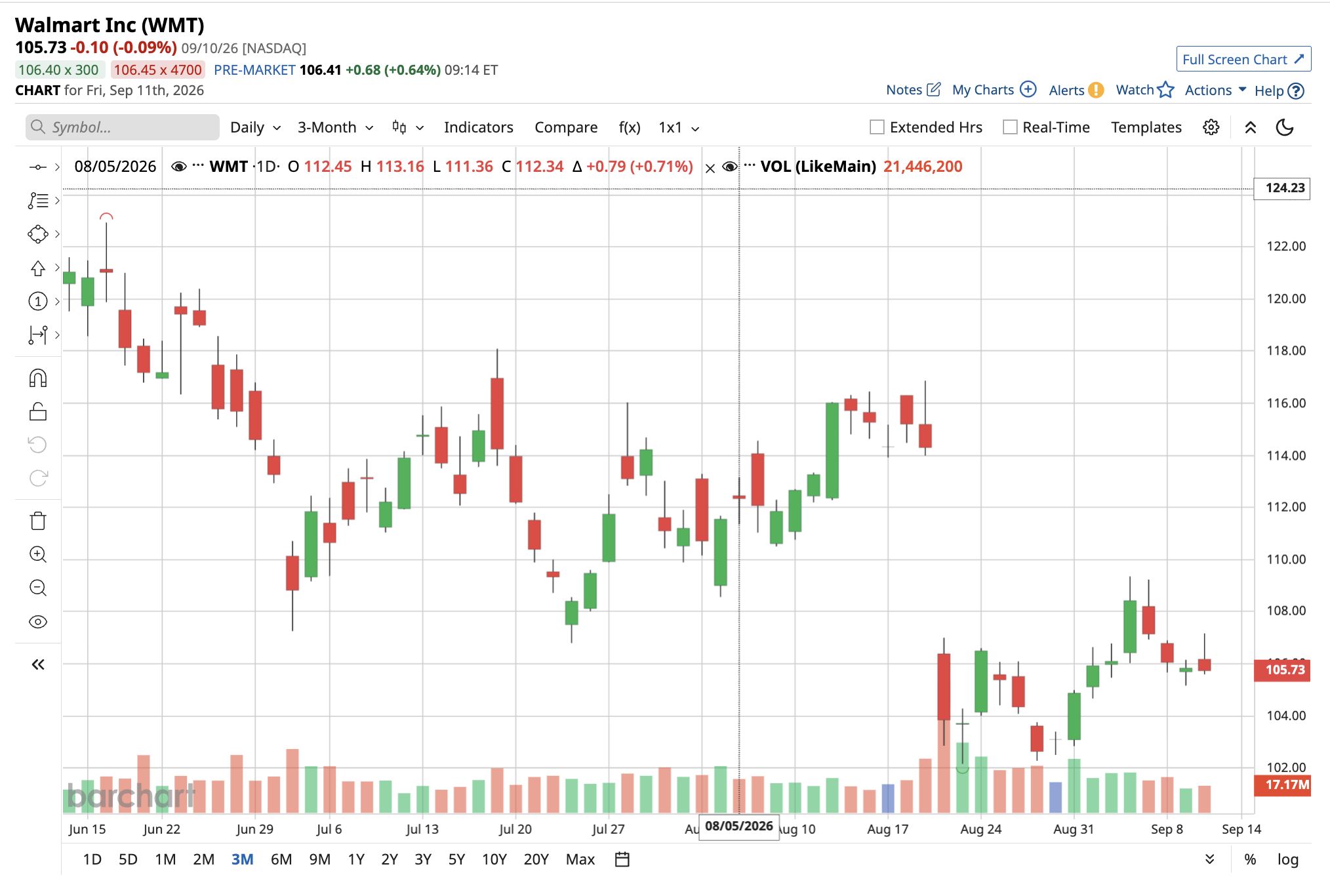
Over the last 12 months, Walmart’s stock has gained just 3%, underperforming the S&P 500’s ($SPX) 15% rise during the same period. Since hitting its all-time high in May, though, the stock has dropped roughly 22%, as weak guidance pulled focus from strong results. The stock now sits much closer to its 52-week low.
 www.barchart.com
Walmart’s Cautious Outlook Rattles Investors
Walmart posted its second-quarter fiscal 2027 earnings on August 20, beating Wall Street on both the top and bottom lines. Revenue of $187.9 billion increased 5.9% year-on-year, ahead of the roughly $186.8 billion expected. Adjusted EPS of $0.81 also jumped 19%, clearing the $0.74 estimate. Global e-commerce grew 23%, with the marketplace up 52% and advertising up 38%. CFO John David Rainey said the business is strong and pointed to tariff refunds Walmart plans to put toward lower prices.
Even with the beat and a raised sales outlook, the stock fell nearly 10% that day. The problem was the full-year adjusted EPS guidance of $2.80 to $2.87, which was below the roughly $2.90 Wall Street wanted. Investors were concerned about slowing U.S. comparable sales. Rainey also warned that shoppers remain stretched thin, especially with fuel costs staying high. The softer profit outlook was enough to overshadow an otherwise solid quarter.
What Are Analysts Saying About Walmart Stock
On Sept. 10, KeyBanc reiterated its Overweight rating on Walmart. The firm remains bullish on the retailer’s market share gains and its momentum in delivery, e-commerce, and advertising. On the same day, Barclays also reiterated its Overweight rating for the stock with a price target of $132.
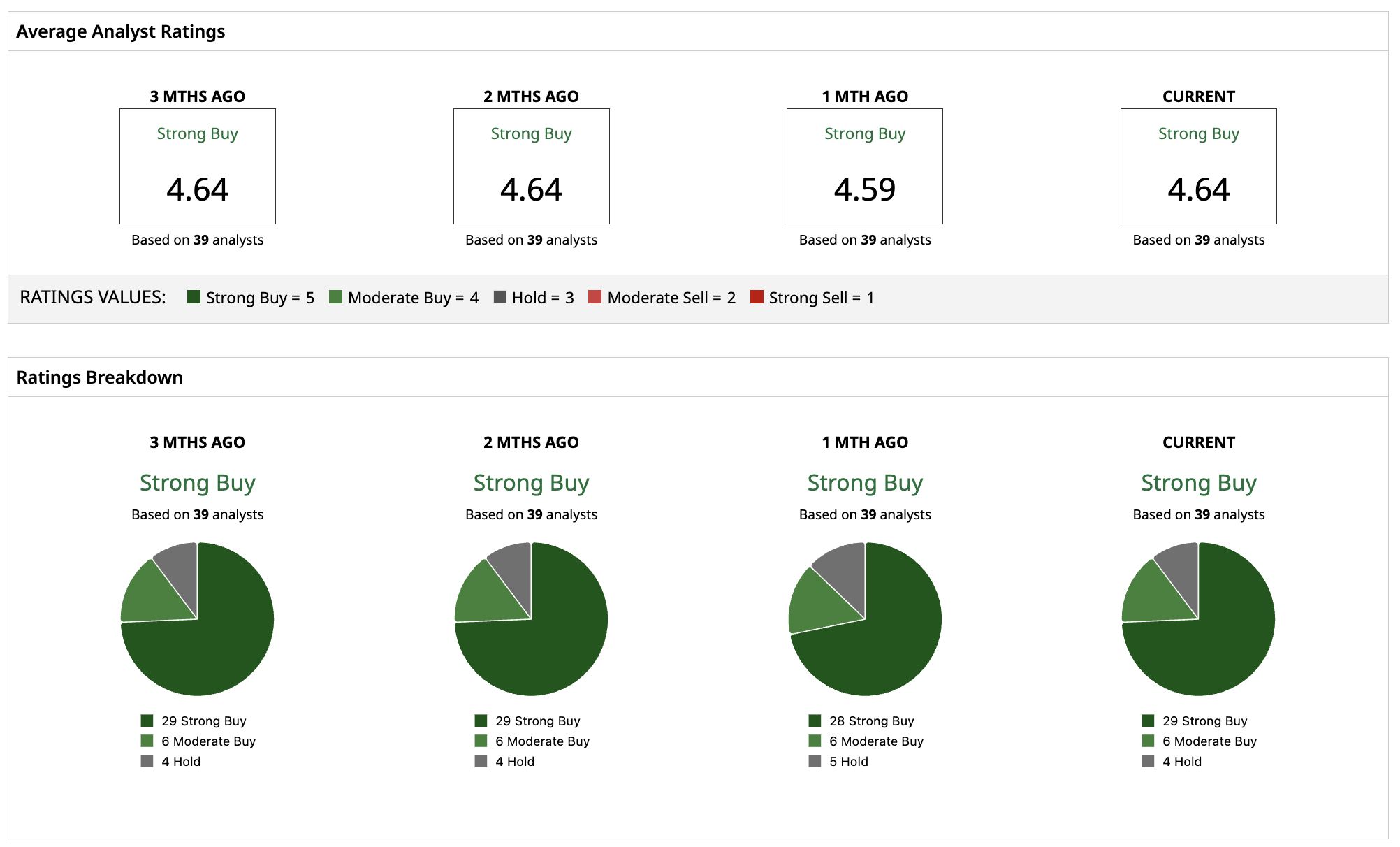
Based on 39 Wall Street analysts, Walmart holds a Strong Buy rating with a mean price target of $127.55, indicating a 21% upside. Out of these 39, not one has rated it a Sell, which reflects that analysts remain largely bullish on a stock that has dropped considerably from its 52-week high.
 www.barchart.com
 On the date of publication, Jabran Kundi did not have (either directly or indirectly) positions in any of the securities mentioned in this article. All information and data in this article is solely for informational purposes. For more information please view the Barchart Disclosure Policy here.
More news from Barchart
Walmart Just Declared War on DoorDash and Uber Eats, But Winning Won't Be Easy for 1 Simple Reason How to Play IBM Stock as It Teams Up with NASA to Launch a New Open-Source Model 3 Stocks to Bet Against If You Want to Invest Like Michael Burry You Can’t Spell SPY Without AI: How the Stock Market Became a 1-Way Bet on the Future