

Restaurant operators are getting a rude reminder that the American consumer may not be quite as “resilient” as some economic forecasts would have us believe.
Stocks across the industry tumbled Tuesday after August foot traffic data showed a 2.4% year-over-year decline for U.S. dining locations. The selling was broad, with names including Bloomin’ Brands (BLMN), Cracker Barrel (CBRL), Brinker International (EAT), Portillo’s (PTLO), and The Cheesecake Factory (CAKE) all under pressure.
Don’t Miss a Day: From crude oil to coffee, sign up free for Barchart’s best-in-class commodity analysis.
The Cheesecake Factory was one of the more notable casualties, with shares falling more than 8% on the day.
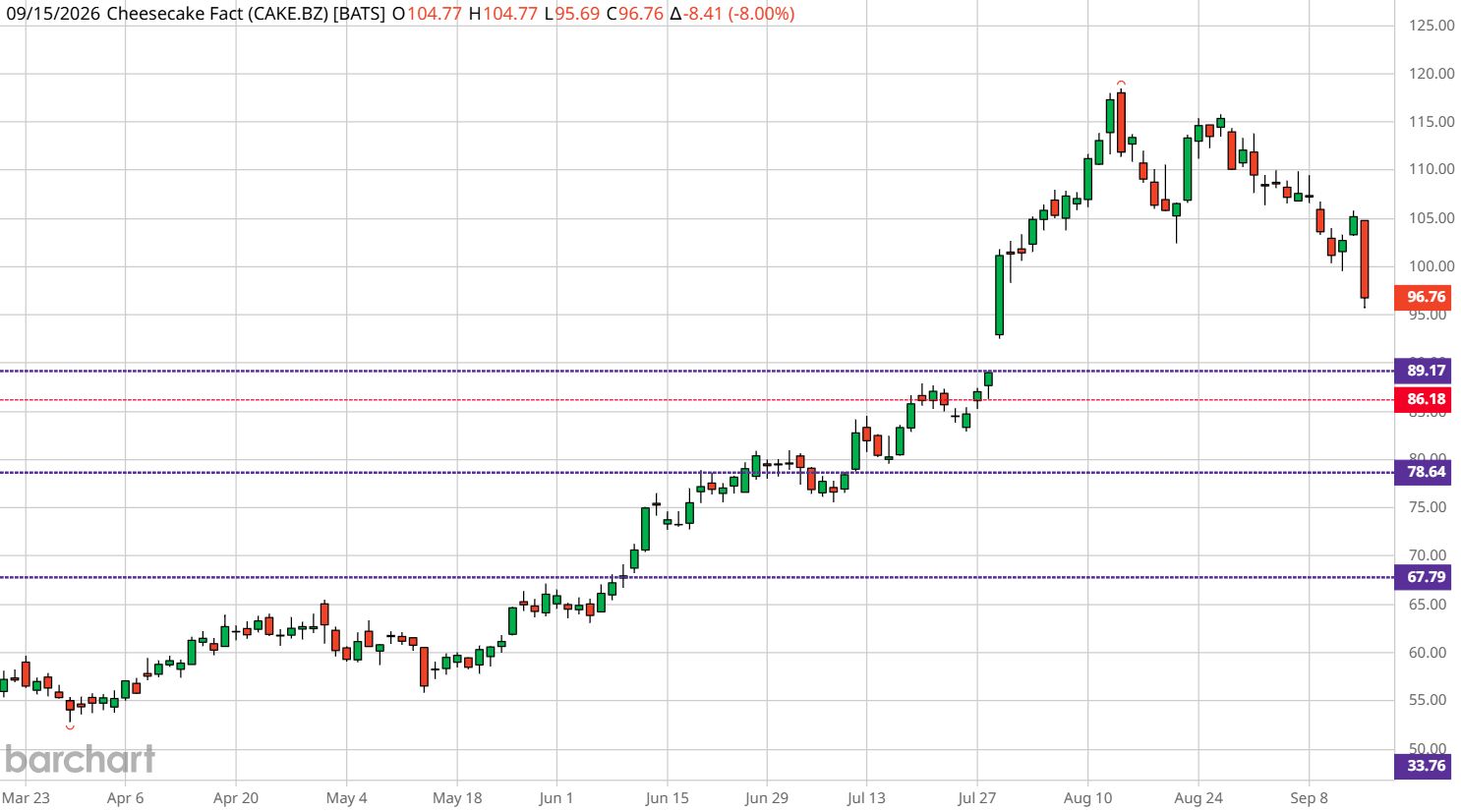 CAKE stock chart.
That reaction is particularly interesting because CAKE had been one of the strongest-performing restaurant stocks this summer, following a second-quarter report that showed 5.8% comparable-sales growth and positive traffic.
In other words, the market may be looking beyond the rearview mirror and questioning whether the recent improvement in restaurant traffic can continue.
Restaurants Fight Against Gas Prices, GLP-1 Meds
There are several forces working against the industry. GLP-1 weight-loss medications are changing eating behavior for a growing number of Americans, with reduced appetites and more modest consumption habits potentially translating into fewer restaurant visits and lower spending per visit.
At the same time, the more traditional economic pressure may be even more important: the cost of simply getting from Point A to Point B has risen sharply.
August gasoline prices increased 3.9% month-over-month, while other motor fuels, including diesel, jumped 9.6% and were up roughly 44% year-over-year. Inflation-adjusted hourly earnings also fell 0.3% year-over-year in August.
That creates a double squeeze for consumers of higher transportation costs on the front end and higher menu prices on the back end. When the household budget gets tighter, an evening out at a restaurant is one of those discretionary expenses that can easily be postponed, reduced, or replaced with a meal at home.
Why Traffic is the Indicator to Watch
From a market perspective, this is why I believe the restaurant group deserves closer scrutiny instead of simply treating Tuesday's selloff as “just another sector rotation.”
Traffic is the key variable to watch here. Restaurants can offset weaker traffic for a while through menu price increases, but there is a limit to how much pricing can compensate for fewer customers walking through the door.
The industry has already demonstrated that dynamic: The Cheesecake Factory's 2025 comparable sales were essentially flat despite a 2.4% increase in average check, because customer traffic declined 2.3%.
If higher energy costs continue to drain disposable income while GLP-1 medications alter eating habits, the restaurant industry could become an increasingly useful barometer of the American consumer. The question for investors at that point isn't whether Americans are still spending; it is where they are choosing to spend their next dollar.
– John Rowland, CMT, is Barchart’s Senior Market Strategist and host of Market on Close.
On the date of publication, Barchart Insights did not have (either directly or indirectly) positions in any of the securities mentioned in this article. All information and data in this article is solely for informational purposes. For more information please view the Barchart Disclosure Policy here.
More news from Barchart
GLP-1s & Gas Prices Are Eating Restaurant Stocks. This Is the Indicator Investors Need to Watch. RKLB Stock Alert: What to Know as Rocket Lab Inches Closer to Iridium Acquisition Palantir and Nvidia Emerge as Key Players in Government AI Modernization This Analyst Just Upgraded Etsy Stock. Here's Why.