


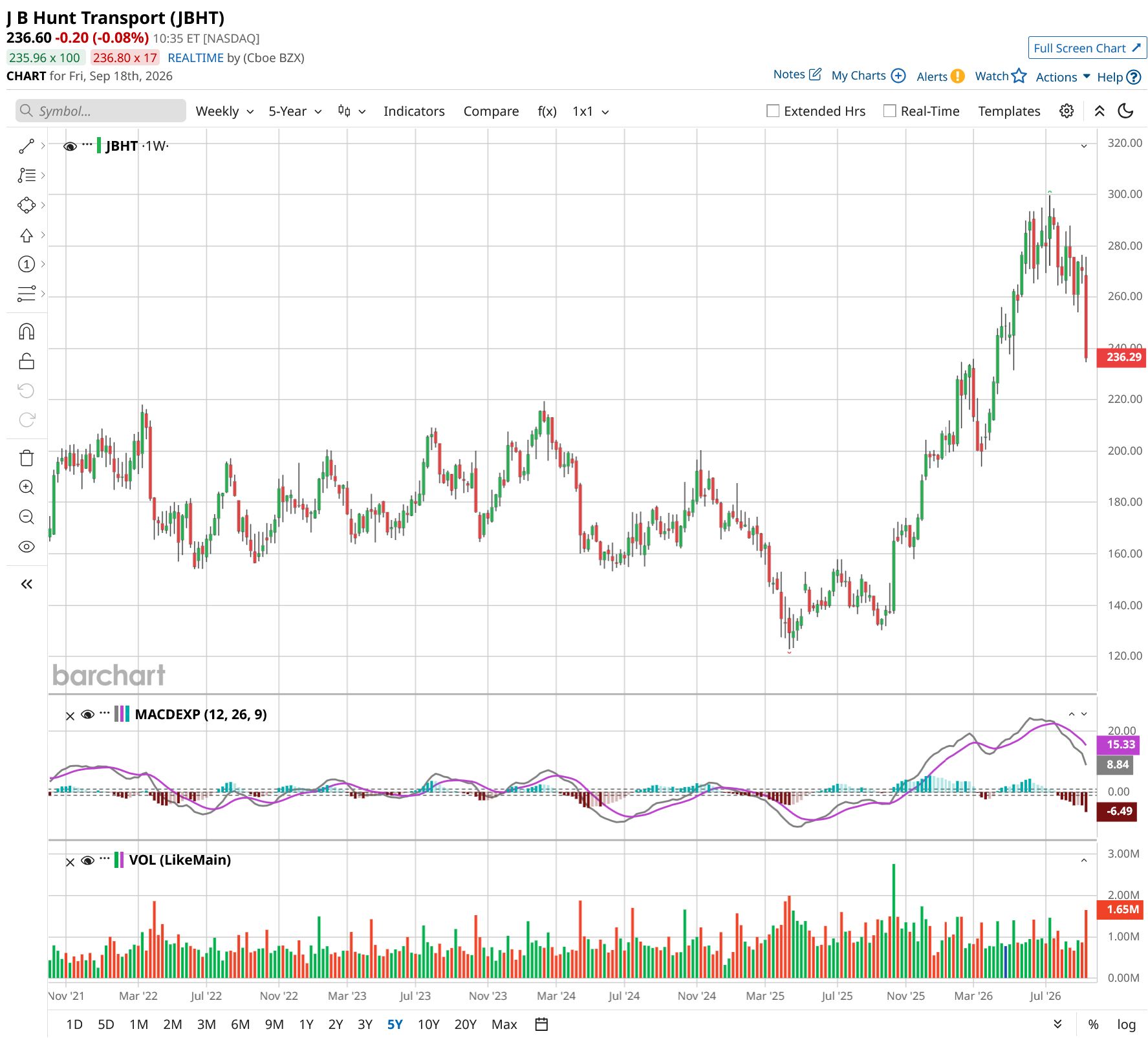
Shares of J.B. Hunt Transport Services (JBHT) tumbled 13% Wednesday, one of the worst single-day drops the trucking giant has seen in years.
The selloff followed JBHT's warning that earnings could fall 5% to 10% this quarter. The warning now leaves JBHT stock 21% below its all-time high, a steep fall for a company that had spent much of the year riding a freight market recovery.
More Top Stocks Daily: Go behind Wall Street’s hottest headlines with Barchart’s Active Investor newsletter.
For a business that just months ago celebrated its best intermodal growth in more than a decade, the sudden gap between steady demand and rising costs caught many investors off guard.
 www.barchart.com
 Why JBHT Stock Price is Under Pressure
J.B. Hunt CFO Brad Delco has spent recent months describing 2026 as an early-stage upcycle for trucking demand. Freight volumes had been rising for the first time since 2023, and J.B. Hunt posted double-digit volume growth across intermodal, its Dedicated contract business, and its brokerage arm, Integrated Capacity Solutions.
Delco explained that spot trucking rates jumped roughly 30% within Q2, an unusually fast and sharp move. At the same time, diesel prices spiked, and Delco noted the industry saw one of the most abnormal and radical swings in fuel costs it has ever experienced.
Add in a driver shortage that Delco called the tightest it has been all year, and J.B. Hunt found itself paying more for drivers, fuel, and insurance well before it could raise prices to match.
J.B. Hunt broke the earnings pressure down into three main cost buckets that will impact the bottom line in Q3.
Driver-related costs, including recruiting, training, and sign-on bonuses, are expected to run about $25 million higher quarter-over-quarter. Fuel is expected to add roughly $10 million more in costs, with the company noting diesel prices are near record highs. Rising insurance and medical claims costs round out the pressure, something Delco said reflects broader healthcare inflation across the country.Together, those costs are the main reason behind the 5% to 10% earnings decline the company flagged for the quarter, according to comments made by company executives at Morgan Stanley's Laguna Conference on Sept. 15.
Importantly, Delco framed it as a timing issue rather than a sign of weaker demand. Intermodal pricing typically lags truckload pricing by about two quarters, meaning J.B. Hunt is absorbing higher costs now while waiting for pricing gains to catch up later.
Why Executives Say the Pain May Be Temporary
J.B. Hunt's leadership team argued the earnings impact reflects a strong freight cycle.
Darren Field, president of the company's intermodal unit, said the value proposition for intermodal shipping is stronger than it has been in over a decade.
High fuel prices and expensive truck capacity are pushing more shippers toward rail-based intermodal service, which the company says is about 65% more fuel-efficient than trucking.
Field also pointed to what he called a record pipeline in the company's Dedicated contract business, along with strong bookings heading into peak shipping season. He described the current cost pressures as cyclical rather than structural, meaning they are tied to this specific point in the freight cycle rather than a permanent shift in the business.
The company is also entering its 2027 bid season, which begins around Oct. 1. Executives said the gap between truckload and intermodal pricing, normally 10% to 15% in the eastern United States and 25% to 30% on transcontinental routes, has widened well beyond that this year.
The gap represents the pricing opportunity the company hopes to capture as it negotiates new contracts.
What It Means for Investors Watching JBHT Stock
For anyone tracking JBHT stock, management's message is clear.
Demand is strong, freight volumes are growing, and the company is gaining market share. But the costs of preparing for that growth, especially driver pay, fuel and insurance, are impacting earnings before the pricing gains show up. Whether the market gives J.B. Hunt credit for that distinction remains to be seen.
For now, the stock's 21% pullback from its highs shows investors are focused on the near-term earnings hit, even as the company insists better pricing is coming once its next bid season plays out.
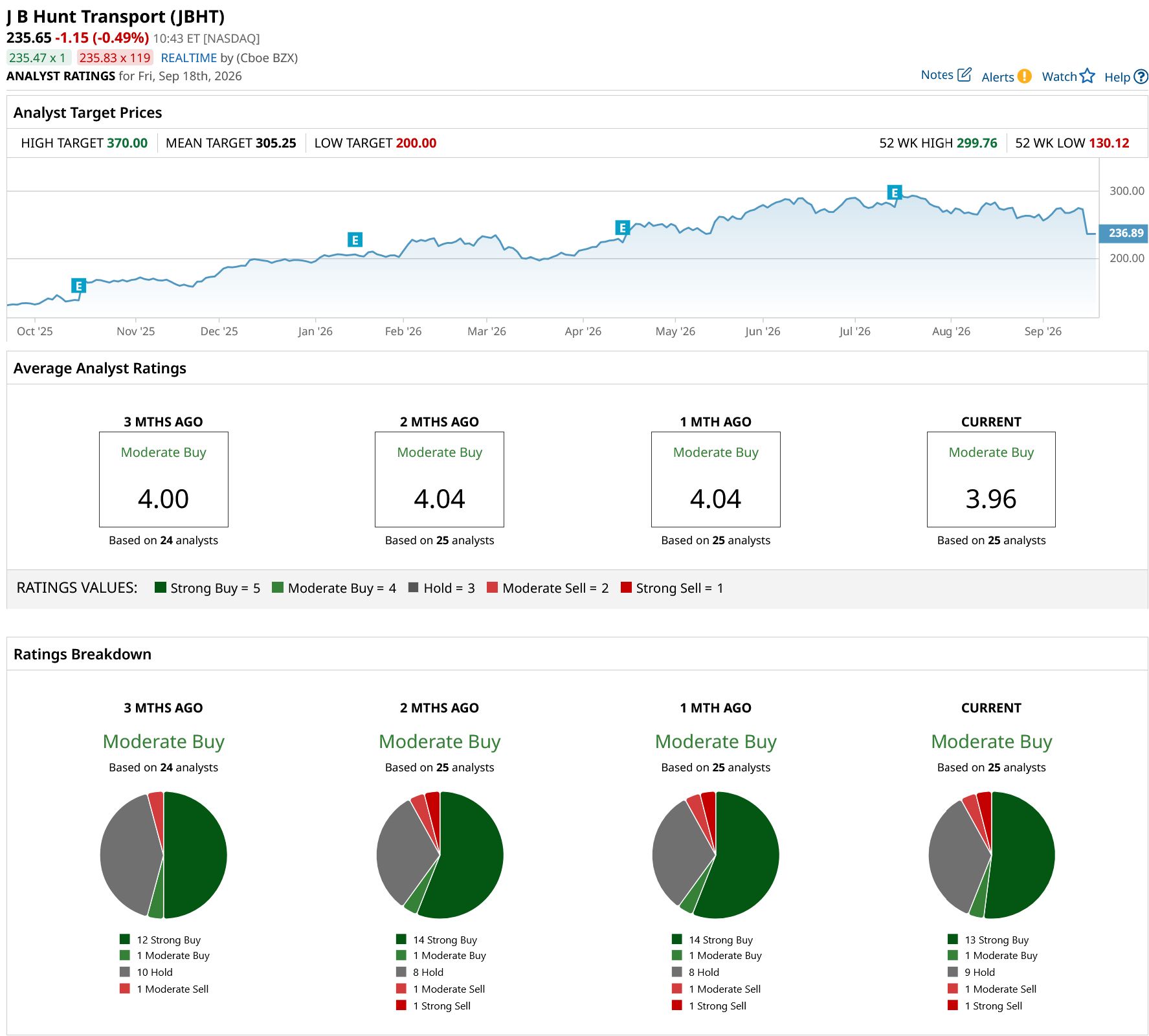
Out of the 25 analysts covering JBHT stock, 13 recommend “Strong Buy,” one recommends “Moderate Buy,” nine recommend “Hold,” one recommends “Moderate Sell,” and one recommends “Strong Sell.”
The average JBHT stock price target is $305.25, above the current price of $235.
 www.barchart.com
 On the date of publication, Aditya Raghunath did not have (either directly or indirectly) positions in any of the securities mentioned in this article. All information and data in this article is solely for informational purposes. For more information please view the Barchart Disclosure Policy here.
More news from Barchart
Down 21% From All-Time Highs, JBHT Stock Warns of Earnings Decline Meta Stock Surges as It Unveils New Personal AI Agent JPMorgan Gives Up Forecasting Iran War Endgame as Trump Tells Reporters ‘Anything Could Happen With Me’ Alphabet Stock Stays Flat - Ideal for GOOGL Short Put and Put Credit Spread Plays