


A long-awaited event is finally in the rearview mirror. ON Semiconductor (ON), also known as onsemi, hosted its 2026 Financial Analyst Day on Sept. 16, giving investors a closer look at how the chipmaker plans to turn artificial intelligence (AI), automotive, and industrial power demand into its next phase of growth.
The event offered plenty of information to digest. Management arrived on the day with bigger 2030 ambitions, raising its long-term revenue growth target and putting AI data centers at the center of the story. The company also outlined opportunities in electrification, physical AI, and a new Embedded Power Platform (EPP) designed to address the increasingly demanding power needs of next-generation infrastructure. At the same time, the company laid out its longer-term margin and cash-flow framework, giving investors a better sense of what that growth could eventually look like on the bottom line.
More Top Stocks Daily: Go behind Wall Street’s hottest headlines with Barchart’s Active Investor newsletter.
Still, the market did not simply take the presentation at face value. ON stock, which had already fallen sharply from its record highs, initially slipped following the event as investors weighed the firm's ambitious targets against execution and margin questions. Shares have since moved higher, adding another twist to an already volatile story.
So, what exactly did ON Semiconductor put on the table, and what do those targets mean for its longer-term growth strategy? Let’s take a closer look.
About ON Semiconductor
Based in Scottsdale, Arizona, ON Semiconductor develops intelligent power and sensing solutions for some of the world’s most demanding applications. The company designs and manufactures analog, standard logic, discrete, and other semiconductor products used across electric vehicles (EVs), AI data centers, industrial equipment, and energy infrastructure.
With a market capitalization of roughly $27.2 billion, onsemi has built a strong position in automotive image sensors for advanced driver-assistance systems (ADAS) and maintains a vertically integrated silicon carbide supply chain. Its products are also supported by long-cycle design wins, particularly in automotive and industrial markets, where customers tend to stay with proven components. The company's “Fab Right” manufacturing strategy focuses capital on areas where it can generate attractive returns while supporting efficiency and margins.
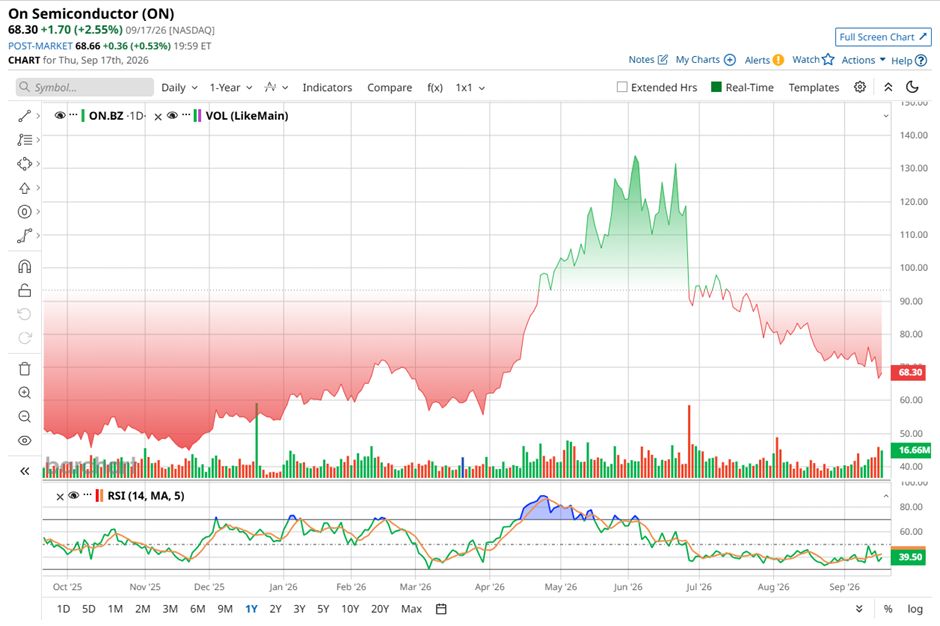
ON stock has had quite the ride this year, and it has been a little less forgiving lately. Shares currently trade near $72, roughly 47% below the 52-week high of $134.92. Over the past three months, ON stock has lost 41%, including a 3% drop over the past month and a sharp 9% slide on Sept. 16.
Zoom out, however, and the picture looks different. ON stock is still up 40% over the past 52 weeks and has gained 32% on a year-to-date (YTD) basis, helped by a cyclical recovery across core markets, rising demand for AI data-center power chips, and stronger financial results.
The recent selloff has a few layers. The $7 billion all-stock Synaptics acquisition sparked dilution and integration concerns, while investors also questioned how quickly the deal and the firm’s AI ambitions could translate into earnings. Then came Financial Analyst Day, where ambitious long-term targets failed to immediately impress the market. Broader semiconductor volatility and higher interest rates added another layer of pressure.
Technically, the 14-day RSI is around 45, suggesting selling pressure has eased from more extreme levels, but the stock is not yet in traditionally oversold territory.
 www.barchart.com
 After the sharp pullback, ON Semiconductor’s valuation is starting to look a little more reasonable. ON stock trades at roughly 21.6 times forward earnings, below the sector average, giving the earnings multiple a more appealing look. The picture is slightly different on sales, though, with the price-to-sales (P/S) ratio of 4.5 times remaining above the sector average. In short, the selloff has taken some heat out of the valuation, but the market is still pricing in meaningful growth.
A Snapshot of ON Semiconductor’s Q2 Report
In August, the company reported second-quarter 2026 revenue of $1.6 billion, up 9% year-over-year (YOY), while adjusted EPS climbed 40% to $0.74. Both figures came in ahead of expectations, giving investors a little more confidence that the semiconductor downturn is gradually easing.
The Power Solutions Group was the standout, with revenue jumping 19% annually and 13% sequentially to $829 million. Demand for power products, particularly those linked to AI data centers, helped drive the improvement. Analog and Mixed Signal revenue slipped 2% YOY to $546 million but edged up 1% sequentially. Intelligent Sensing revenue rose 7% YOY to $229 million, although it declined 3% from the previous quarter.
The broader recovery is also becoming more diversified. Management pointed to improving conditions in China, battery-electric vehicles, automotive applications, energy infrastructure, medical markets, and industrial automation. AI data centers remain an especially important growth engine, with onsemi expecting related revenue to more than double by the end of 2026.
There are encouraging signs on the manufacturing side, too. Factory utilization increased to 83% from 77% in the prior quarter as onsemi ramped production to work through a growing backlog.
The company spent about $34 million on capex, and still generated $425 million in free cash flow, nearly four times the year-ago level. It also returned $332 million to shareholders through share repurchases and finished the quarter with $3.9 billion in cash, equivalents, and short-term investments.
Meanwhile, onsemi continues to add new opportunities. During Q2, it expanded its role in Nvidia's (NVDA) MGX ecosystem by supplying advanced power systems for next-generation AI servers. The company also secured two power-supply platform wins from Great Wall in China. Management expects AI data center-related silicon carbide revenue to rise more than 60% YOY in 2026.
Looking ahead, the company expects Q3 revenue of $1.65 billion to $1.75 billion, while adjusted EPS is projected at $0.81 to $0.93. Newer products, including automotive Ethernet, sensing technologies, and the Treo analog mixed-signal platform are expected to increasingly contribute to growth.
Analysts tracking ON Semiconductor forecast EPS to rise 37% YOY to $3.23 in fiscal 2026, then surge by 39% to $4.50 in fiscal 2027.
ON Semiconductor Lays Out a Bigger 2030 Growth Ambition
ON Semiconductor's management gave investors a detailed look at how it plans to turn years of investment in power and sensing technologies into faster growth through 2030. The company now expects revenue to expand at a 12% to 14% compound annual growth rate (CAGR) through 2030, with revenue reaching roughly $11 billion by the end of the period.
The company expects its AI data-center revenue to more than double in 2026 and double again in 2027, potentially rising from about $500 million in 2026 to more than $2.5 billion by 2030. Management expects this business to grow at least 10 percentage points faster than the broader AI data-center market. Assuming roughly 40% market growth, that would put ON’s AI data-center growth at at least 50% annually. The company also expects semiconductor content per AI rack to climb from about $15,000 to more than $115,000, driven by the industry's shift toward higher-voltage power architectures.
Automotive remains another major growth engine, with ON targeting roughly 9% annual revenue growth through 2030. Industrial revenue is expected to grow around 10% annually through 2030, while emerging physical-AI applications could represent a $6 billion addressable market.
The financial targets are equally ambitious — 53% gross margin, 38% operating margin, and capital intensity of about 5% of revenue by 2030. ON also highlighted its $8.7 billion investment over the past five years, including $3.6 billion in R&D and $4.3 billion in capex.
Perhaps the most notable technology announcement was the EPP, which integrates silicon, silicon carbide, and gallium nitride technologies into a wafer-level architecture. ON says the platform can deliver three to five times higher power density for applications spanning AI infrastructure and EVs.
During the presentation, CEO Hassane El-Khoury said power is now the last major bottleneck to scaling AI data centers, following earlier constraints around compute and memory. El-Khoury explained that solving the issue will require a combination of existing technologies, products, and systems working together to deliver greater power density and efficiency. Management estimates a $213 billion total addressable market (TAM), with much of it tied to power.
What Do Analysts Expect for ON Stock?
Analysts came away from the Financial Analyst Day with a somewhat measured view of ON Semiconductor's longer-term opportunity. Stifel cut its price target for ON stock to $75 from $90 while keeping a “Hold” rating, pointing to uncertainty around the company’s near- to medium-term gross-margin trajectory. UBS kept a “Neutral” rating and $95 price target, saying that ON presented a case for double-digit annual revenue growth while the numbers largely matched its expectations. UBS also noted that investors may have been looking for more from the event. Mizuho was comparatively more confident, maintaining an “Outperform” rating while trimming its target to $95 from $110.
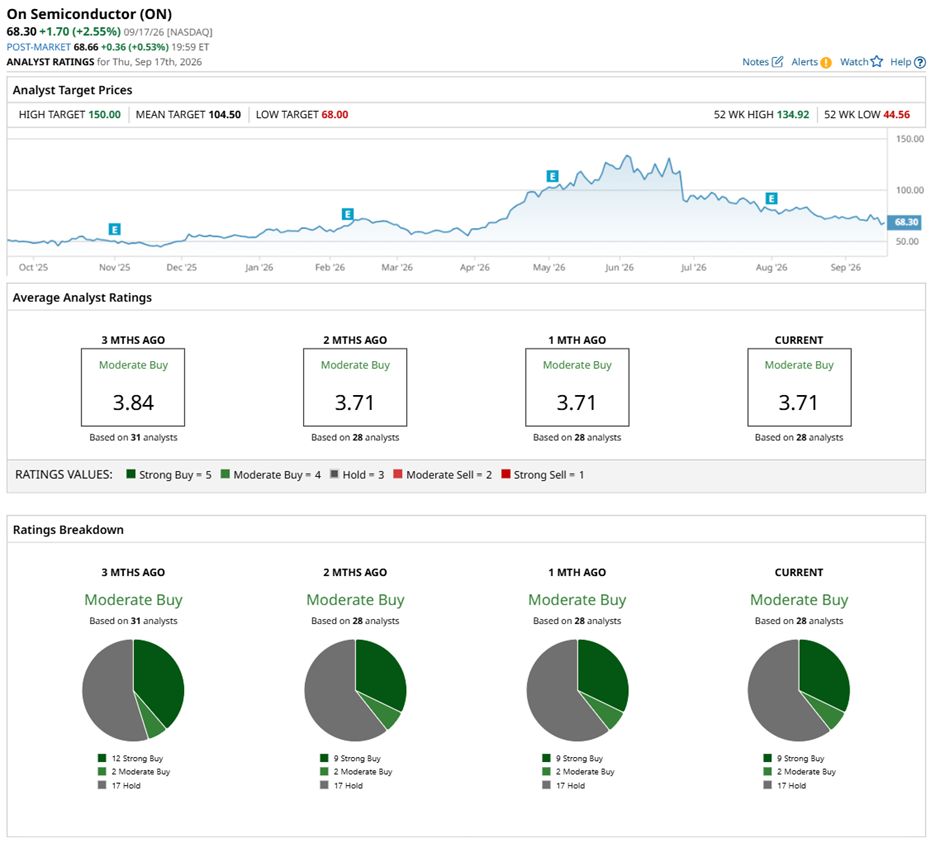
Overall, ON stock has a consensus “Moderate Buy” rating on Wall Street. Out of the 28 analysts with coverage, nine recommend a “Strong Buy,” two advise a “Moderate Buy,” and 17 analysts have a “Hold" rating. The mean price target of $102 suggests potential upside of 42% from current levels, while the Street-high target price of $150 implies the stock could rally as much as 109% from here.
 www.barchart.com
 On the date of publication, Sristi Suman Jayaswal did not have (either directly or indirectly) positions in any of the securities mentioned in this article. All information and data in this article is solely for informational purposes. For more information please view the Barchart Disclosure Policy here.
More news from Barchart
Why Cathie Wood Says SpaceX Stock Could Be a Deep-Value Buy Dear ON Semiconductor Stock Fans, Here’s What You Need to Know About ON’s Financial Analyst Day Netflix Stock Valuations Seem Attractive Amidst Growth Deceleration Concerns Grab Stock Is Worth the Risk as Valuations Fall to Historical Lows