

Meta (META) CEO Mark Zuckerberg may swear by Android, yet that has not stopped the company's recently launched personal AI agent Muse from reaching the No.1 position in Apple's (AAPL) App Store within a week. As concerns around AI safety gather momentum, this development from Muse is noteworthy, as the future of AI may see personal AI agents gaining prominence over general platforms.
Commenting on the development, Meta's Chief AI Officer, Alexander Wang, posting on X (formerly Twitter), said, “A week after launch, Muse is now the #1 app in the App Store! It's been SO exciting to see how much y'all have done with Muse. We can't wait to do more together!” Interestingly, the announcement was made on none of the platforms owned by Meta, but rather on X, a company under Elon Musk, with whom Zuckerberg have not had cordial relations to say the least.
More Top Stocks Daily: Go behind Wall Street’s hottest headlines with Barchart’s Active Investor newsletter.
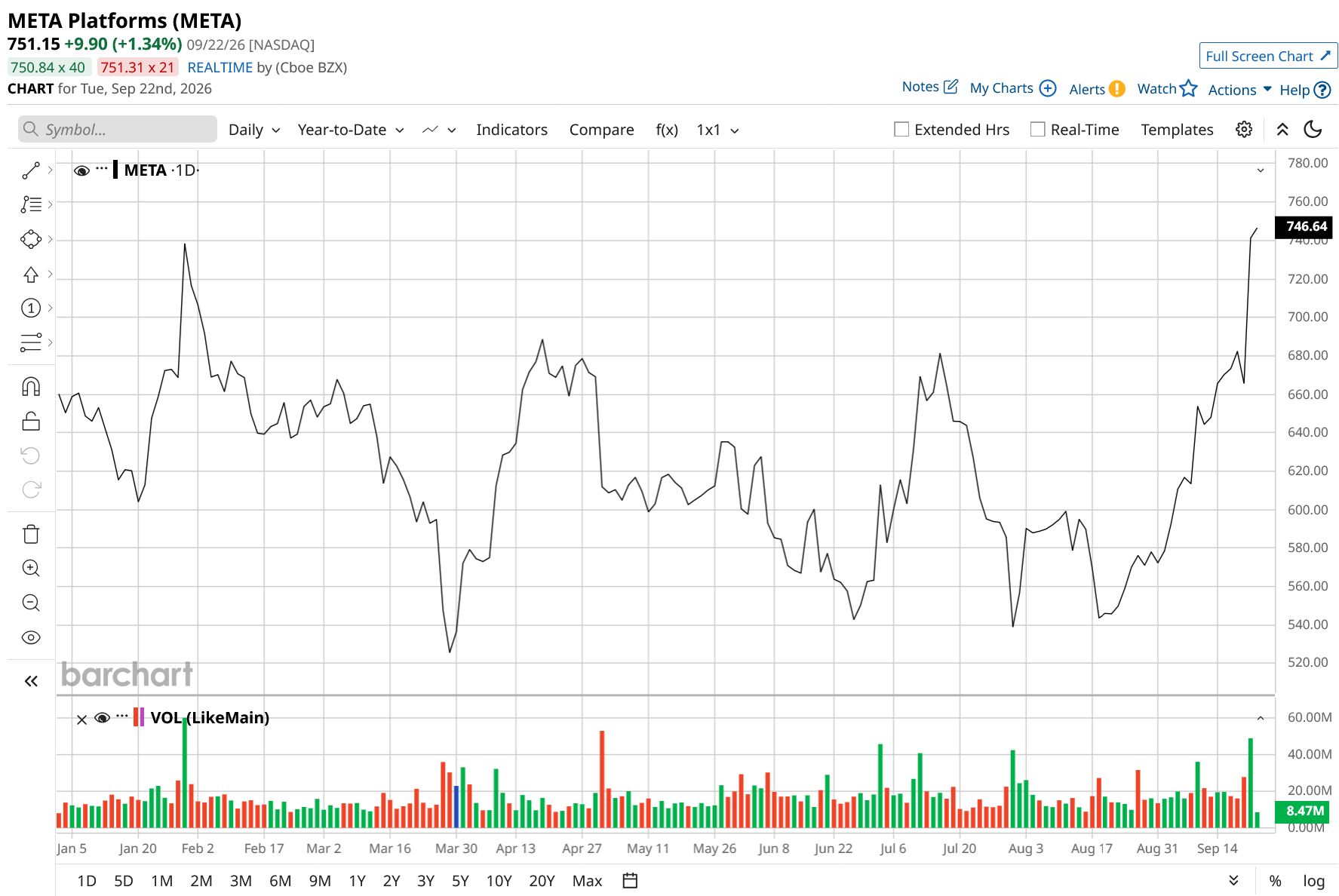
So far at least, Muse seems to have sparked META stock back to life. After an impressive 35% spike in price over the past month, the stock is now up 13% year-to-date (YTD). It is still to be seen if this rally can be sustained, as Meta has remained mired in legal quagmires this year, with the most notable being the $18 billion settlement reached with several states on child safety.
 www.barchart.com
 Musing on Muse
Muse's journey to the zenith in the App Store should be looked at in a larger context. The rapid climb appears to reflect a combination of product design, Meta’s distribution reach, curiosity around agentic software, and strong early visibility.
The central distinction is that Muse is designed to complete tasks rather than simply answer questions. Meta says users can ask it to research a subject, book appointments, fill out forms, purchase products, generate images, create documents, set reminders, monitor information, and connect services such as email, calendars, Instagram, Spotify (SPOT), and OpenTable. It can also continue working after the user closes the application. For example, a user could ask Muse to monitor weather conditions, track a price, or organize a longer personal goal and receive an update when something changes or when approval is required. That persistent workflow is likely more attractive to the mass market than a chatbot that mainly produces text inside a conversation.
In fact, Business Insider reported examples of Muse users saying it helped with things such as shopping and insurance savings, while also noting that the system still has limitations. Particularly for shopping, Muse can search for products, locate discounts, add items to a shopping cart, and complete a purchase after receiving permission. Meta says checkout uses Stripe’s Link service, with a one-time card number designed to conceal the user’s actual payment details. Eligible purchases receive Link purchase protections covering issues such as damaged or lost goods, price reductions, and returns.
Meanwhile, enhanced privacy controls could have also been a point of attraction for users. Meta says Muse operates inside a dedicated virtual machine, while a separate Sentinel system reviews internet access and sensitive actions. Users are asked before emails are sent or purchases are made, can inspect an activity record, and can adjust permissions for each connected service. Meta also says Muse cannot see stored passwords or payment information, does not share conversations with its advertising systems, and allows users to opt out of model training.
Thus, Muse’s early advantage appears to be accessibility, integration with Meta’s consumer ecosystem, persistent background work, and a heightened focus on making shopping easier. Now, sustained adoption will depend on reliability, privacy confidence, and whether Muse consistently completes useful tasks without requiring excessive supervision.
Moreover, reaching No. 1 on Apple's App Store should not be interpreted as Muse overtaking established AI assistants in total users. App Store rankings primarily reflect download momentum, making the milestone more indicative of strong recent adoption than cumulative market share.
Meta's Unlikeable Q2
Meta's latest set of quarterly numbers for Q2 2026 was not liked by the Street. Shares dropped almost 10% post the results as a collapse in free cash, a decrease in operating margins, and a rise in the lower end of the capex guidance all made up a concoction that spooked investors.
However, Q2 2026 saw the company report revenues of $60.8 billion, up 28% from the previous year, as its “Family of Apps” saw a 3% yearly rise in daily active users to 3.60 billion. This is just under half the world population. And despite AI being the primary focus of the company, ad revenues remain vital for the company (97.6% of overall revenues at $59.4 billion), and a 12% year-over-year (YoY) increase in average price per ad would be welcomed.
Meanwhile, earnings slid by 13% from the previous year to $6.18 per share, missing the consensus estimate of $7.40 per share by a wide margin. A 55% increase in costs and expenses to $42.02 billion and an even sharper bump of 82.7% in capital expenditures to $31.08 billion were the contributing factors to the decline in profits. Moreover, Meta raised the lower end of its capex guidance to $130 billion from $125 billion, keeping the upper range unchanged at $145 billion.
Q3 revenue estimates range between $61 and $64 billion, with the Street estimates standing at $63.31 billion.
Coming back to Q2, net cash from operating activities for the quarter came in at $31.9 billion, up from $25.6 billion in the year-ago period. Overall, Meta ended the quarter with a cash balance of $15.5 billion, much higher than its short-term debt levels of $2.43 billion. On the other hand, free cash flow tumbled to $784 million from a mammoth $8.55 billion a year ago, putting more pressure on the huge AI capex of the company to pay off.
Valuation comfort is also not there for META, as the stock's forward P/E, P/S, and P/CF of 21.34, 6.67, and 12.71 are all above the sector medians of 12.98, 1.15, and 7.36, respectively.
Analyst Opinion on META Stock
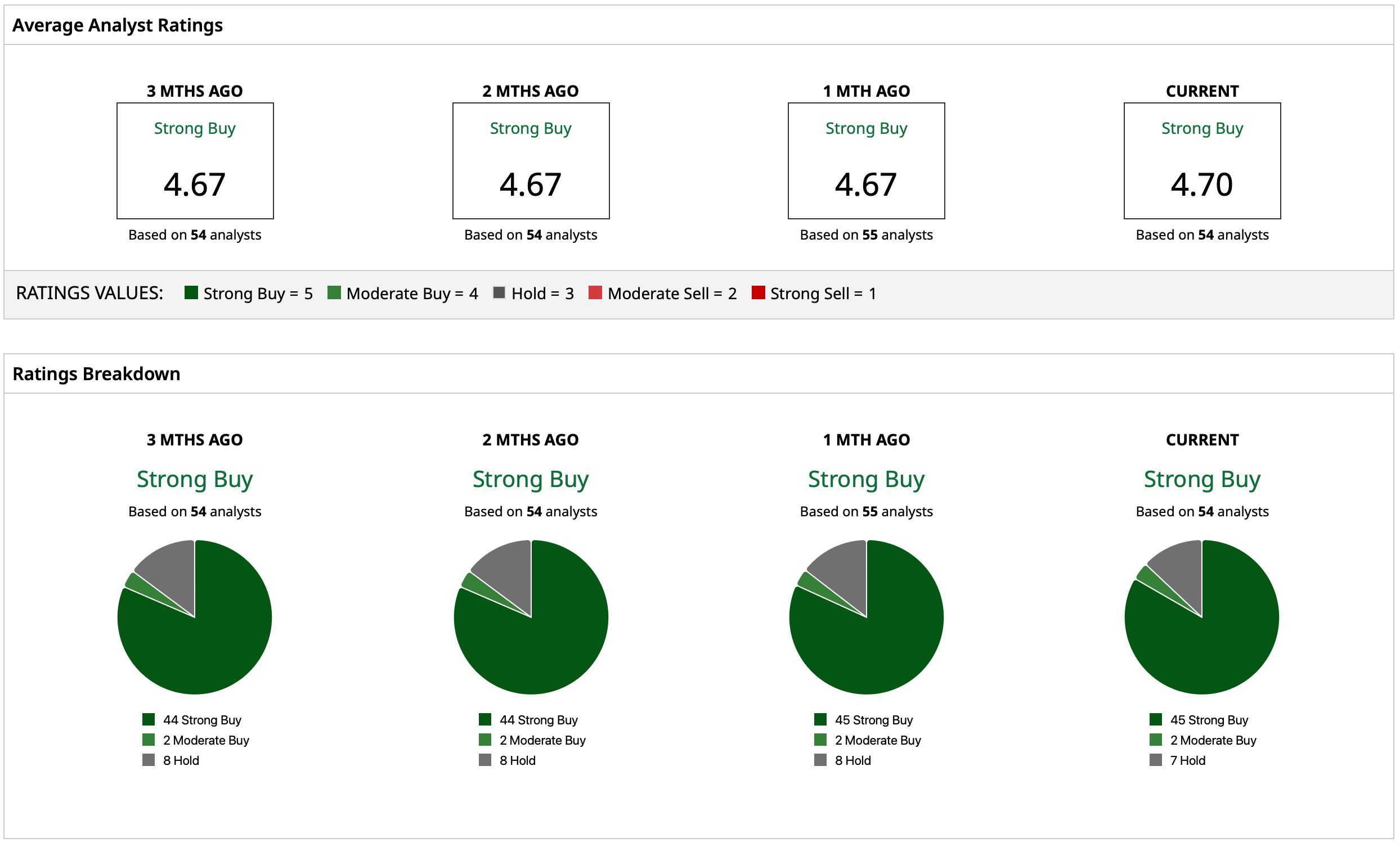
Wall Street remains upbeat about META stock, though, giving it a consensus “Strong Buy” rating. The mean target price of $761.38 indicates a potential upside of 2% from current levels. Out of 54 analysts covering the stock, 45 have a “Strong Buy” rating, two have a “Moderate Buy” rating, and seven have a “Hold” rating.
 www.barchart.com
 On the date of publication, Pathikrit Bose did not have (either directly or indirectly) positions in any of the securities mentioned in this article. All information and data in this article is solely for informational purposes. For more information please view the Barchart Disclosure Policy here.
More news from Barchart
RBC Is Bullish on Kraft Heinz Stock and Expects Growth to Return in 2027 Huawei Is Ramping Up to New Chips in 2027. What That Means for Nvidia Stock Now. Meta’s Muse Is Dominating the App Store. What This Means for META Stock. This Blue-Chip ‘Loser’ Just Might Offer Contrarians a Pleasant Surprise