

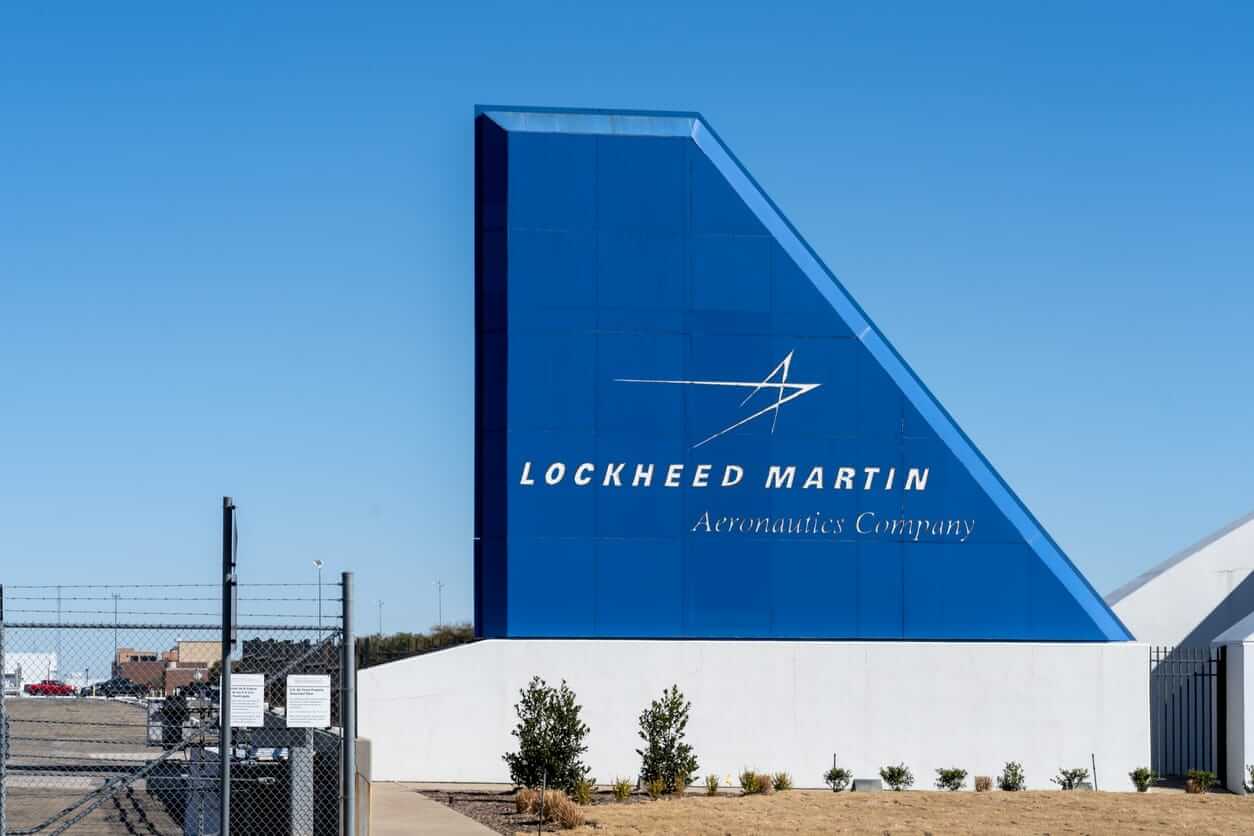
Lockheed Martin (LMT) has secured a potentially significant new catalyst for investors, with the U.S. Army awarding the defense giant an indefinite-delivery, indefinite-quantity (IDIQ) contract valued at up to $1.2 billion to produce the next-generation Precision Strike Missile (PrSM) Increment 2. This was announced on Sept. 21 and covers initial procurement, future orders, follow-on production, and continued development of the missile, with work to be performed at Lockheed Martin facilities and across its U.S. industrial base.
The contract moves PrSM Increment 2 from flight testing toward production after two successful flight tests in 2026. The first test took place in March, while the second in August demonstrated the missile’s ability to engage a moving maritime target. The Increment 2 variant features a multimode seeker designed to engage both moving land and maritime targets, expanding the Army’s long-range precision-strike capabilities beyond the baseline system.
More Top Stocks Daily: Go behind Wall Street’s hottest headlines with Barchart’s Active Investor newsletter.
Moreover, the award comes as the company expands its PrSM manufacturing capacity, with plans to quadruple production while continuing development of additional missile increments. Additional Increment 2 flight tests are scheduled for 2027, while initial production will begin under the new contract. Thus, giving investors another important development to watch as Lockheed Martin strengthens its missile portfolio.
About Lockheed Martin Stock
Lockheed Martin is a Bethesda, Maryland-based global aerospace and defense company that develops and manufactures advanced aircraft, missile defense systems, precision weapons, satellites, and space systems. The company is a major supplier to the U.S. Department of Defense and other government agencies, with operations spanning four primary business areas: Aeronautics, Missiles and Fire Control, Rotary and Mission Systems, and Space. Lockheed Martin had a market cap of around $121.1 billion.
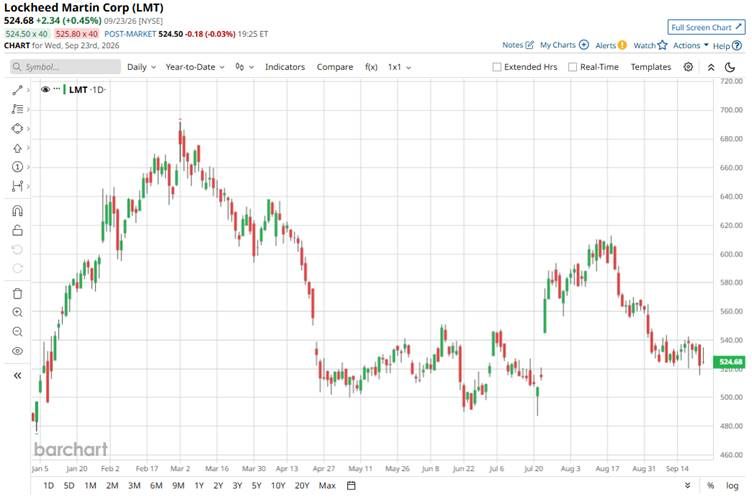
Lockheed Martin stock has delivered positive returns in 2026, although the shares have pulled back sharply from their March peak. LMT is up 8.5% year-to-date (YTD) and 7.8% over the past 52 weeks. At the last closing of $524.68, shares are about 24.2% below their 52-week high of $692, reached on March 2.
The recent weakness reflects broader pressure on defense stocks as investors weigh the outlook for U.S. defense spending, geopolitical developments, and the pace of growth across major programs.
Nevertheless, Lockheed Martin has several potential growth drivers that could support the stock, particularly its expanding missile business. The company is accelerating production of key systems such as Patriot missiles and recently officially unveiled its next-generation AIM-260 air-to-air missile, while demand for long-range precision weapons remains elevated.
On the other hand, LMT stock came under pressure on Sept. 22, falling 2.4% to $522.34. The decline came despite the company announcing a day earlier that it had won a U.S. Army contract worth up to $1.2 billion for the Precision Strike Missile. The stock recovered only marginally in the following session, causing the stock to remain down 2.3% over the past five trading days.
The weakness was largely tied to a shift in geopolitical expectations. Reports that Iran had offered to reopen the Strait of Hormuz within seven days if the U.S. took initial steps toward easing military pressure reduced the geopolitical risk premium supporting defense stocks.
 www.barchart.com
 The stock is currently trading at 17.59 times forward earnings, which is a discount compared to industry peers.
Stable Financial Standing
Lockheed Martin reported its second-quarter 2026 financial results on July 23. Sales rose 11% year-over-year (YOY) to $20.1 billion, while consolidated operating profit jumped to $2.5 billion from $748 million. Business segment operating profit increased to $2.2 billion from $571 million, reflecting stronger operating performance across the portfolio.
Net earnings surged to $1.8 billion, or $7.94 per share, compared with $342 million, or $1.46 per share, a year earlier and ahead of expectations. The year-ago results included approximately $1.6 billion of reach-forward program losses and $169 million of other charges, making the year-over-year comparison particularly favorable.
Cash generation also improved substantially. Cash from operations jumped to $3.2 billion from $201 million, while free cash flow swung to $2.9 billion from negative $150 million in Q2 2025. Lockheed Martin attributed the improvement primarily to the timing of customer receipts and lower tax payments. Capital expenditures were $318 million, compared with $351 million a year earlier.
At the segment level, Aeronautics sales increased 9.3% to $8.1 billion, while Missiles and Fire Control was another major growth driver, with sales rising 19.4% to $4.1 billion, supported by production ramps for PAC-3, THAAD, and Precision Strike Missile programs. Also, Rotary and Mission Systems sales grew 9% to $4.3 billion, and Space sales rose 5.7% to $3.5 billion.
Lockheed Martin also highlighted a record $230 billion backlog, including a multiyear contract with the Missile Defense Agency to produce THAAD interceptors. The company said it received approximately $65 billion of new orders during the quarter, underscoring continued demand for its defense and missile systems.
Following the strong quarter, management raised its full-year 2026 outlook, with the company now expecting sales of $79.75 billion to $81.75 billion, up from its previous $77.5 billion-$80 billion range. Business segment operating profit is projected at $8.5 billion-$8.7 billion, compared with the prior $8.425 billion-$8.675 billion outlook, while EPS guidance increased to approximately $29.95-$30.65 from $29.35-$30.25.
Lockheed Martin also raised its free cash flow forecast to approximately $7 billion-$7.2 billion from $6.5 billion-$6.8 billion, while capital expenditure guidance was reduced to roughly $2 billion-$2.4 billion from $2.5 billion-$2.8 billion. Cash from operations is now expected at $9.2 billion-$9.4 billion, compared with the previous $9.15 billion-$9.45 billion outlook.
Additionally, Street expects EPS growth of 6.7% YOY to $30.44 in fiscal 2026, followed by another 8.5% increase to $33.02 in fiscal 2027.
What Do Analysts Expect for Lockheed Martin Stock?
UBS turned more constructive on Lockheed Martin on Sept. 8, upgrading the stock to “Buy” from “Neutral” and raising its price target to $674 from $581. UBS analyst Gavin Parsons sees the company’s missiles and munitions business as a major source of upside, alongside growth in F-35 sustainment, CH-53K helicopters, and the Trident program driving revenue.
On the other hand, Jefferies reiterated its “Hold” rating on Lockheed Martin on Sept. 2, while maintaining its $595 price target.
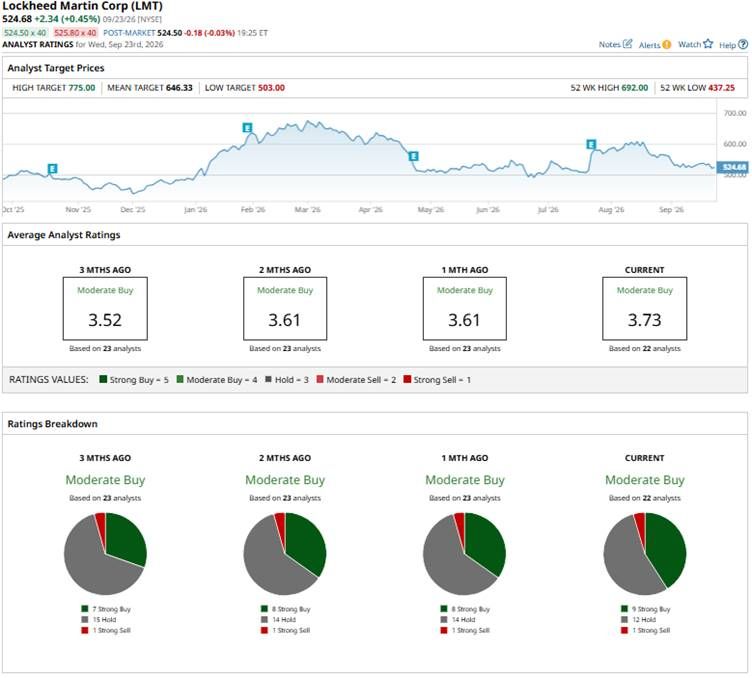
LMT stock has a consensus “Moderate Buy” rating overall. Out of 22 analysts covering the stock, nine recommend a “Strong Buy,” 12 analysts stay cautious with a “Hold” rating, and one advises a “Strong Sell.”
LMT’s average price target of $646.33 indicates potential upside of 23.2%, while the Street-high target price of $775 suggests 47.7% upside ahead.
 www.barchart.com
 On the date of publication, Subhasree Kar did not have (either directly or indirectly) positions in any of the securities mentioned in this article. All information and data in this article is solely for informational purposes. For more information please view the Barchart Disclosure Policy here.