

Qualcomm’s (QCOM) story has changed quite a bit. After years of volatility, the chipmaker has started to find its footing as new artificial intelligence (AI) opportunities, an Amazon (AMZN) data-center deal, and easing U.S.-China trade concerns have given investors more reason to look beyond its smartphone-heavy past. That shift has helped QCOM stock regain momentum this year, with shares putting together an impressive run and jumping 9% in a single trading session on Sept. 21. The surge came right before Snapdragon Summit 2026, which gave the rally another jolt.
At the summit, Qualcomm unveiled its new Snapdragon 8 Elite processors while also showcasing AI-powered technologies for wearables and next-generation audio devices. The company is also pushing deeper into physical AI with plans to acquire PickNik Robotics.
More Top Stocks Daily: Go behind Wall Street’s hottest headlines with Barchart’s Active Investor newsletter.
Even after the latest movement, QCOM stock remains roughly 22% below its 52-week high, leaving an interesting gap between its recent momentum and its longer-term peak. In other words, Qualcomm has already taken its share of punches, but the chart is starting to look considerably healthier.
With Qualcomm now hovering near multi-month highs, the question is no longer simply whether the stock can keep climbing. It is about how investors should approach a stock that has already made a strong move recently. Let’s take a closer look at the setup and what traders should watch from here.
About Qualcomm Stock
Qualcomm is more than just a smartphone-chip story now. Based in San Diego, California, the semiconductor giant has built a broad technology business spanning processors, wireless connectivity, licensing and strategic investments. Its Qualcomm CDMA Technologies (QCT) segment develops chips and platforms, while Qualcomm Technology Licensing (QTL) monetizes the company's extensive portfolio of wireless patents, giving Qualcomm multiple engines under the hood.
With a market capitalization of about $212 billion, Qualcomm has spent the past four decades helping power the connected world. Now, the company is widening its runway, taking its power-efficient computing expertise into AI, data centers, automotive, enterprise, and industrial applications. The firm's Snapdragon and Dragonwing platforms are central to that push beyond handsets.
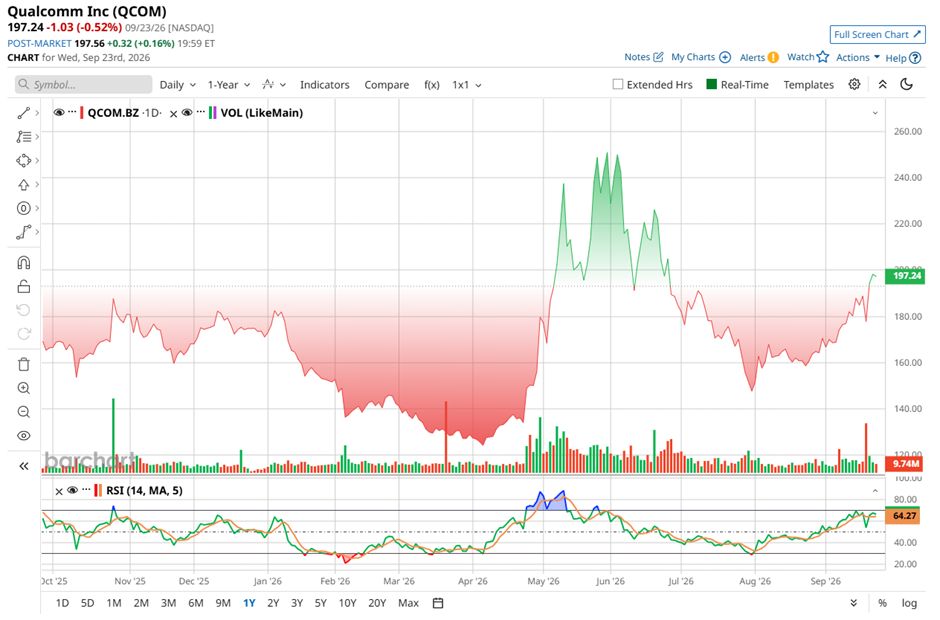
Qualcomm's chart has shown signs of volatility this year. QOCM stock started turning things around in April 2026, hitting a 52-week low of $121.99 before the rally really got going. By late May, shares had rocketed to a 52-week high of $259.92. But just as investors were getting comfortable, the story flipped. Fears that Qualcomm’s core smartphone-chip business could slow sent shares sliding in July.
The selloff did not stop there. After its third-quarter earnings-related drop, QCOM stock fell to around $142.89 in early August. Since then, though, Qualcomm has steadily worked its way back, reaching nearly $202 at current levels.
That comeback looks even more interesting when we zoom out. The stock is now 66% above its April low and has gained 55% over the past six months and 19% over the past 52 weeks. The recent momentum is hard to miss; QCOM stock has also jumped 26% over the past month. Clearly, this stock has had plenty of ups and downs, but the bulls seem to be getting the better ending right now.
Technically, QCOM stock’s rebound is starting to show some muscle. The 14-day RSI has climbed from late July’s oversold territory to around 67, suggesting buying momentum has returned while earlier selling pressure has cooled.
 www.barchart.com
 That improving chart is one thing, but Qualcomm's valuation gives the rally a little more context. The stock trades at roughly 25 times forward earnings. However, the forward sales multiple of 4.6 times is above both its sector peers and its own historical average, so the valuation picture is not exactly cheap.
The dividend adds another layer to the story. The company has increased its payout for 22 consecutive years and currently pays $0.92 per share each quarter, or $3.68 on an annualized basis. That translates to a forward yield of about 1.89%. Better yet, with a payout ratio of roughly 40%, Qualcomm is not stretching its balance sheet just to keep shareholders happy. That leaves some breathing room for future dividend increases.
A Snapshot of Qualcomm's Q3 Report
Released on July 29, Qualcomm's Q3 fiscal 2026 results showed revenue holding up better than expected, although earnings came in below consensus as weaker handset demand and higher costs weighed on profitability. Qualcomm posted $9.95 billion in revenue, down 4% year-over-year (YOY), while non-GAAP EPS fell 20% to $2.21. The company's core QCT business also felt the pressure, with revenue slipping 5% to $8.5 billion.
Automotive was a clear standout, however. Revenue jumped 61% YOY to a record $1.6 billion, marking Qualcomm’s 23rd consecutive quarter of double-digit growth. A favorable product mix and higher average selling prices contributed $381 million, while higher shipments tied to digital cockpit, advanced driver-assistance, and automated-driving launches added $223 million.
The weak spot was handsets. Revenue from the category plunged 20% YOY to $5.1 billion as major OEMs reduced chipset purchases and worked through inventory amid tight memory supply and rising memory prices. There could be some relief ahead, though, with management expecting China handset revenue to rebound sequentially in fiscal Q4.
For Q4, management projects $9.7 billion to $10.5 billion in revenue and $2.05 to $2.25 in non-GAAP EPS. QCT revenue is anticipated to be between $8.4 billion and $9 billion, while automotive revenue is expected to grow about 60% annually.
Costs remain another wrinkle, with higher wafer, assembly, testing, packaging and memory costs squeezing margins. The company has responded by raising prices, although management expects the margin benefits to build gradually. Still, the bigger picture is getting interesting. Qualcomm raised its fiscal 2026 exit outlook for annualized automotive revenue to about $7 billion, showing just how important the business beyond smartphones is becoming.
Analysts forecast an EPS decline of 43% YOY to $1.47 in Q4, while revenue is expected to be around $10.14 billion. Looking ahead, EPS is projected to slip 23% YOY to $7.74 in fiscal 2026, then decline another 7% to $7.17 in fiscal 2027.
What Do Analysts Expect for QCOM Stock?
Most recently, Bernstein analyst Stacy Rasgon maintained a “Hold” rating on QCOM stock and set a price target of $165.
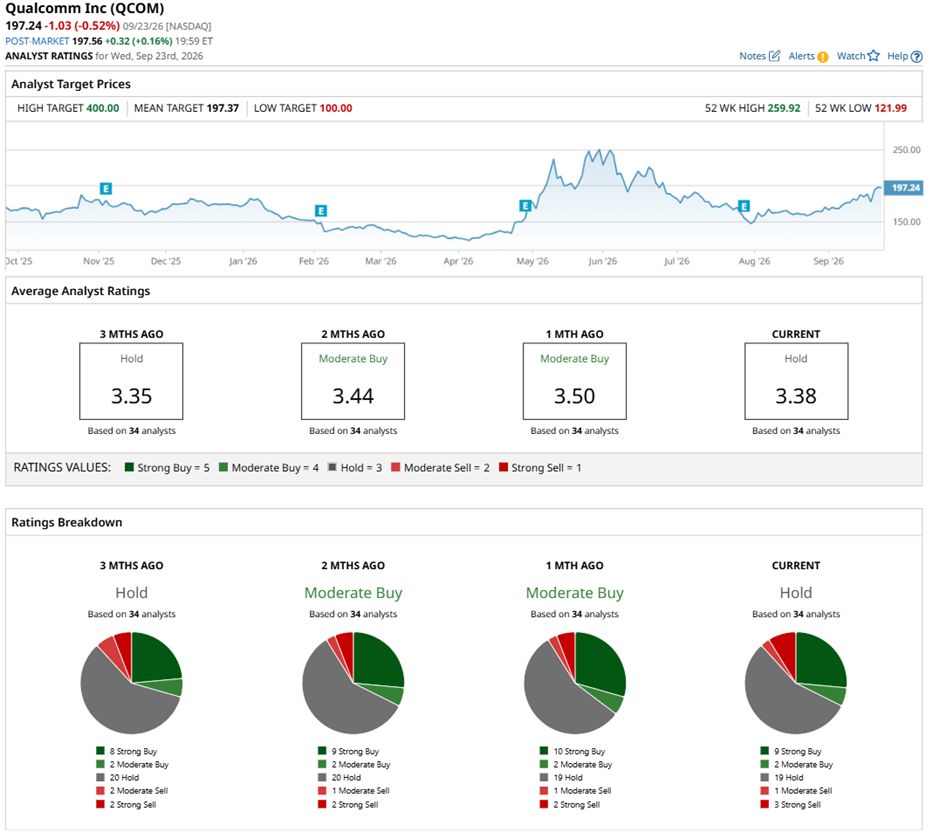
Overall, Wall Street’s view of QCOM stock has turned more cautious. Qualcomm currently carries a consensus “Hold” rating based on 33 analysts with coverage, down from a “Moderate Buy” rating a month ago. Out of those analysts, nine suggest a “Strong Buy,” two recommend a “Moderate Buy,” 18 analysts have a “Hold” rating, one has a “Moderate Sell,” and three analysts have a “Strong Sell" rating.
Qualcomm stock has already surpassed the average price target of $198.31. Meanwhile, the Street-high target price of $400 implies potential upside of 98% from current levels.
 www.barchart.com
 Final Thoughts on QCOM Stock
The recent rally has made QCOM stock interesting again, but shares trading near multi-month highs calls for a little patience. The chart has momentum and Qualcomm’s growing bets beyond the smartphone market add another piece to the story. For traders, the key may be watching how the stock handles its recent gains rather than chasing every move. After all, even good rallies need room to breathe.
On the date of publication, Sristi Suman Jayaswal did not have (either directly or indirectly) positions in any of the securities mentioned in this article. All information and data in this article is solely for informational purposes. For more information please view the Barchart Disclosure Policy here.
More news from Barchart
How to Trade Qualcomm Stock Near Multi-Month Highs Nvidia’s CEO Expects AI-Powered Cybersecurity to Boom. These 2 Companies Are Poised to Get a Big Boost From the Trend. This Cancer Drug Is Already Working. Now Its Nvidia-Backed Maker Is Going Public: Here’s What You Need to Know About Its IPO BlackRock’s CEO Is Backing a $1.5 Trillion Social Security Fund That Needs 75 Years to Work. CBO Projects the Trust Fund Runs Short In 2032.