

Qualcomm (QCOM) recently announced that Apple (AAPL) has renewed its licensing agreement with the company. Not revealing much about the contours of the deal, Executive Vice President and General Manager of Qualcomm Technology Licensing John Han said, “We are pleased to extend the Apple license agreement.”
Apple and Qualcomm have had a longstanding partnership over the years, wherein the latter supplied the former with modem chips, while Qualcomm also earned royalty revenues from Apple. However, since Apple acquired Intel's (INTC) modem business in 2019 for about $1 billion, its dependence on Qualcomm has been decreasing.
More Top Stocks Daily: Go behind Wall Street’s hottest headlines with Barchart’s Active Investor newsletter.
At one point, Apple sued Qualcomm for its supposedly excessive royalties. The suit was settled in 2019, and one of the points of settlement included a six-year global patent licensing agreement, effective April 1, 2019. This is the agreement that has been renewed and will be effective as of April 1, 2027.
About Qualcomm
Founded in 1985, Qualcomm is both a semiconductor company and an intellectual-property/licensing company. Its historical strength comes from inventing foundational wireless technologies and licensing them broadly, while its current strategy is to use that technology base to expand from smartphones into other areas.
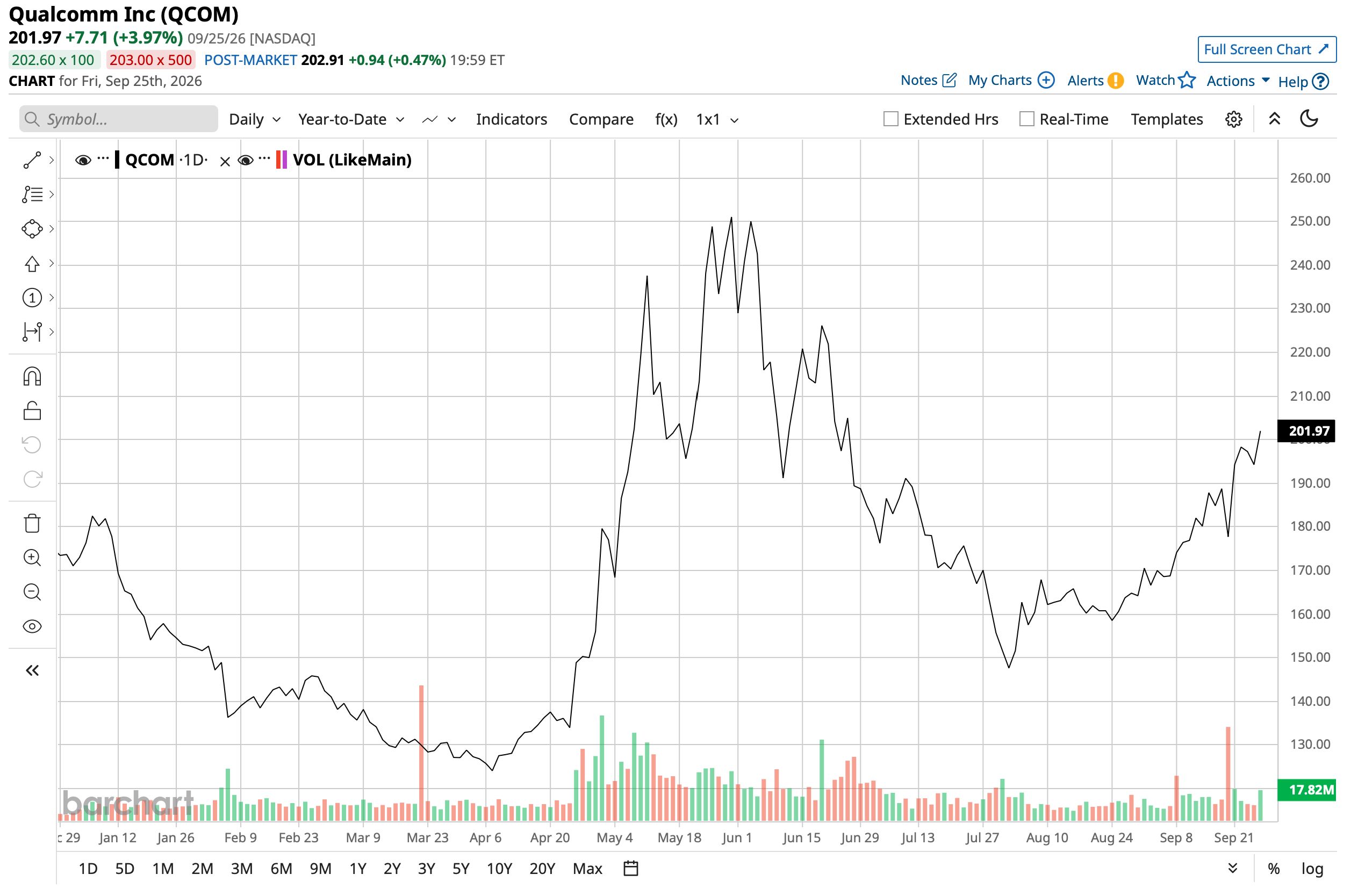
Valued at a market capitalization of $197 billion, QCOM stock is up 8% on a year-to-date (YTD) basis. The stock also offers a dividend yield of 1.82%, with the company on the verge of becoming a “Dividend Aristocrat,” having raised its dividend for the past 23 consecutive years.
So, Qualcomm hasn't been on fire. But does that make it a sound investment now? Let's take a closer look.
 www.barchart.com
 A Stealthy Start
When Qualcomm announced that it was reentering the data-center business, the market reacted positively. Shares popped as investors believed that the competitive intensity in the chip business would increase to challenge the hegemony of Nvidia (NVDA), and AMD (AMD) to a lesser extent. Yet after the initial pop, Qualcomm's share price performance has been sedated, to say the least. That's despite the company signing agreements with the likes of Meta Platforms (META), Amazon (AMZN) and Saudi Arabia's HUMAIN.
Why is Qualcomm ailing? Well, one of the reasons seems to be just plain bad luck. Qualcomm's core business is still handsets, and the sharp rise in memory prices has coincided with the company's AI ambitions — both of which require substantial memory infrastructure. Moreover, as mentioned earlier, Apple building its own modems has not helped matters for the company.
Qualcomm has ambitions to reach $15 billion in data-center revenue by fiscal 2029, and its recent deals with hyperscalers should certainly help. Having said that, funding a data-center business from scratch is an arduous task and dilutive to a company's margins. If a company's core business — like handset revenues for Qualcomm — takes a hit at the same time, the scenario becomes even more grim.
Things could change next year with Dragonfly, the company's data-center infrastructure platform encompassing AI accelerators, server CPUs, high-speed connectivity, and software with a particular focus on energy-efficient, rack-scale AI inference. Its speciality is framed around a tightly integrated compute stack that blends a dedicated AI core with general-purpose processing and a high-bandwidth memory (HBM) fabric so workloads can be moved between fast local compute and broader server resources without friction. In addition, Dragonfly is built to work with Qualcomm's broader ecosystem, which includes 5G network and edge-compute platforms so operators can push intelligence closer to customers while preserving centralized control and governance.
Finally, Qualcomm claims up to 8 times better tokens per second per watt than comparable GPU-based systems, more than 2 times better performance per watt than contemporary server CPUs, and 6 times higher memory bandwidth per watt than conventional HBM-based designs. Its High Bandwidth Compute (HBC) architecture places compute close to memory, reducing energy-intensive data movement, and is claimed to provide up to 200 times greater memory capacity per watt than SRAM-based approaches.
Qualcomm Reports a Mixed Q3
Qualcomm's latest results for the third quarter of fiscal 2026 were marked by a decline in both revenue and earnings. However, revenue at least managed to surpass Wall Street estimates, as high memory prices hurt overall operations.
Qualcomm's revenue fell 4% year-over-year (YOY) to $9.9 billion, as the key handset segment saw a sharp drop of 20% YOY to $5.1 billion. The decline in Q3 licensing revenue was not as acute, but it fell nonetheless. Coming in at $1.3 billion, licensing revenue was down 3% YOY. Meanwhile, non-GAAP diluted EPS fell 20% YOY to $2.21, missing the consensus estimate of $2.23 per share.
For Q4, Qualcomm expects EPS to be between $2.05 and $2.25. The midpoint of that guidance denotes an expected decline of 28% YOY from $3 per share in Q4 2025. In terms of sales, Qualcomm expects chips revenue to range between $8.4 billion and $9 billion and licensing revenue to range between $1.2 billion and $1.4 billion.
Notably, Q3 also saw gross margins correcting to 53% from 56% in the year-ago period. Further, net cash from operating activities for the nine months ended June 28, 2026 was $8.4 billion, down from $10 billion in the prior-year period. Overall, Qualcomm ended the quarter with a cash balance of $4.5 billion, higher than its short-term debt levels of roughly $2.5 billion.
Qualcomm's muted stock price performance this year has brought its valuation multiples to relatively reasonable levels, however. While its price-to-cash flow (P/CF) ratio of 17 times is below the sector median, the forward price-to-earnings (P/E) ratio of 26 times and the forward price-to-sales (P/S) ratio of 4.7 times are both above the sector medians of 23 times and 3.4 times, respectively.
What Do Analysts Think of Qualcomm Stock?
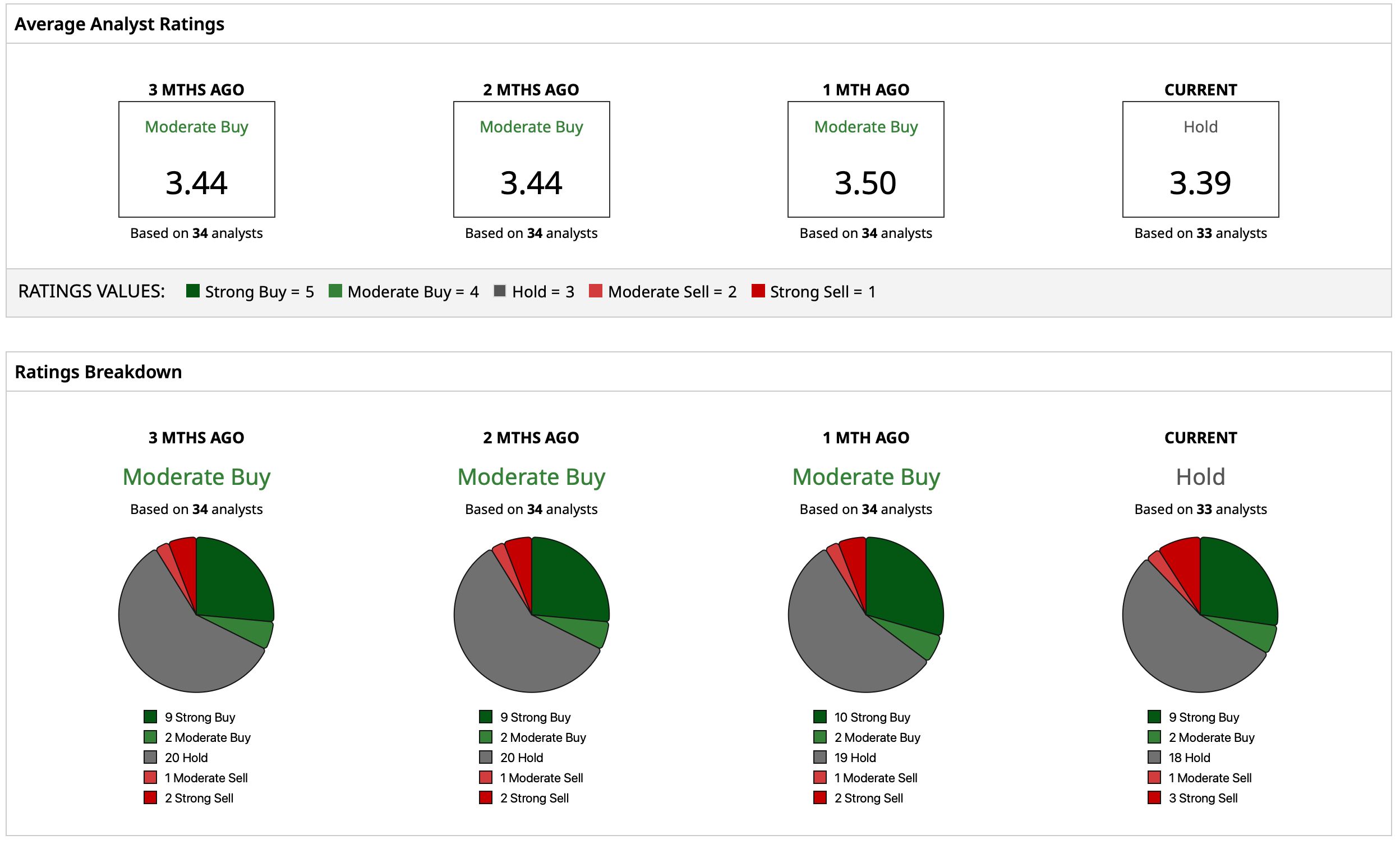
Overall, analysts have a consensus “Hold” rating for QCOM stock. Out of 33 analysts covering the stock, nine have a “Strong Buy” rating, two have a “Moderate Buy” rating, 18 have a “Hold” rating, one has a “Moderate Sell” rating, and three have a “Strong Sell” rating.
The mean target price of $198.31 indicates potential upside of 8% from current levels. Meanwhile, the high target price of $400 denotes potential upside of about 117% from here.
 www.barchart.com
 On the date of publication, Pathikrit Bose did not have (either directly or indirectly) positions in any of the securities mentioned in this article. All information and data in this article is solely for informational purposes. For more information please view the Barchart Disclosure Policy here.
More news from Barchart
How to Play QCOM Stock as Apple Renews Licensing Agreement With Qualcomm Dear Corteva Stock Fans, Mark Your Calendars for Oct. 1 Nvidia Just Spent Nearly $13 Billion on Something Other Than GPUs. Here’s How It Helps NVDA. Dear Nike Stock Fans, Mark Your Calendars for Oct. 1