

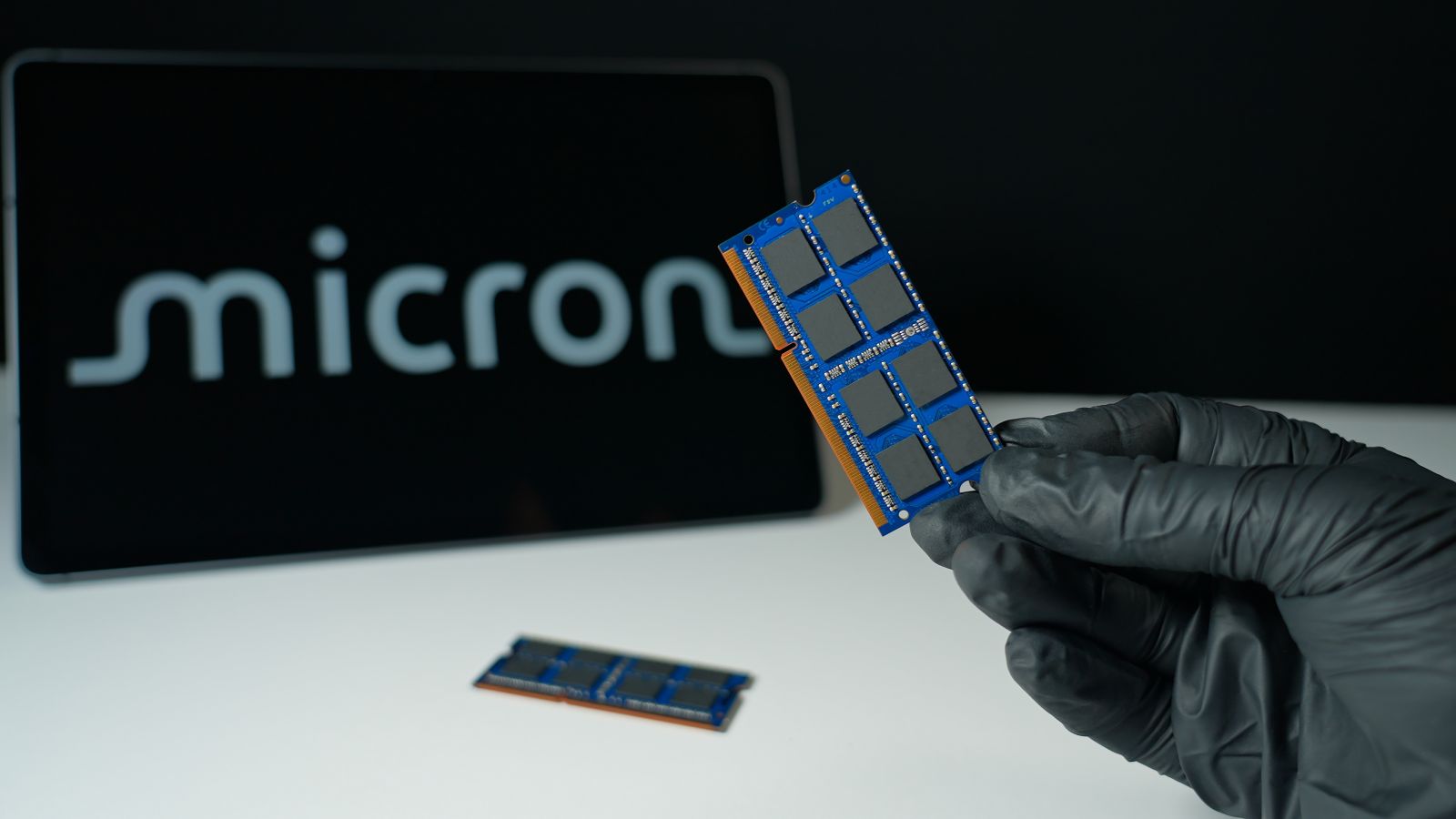
Micron Technology (MU) delivered fiscal fourth-quarter adjusted earnings of $33.42 per share on revenue of $54.23 billion after the close on September 30, 2026, surpassing already elevated Wall Street consensus estimates of $31.72 per share and $51.49 billion amid what management described as one of the most severe memory shortages in industry history.
Revenue surged approximately 379% year-over-year from $11.32 billion, marking the company's seventh consecutive quarter of triple-digit percentage earnings growth — yet shares rose only 1.7% in after-hours trading compared to the options market’s implied move of 6.3%, a possible signal that extraordinary performance is now the baseline expectation.
Can’t Get Enough Options?: Join the list for Barchart’s daily unusual options report, delivered free.
Software-Like Margins From a Chip Maker
The quarter's most striking figure was not the top or bottom line but the gross margin of approximately 86% — a level that would be remarkable for a capital-light software company, let alone a semiconductor manufacturer historically subject to brutal commodity cycles.
That margin resilience is anchored by high-bandwidth memory sold under fixed-price, long-dated strategic customer agreements, and it will determine whether the market rerates Micron from its current forward adjusted price-to-earnings ratio of roughly 14 times.
Full fiscal year 2026 results were equally extraordinary, with total revenue reaching $133.19 billion and GAAP net income of $84.97 billion — or $74.33 per diluted share — representing a complete transformation from the $37.38 billion in revenue generated in the prior fiscal year.
Guidance That Outran the Bulls
Perhaps more critical than the backward-looking results was forward guidance that exceeded expectations by a wide margin, with management projecting fiscal first-quarter 2027 adjusted earnings of $38.15 per share on revenue of $61.5 billion at the midpoint, well above the $35.47 per share and $57.4 billion analysts had modeled.
CEO Sanjay Mehrotra stated that fiscal 2027 is expected to be even stronger than the record year just completed, signaling no near-term deceleration in the AI-fueled memory supercycle.
“AI is becoming Super Intelligence (SI), and memory enhances this intelligence and the competitiveness of our customers’ platforms,” said Mehrota in a release accompanying the results. “We are increasing our investments in technology, products and manufacturing to help drive SI forward with our customers, and our Strategic Customer Agreements provide added confidence in the durability of Micron’s financial performance.”
HBM4 and $100 Billion in Contracted Revenue
Micron's HBM — high-bandwidth memory — franchise has become the company's growth engine, with HBM4 ramping at approximately twice the pace of its predecessor. The company's 16 multi-year strategic customer agreements, 14 of which carry approximately $100 billion in minimum-price revenue with contractual price floors, provide a level of earnings visibility unprecedented in the memory industry.
Cloud memory revenue nearly doubled sequentially to $16.28 billion, while the Core Data Center Business unit contributed $18 billion, reflecting the overwhelming concentration of growth in AI infrastructure spending.
The Ripple Effects Across Tech's Biggest Names
Micron's pricing and supply commentary serves as the most authoritative barometer for the entire memory ecosystem, and the downstream pressure is already visible.
Nvidia (NVDA) has attributed gross margin pressure to memory scarcity, Microsoft (MSFT) disclosed billions in higher component costs, and Dell Technologies (DELL) saw inventories more than double in apparent pre-buying ahead of further price increases.
Apple (AAPL) has passed through memory cost increases directly to consumers, with the iPhone 18 Pro line priced $100 above its predecessor.
The Risk the Market Is Pricing In
However, the muted after-hours reaction for MU stock — despite a beat-and-raise quarter of historic proportions — suggests the market is laser-focused on cycle duration rather than near-term beats, and any hint of demand normalization could trigger a sharp multiple compression from already depressed valuations.
If Micron's guidance pointing to continued tightness into 2027 proves accurate, memory producers will continue capturing an outsized share of AI infrastructure profits — but if not, 86% gross margins will look like the peak of a cycle rather than the new floor.
This article was created with the support of automated content tools from our partners at Sigma.AI. Together, our financial data and AI solutions help us to deliver more informed market headline analysis to readers faster than ever.
On the date of publication, Sarah Holzmann did not have (either directly or indirectly) positions in any of the securities mentioned in this article. All information and data in this article is solely for informational purposes. For more information please view the Barchart Disclosure Policy here.
More news from Barchart
Micron Just Reported Earnings in the Middle of a Memory Shortage. Here Are the Numbers You Need to Know. Huge Call Options Volume in ViaSat - Is VSAT Stock Set to Spike Higher? If You Love Speculating, You Should Keep a Close Eye on Novo Nordisk Stock 2 Covered Call Ideas on Shopify Stock. Which One is Better?