


Two tech giants have recently made major AI agent moves. Meta Platforms (META) launched Muse on Sept. 8, a personal agent that can book travel, send emails, and shop on a user’s behalf. It reached No. 1 on Apple’s (AAPL) U.S. App Store only 10 days later. Then on Sept. 25, Microsoft (MSFT) unveiled a redesigned Copilot built around agents. It brings Word, Excel, and PowerPoint inside Copilot and adds Autopilot, an agent that can handle multi-step work tasks on its own. Both companies want to own the AI that does work for you. But they’re chasing very different customers.
Meta’s Reach Comes With a Catch
Meta’s biggest advantage is reach. It can promote Muse across Facebook, Instagram, and WhatsApp, and downloads have already passed 3.4 million, according to Sensor Tower. Few companies can put an agent in front of that many people this quickly. The weak spot showed up within two weeks. On Sept. 20, Amazon (AMZN) blocked Muse from shopping on its site, saying Meta never had permission. To me, that’s the bigger issue for consumer agents. Much of what Muse needs to do happens on other companies’ platforms, and they can shut it out. Meta also hasn’t made clear how Muse will make money yet, though its Shopify (SHOP) partnership points toward commerce.
More Top Stocks Daily: Go behind Wall Street’s hottest headlines with Barchart’s Active Investor newsletter.
Microsoft Plays on Home Turf
Microsoft’s agent works inside tools it already owns. Autopilot gets its own work account, and the business decides what it can access. Microsoft said security and compliance worries have made it hard for companies to bring in agents, and it designed Autopilot around that. No outside platform can block Copilot from working in Word or Teams. I think that’s Microsoft’s strongest card. Businesses already spend their day inside its software, which makes adding an agent there an easy sell. Microsoft also has a clear way to charge for the agent, pairing user subscriptions for everyday use with usage-based billing for advanced features. The challenge is winning people over. Critics have said Microsoft’s many Copilot products left customers confused, so this version needs to prove it’s worth paying for.
Which Stock Is More Attractive Right Now?
If I were answering the above question one month ago, META would have been the obvious winner. It was trading at under 20x forward earnings, and in hindsight, that was a price worth backing the stock at. Since Muse came out, the stock is slowly inching toward the 25x mark, which is where Microsoft currently sits.
Based on the earnings multiple, I would say there isn’t a clear winner now that META has re-rated. If I had to pick which company turns agents into revenue first, it would be Microsoft. Meta may end up with far more users, but Microsoft already has a clear way to get paid. In that context, I would back Microsoft at the current share price.
How Have META and Microsoft Stocks Performed?
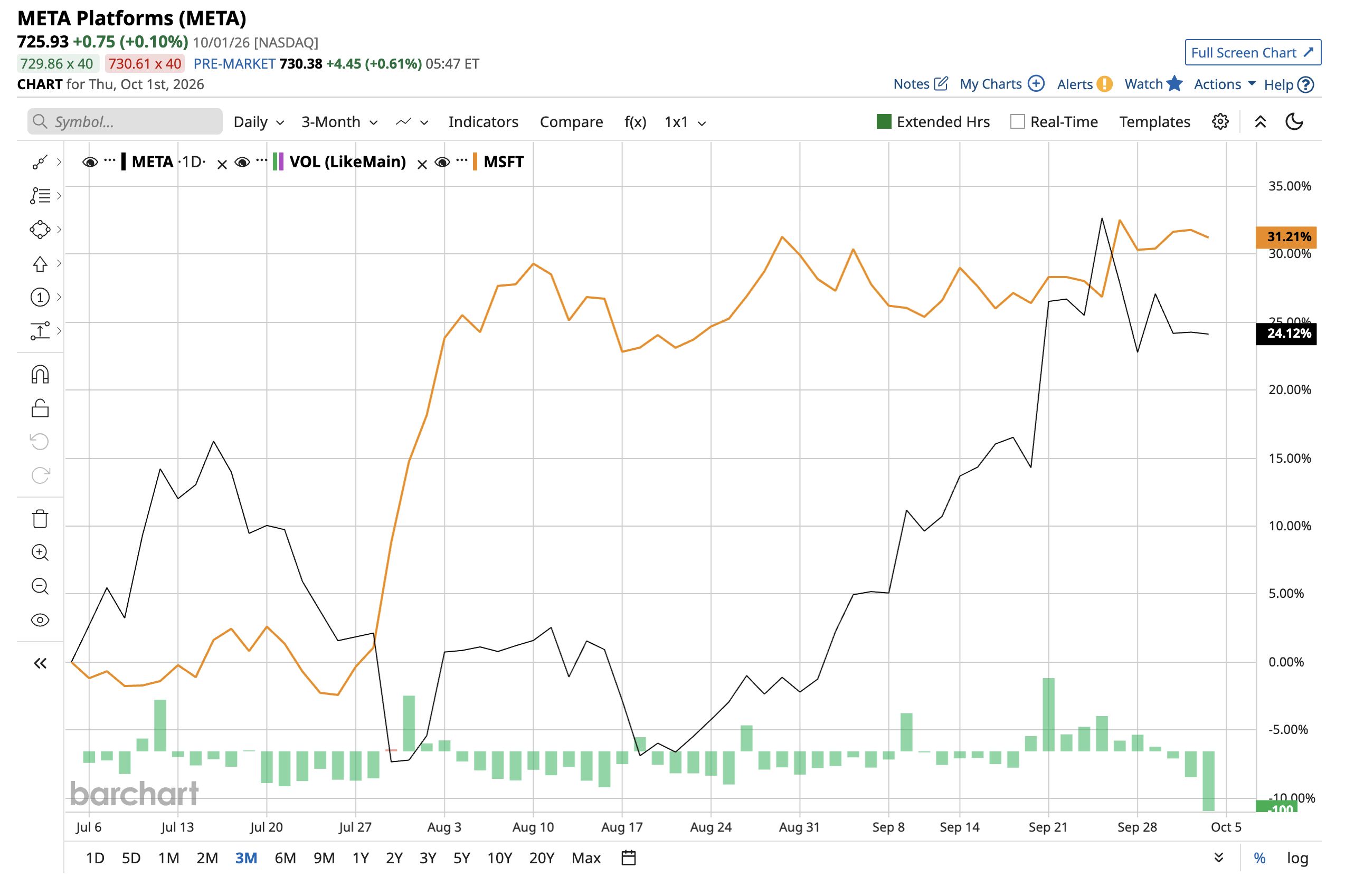
If we look at the stock performance, Meta shares have gained almost 12% year-to-date, outperforming Microsoft’s 8% rise over the same period. However, Meta’s path has been volatile. The stock fell to $525 in late March and then started gaining traction. Most of the gain came after the company released Muse on Sept. 8, making the stock rise about 30% from its end-of-August close of $572.34 to around $750. Early adoption pushed the shares up 11.4% on Sept. 21, the company’s best day since April 2025. Similarly, Microsoft rose almost 31% following its fourth-quarter earnings on July 29. The stock jumped 15.5% on July 30 and gained 19% over the two days after the release. However, Meta’s lead over Microsoft is narrow and may not last. Both stocks fell sharply earlier in the year and then bounced back because of company-specific factors.
 barchart.com
What Do Analysts Think Of META and Microsoft Stocks?
Based on 54 Wall Street analysts covering the stock, META holds a consensus “Strong Buy” rating. The stock has a mean price target of $798, which reflects a modest 10% upside from current levels. Similarly, MSFT holds a consensus “Strong Buy” rating, and its mean price target of $565 also implies a 10% upside from the current share price.
On the date of publication, Jabran Kundi did not have (either directly or indirectly) positions in any of the securities mentioned in this article. All information and data in this article is solely for informational purposes. For more information please view the Barchart Disclosure Policy here.
More news from Barchart
Carnival Corp Generates Strong Free Cash Flow - What's the Best CCL Play Analyst Sees 6 Million iPhone Duo Sales This Year. Why That’s Not Enough to Move AAPL Stock. Netflix’s Own Co-CEO Just Warned of Slowing Growth Meta vs. Microsoft: One AI Agent Has a Problem the Other Doesn’t.