

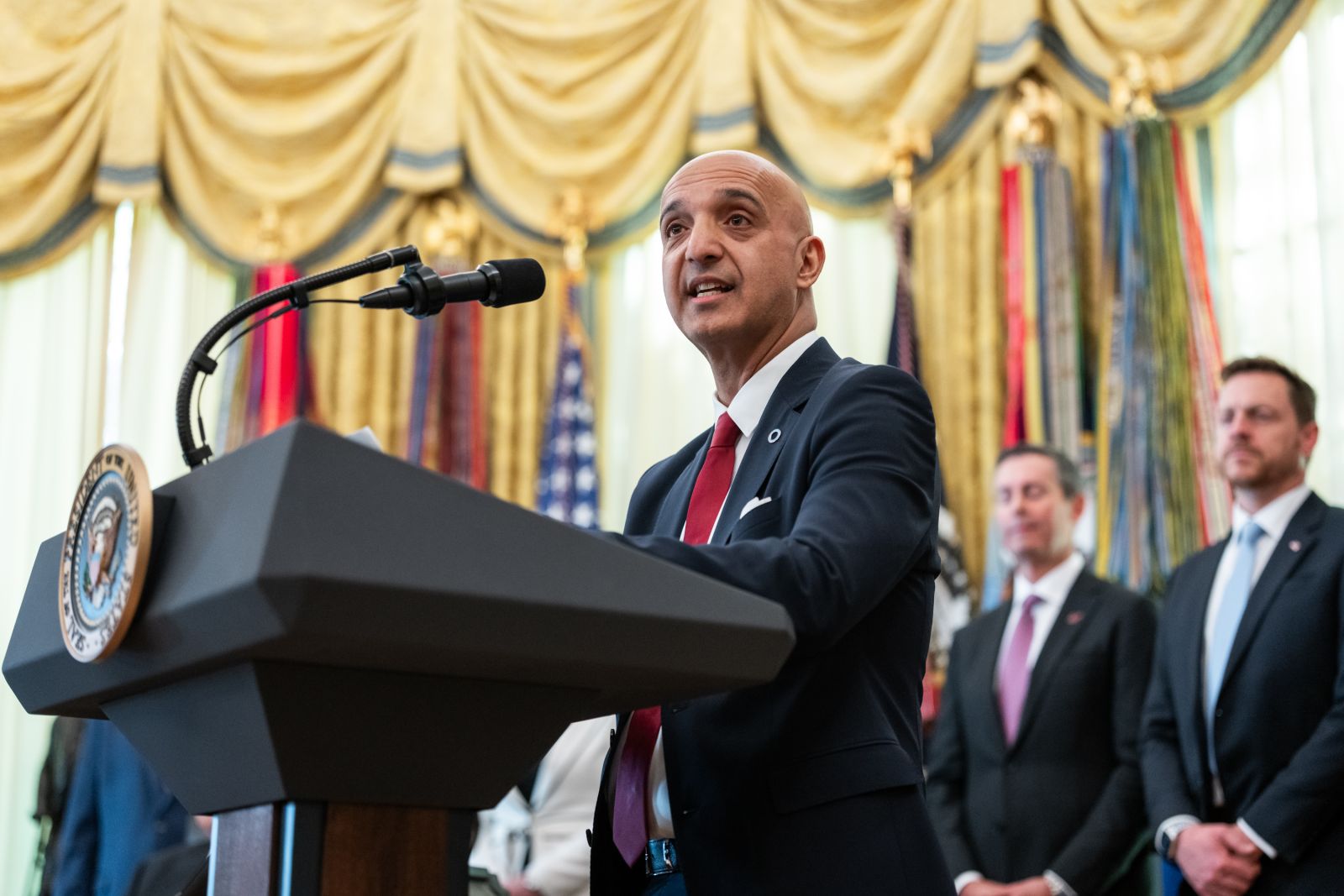
Jim Cramer put the obvious question to Novo Nordisk's (NVO) chief executive: Why does the stock keep falling when the news keeps getting better? Mike Doustdar had a surprising response: “Coming back to your comment about the stock price, the stock market is always right, but with a bit of a time difference,” he said. “It's fair.” Executives almost always answer that the market has it wrong, but Doustdar instead says patience on timing is key.
The facts he was conceding sat awkwardly together. Novo beat expectations and raised its outlook on Aug. 5; the shares fell on the day. The company is in the middle of what Doustdar elsewhere in the same interview called the best product launch in pharmaceutical history, and full-year sales guidance is still for a decline, improved three times this year and negative at every revision. A reader could reasonably assume one of those four things must be untrue. All four are true at once.
More Top Stocks Daily: Go behind Wall Street’s hottest headlines with Barchart’s Active Investor newsletter.
Sponsored Content: A $9 Trillion Flying Car Market Is Taking Shape. This Company Is Open to Investors.
Doustdar's explanation is arithmetic: “You know this from math: if you halve the price, you have to double the volume to make it even, but you can halve the price on day one,” he said. “You cannot double the volume on day one.” A price cut lands in a single day across an entire installed base. The volume response arrives over quarters, prescription by prescription. The gap between those two speeds is where a share price goes to die.
Halving price does require doubling volume to hold revenue flat; that part is exact. But gross profit drives a stock, and it doesn't scale the same way. Every unit still costs something to make and distribute, so when the price halves, the per-unit margin falls by more than half. He was equally direct about why the cut was unavoidable. “It is not conceivable that people can pick up a box of Ozempic or Wegovy for $1,000, frankly speaking,” he said. “So we needed to take the hard pill. We had to basically reduce the price quite a bit.”
The structural difficulty is in the mix. “The majority of our sales are on the injectable side,” Doustdar said. “And last year on the back of MFN and price pressure, we reduced the prices of Ozempic and Wegovy tremendously.” So the fast-growing part of the business is the smaller part, and the larger part is absorbing a deliberate price reset. Barchart wrote about the early moves in that direct-pricing strategy when the company launched Wegovy subscriptions.
Then he did something unusual: he set his own test. “What I think we need to do is again, continue the results, like we have shown in the last two quarters over a period of time,” he said. “And then this moment turns into a trend. And hopefully the stock market will also follow.” That is a falsifiable standard, supplied voluntarily by the person being measured: two more quarters of the same, and the time difference he is asking for either closes, or it does not.
One caution about accepting his single-variable story. Pricing is not the only reason the shares have fallen. Barchart reported on a late-stage heart drug trial failure that removed a route to broadening the company beyond weight loss, and he concedes elsewhere in the interview that Eli Lilly (LLY) has been taking share. A stock can be marked down for a pipeline disappointment and a competitive one at the same time as a pricing one, and the market is not obliged to separate them politely. More generally, good news isn't always enough for a stock when the level still points the wrong way.
What makes his claim testable rather than rhetorical is that the measurement already exists. Novo breaks out volume growth and price effect for the obesity franchise in its quarterly announcements. If volume growth is closing on the price drag, the time difference is real and datable. If the lines are parallel, it is not. That is arithmetic conditional on what the company itself discloses, not a forecast, and emphatically not a view on whether anyone should own the stock.
On the date of publication, Caleb Naysmith did not have (either directly or indirectly) positions in any of the securities mentioned in this article. All information and data in this article is solely for informational purposes. For more information please view the Barchart Disclosure Policy here.
More news from Barchart
Following Tilray Earnings, Here's What Comes Next for TLRY Stock Dear UnitedHealth Stock Fans, Mark Your Calendars for October 13 ‘I Got Slaughtered’: Kevin O’Leary Says Shorting Yahoo Cut His Net Worth ‘40, 50%’ After ‘Losing 3, 4 Million An Hour’ So He ‘Never Ever Ever Shorted A Stock Again’ Novo Nordisk’s CEO Was Asked Why His Stock Keeps Falling on Good News: ‘The Stock Market Is Always Right, but With a Bit of a Time Difference’