

United Airlines (UAL) stock investors have a date to circle on their calendars—Oct. 20. The airline is set to report its third-quarter 2026 results after the market closes on Tuesday, and this time, the question is whether strong passenger demand can make up for the rising cost of keeping its planes in the air.
The ongoing war in the Middle East has sent oil prices higher, putting pressure on airlines’ fuel bills and threatening profitability. United Airlines is not immune, with its shares already down 15% on a year-to-date (YTD) basis. Still, there is a silver lining. Resilient bookings, premium travelers willing to pay more, and recent fare increases have helped support revenue. The airline is also investing in customer experience, including free high-speed Wi-Fi and upgraded entertainment, to keep passengers coming back.
More Top Stocks Daily: Go behind Wall Street’s hottest headlines with Barchart’s Active Investor newsletter.
However, higher labor and other operating expenses remain challenges, and analysts expect the bottom line to decline despite higher revenue. United Airlines has beaten EPS estimates in each of the past four quarters. Can it keep that streak alive? Let’s take a closer look at what analysts expect from the upcoming report.
About United Airlines Stock
Based in Chicago, Illinois, United Airlines is one of the world’s leading airlines, connecting millions of travelers to more than 370 destinations across six continents. Its extensive network covers major cities across Europe, Asia, Australia, Latin America, the Middle East, and Africa, making it a major player in international travel. With a market capitalization of roughly $31 billion, United has the global reach to compete in the crowded airline industry.
The airline is also working to make flying more connected. Its Starlink Wi-Fi service is now available on nearly half of its daily departures. United has also launched a digital tracker at StarlinkTracker.United.com, allowing passengers to check whether their upcoming flight offers Starlink Wi-Fi. The airline has extended its “Switch to Better Wi-Fi” status match campaign through Oct. 22.
UAL stock has had a rough time in 2026, and rising jet fuel costs have made the ride even bumpier. Geopolitical tensions have pushed fuel expenses higher, putting pressure on margins just as analysts expect the airline’s third-quarter bottom line to shrink. United is also scaling back planned flight capacity to protect profitability. Wall Street has noticed, and investors are not exactly handing out frequent-flyer miles for this strategy.
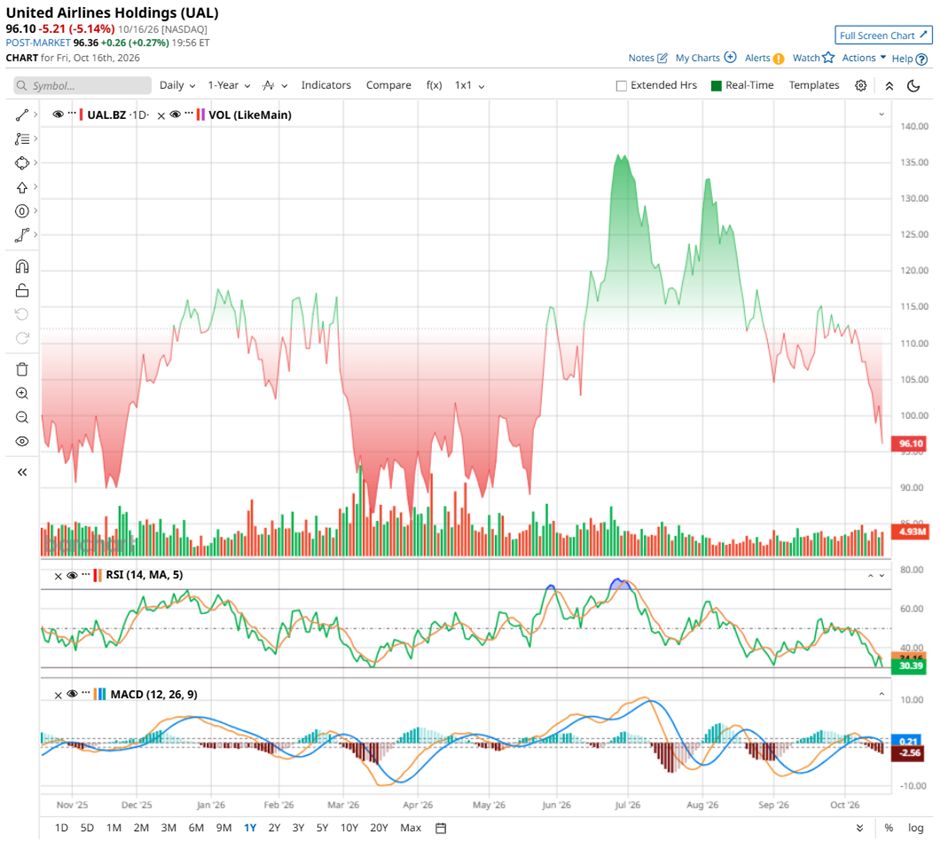
Shares have fallen over 31% from their June peak of $138.77, losing 19% over the past three months and another 8% in the last five trading sessions.
The technical picture is not much prettier. The 14-day RSI sits at 31, nearing oversold territory but not quite there. Meanwhile, the MACD line has slipped below its signal line, with the histogram in negative territory, pointing to continued bearish momentum.
 www.barchart.com
UAL stock might look like a bargain, with its forward non-GAAP P/E at 12.3x and price-to-sales multiple at 0.46x, both below airline sector averages. But Wall Street is not handing out discounts for fun. Rising fuel costs, uncertain earnings, and slower capacity growth suggest investors see turbulence ahead.
A Closer Look at United Airlines’ Q2 Earnings Report
United Airlines gave investors a mixed bag in July, when it reported its second-quarter 2026 results. The airline beat expectations on both revenue and earnings, but soaring fuel costs took a serious bite out of profitability. Operating revenue climbed 16% year-over-year (YoY) to $17.7 billion, supported by a 12.1% increase in total revenue per available seat mile (TRASM) and solid growth across premium travel, loyalty programs, and cargo. Adjusted EPS, however, fell 48.6% annually to $1.99.
Passenger demand remained healthy throughout the quarter. Passenger revenue rose 16.4% to $16.1 billion, with domestic revenue jumping 20.3% and international revenue increasing 11.2%. Premium revenue grew 16%; Basic Economy and loyalty revenue each advanced 11%, while contracted business revenue surged 27% on strong close-in bookings.
Traffic increased 3.8%, slightly ahead of the 3.5% capacity expansion, lifting the consolidated load factor by 0.3 percentage points to 83.4%. United carried 48.7 million passengers, up 5.4% from a year earlier, and operated its 10 busiest passenger days on record during June. Domestic load factor slipped 0.6 percentage points to 83.5%, while international load factor improved 1.2 points to 83.2%.
Unfortunately, filling more seats did not come cheap. Operating expenses climbed 19.2% to $16.6 billion, outpacing revenue growth. Aircraft fuel expense soared 84.1% to $5.1 billion as the average fuel price jumped 79.4% to $4.19 per gallon. Fuel consumption also increased 2.7%. As a result, adjusted operating income plunged 46.3% to $951 million, and the adjusted operating margin narrowed by 6.2 percentage points to 5.4%.
Still, United maintained a solid cash position. Operating cash flow reached $1.6 billion, while free cash flow totaled $322 million. Adjusted capital expenditures came in at $1.45 billion as the airline continued investing in its fleet and customer experience. Available liquidity ended the quarter at $19.6 billion, including $10.2 billion in cash and cash equivalents and $6.5 billion in short-term investments. Meanwhile, debt, finance lease obligations, and other financial liabilities totaled $26.5 billion.
Looking ahead, management expects fiscal 2026 adjusted EPS of $9 to $11, with third-quarter earnings projected at $2.50 to $3.50 per share. United also expects TRASM growth in both the third and fourth quarters to exceed Q2’s 12.1% increase. The airline expects to recover 80% to 90% of higher fuel costs in Q3 and the full increase by Q4. Adjusted capex is forecast at approximately $7.5 billion for 2026.
Wall Street has been adjusting its expectations because of higher fuel prices. Analysts expect United Airlines’ non-GAAP EPS to slip 6.5% YoY to $2.60 in Q3, while revenue is anticipated to rise to $17.9 billion in the September quarter. Looking ahead to fiscal 2026, EPS is anticipated to decline 25.9% YoY to $7.87 but then surge by 75.5% annually to $13.81 in the next fiscal year.
What Do Analysts Think About UAL Stock?
Wall Street remains optimistic about United Airlines, but rising fuel costs and macroeconomic uncertainty are keeping expectations in check. Recently, UBS analyst Atul Maheswari lowered his price target on UAL stock to $139 from $146 while maintaining a “Buy” rating.
He believes the airline needs to sustain strong travel demand to avoid downside risks. Meanwhile, a meaningful and lasting rally may be difficult to achieve unless jet fuel prices decline substantially. In short, United has demand on its side, but fuel costs could still spoil the party.
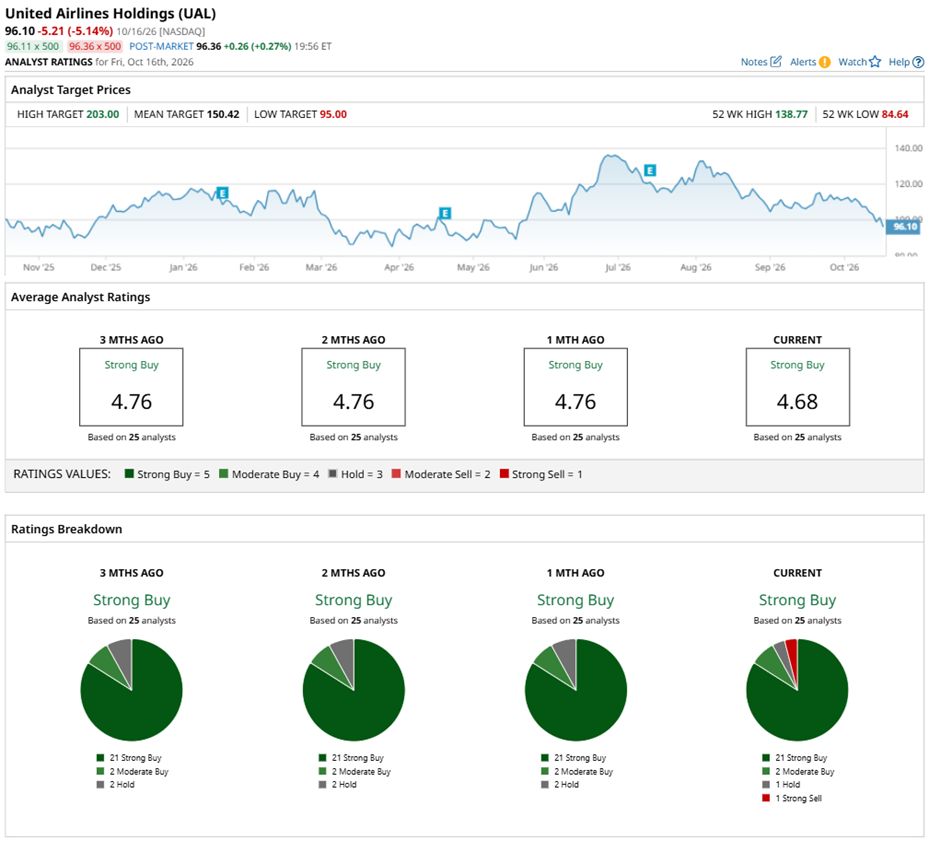
Overall, analysts are bullish about UAL’s growth prospects, giving the stock a consensus rating of “Strong Buy.” Of the 25 analysts covering the stock, 21 recommend a “Strong Buy,” while two suggest a “Moderate Buy,” one advises a “Hold,” and the remaining one has a “Strong Sell.”
The average analyst price target for UAL is $150.42, indicating potential upside of 57%. The Street-high target price of $203 suggests that the stock could rally as much as 111% from here.
 www.barchart.com
On the date of publication, Sristi Suman Jayaswal did not have (either directly or indirectly) positions in any of the securities mentioned in this article. All information and data in this article is solely for informational purposes. For more information please view the Barchart Disclosure Policy here.
More news from Barchart
Dear United Airlines Stock Fans, Mark Your Calendars for October 20 AutoZone Stock is Up and Price Targets are Still High - What's the Best AZO Play? Caterpillar vs. Deere: The Better Heavy Equipment Stock for the Data Center Boom TSMC Stock Just Delivered Another Blowout Quarter. Why It's a Buy for the Next 10 Years.