


While the commodities complex was mostly in the overnight through early Thursday morning, the Energies sector, led by diesel fuel, continued to trend higher.
Natural gas was the outlier, following Wednesday's rally with another sell off overnight possibly tied to a news release from the US Department of the Interior.
Don’t Miss a Day: From crude oil to coffee, sign up free for Barchart’s best-in-class commodity analysis.
The Grains sector was mostly higher early Thursday, with the spotlight still on soybean contracts holding above short-term moving averages.
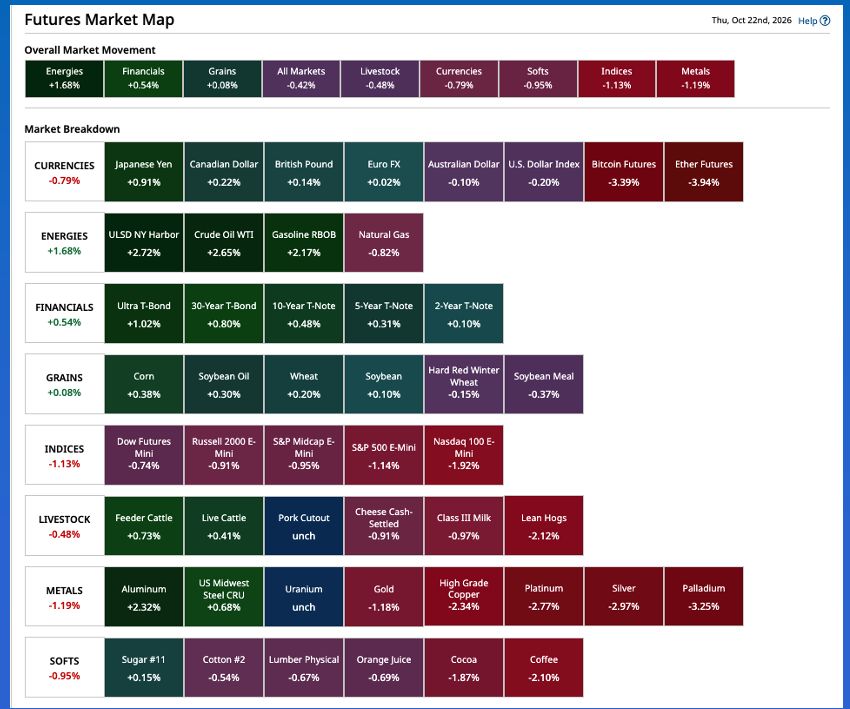
Morning Summary: As the old story goes, there are early birds and night owls, with every marriage tending to consist of one of each. The thing with early birds is that they have most of their energy during the quiet pre-dawn hours, fitting this morning with a look at the Barchart Futures Market Heat Map. Here we see the Energies sector running away from the rest of the commodity complex with diesel fuel leading the charge. The spot-month contract (HOX26) is up 13.25 cents at this writing and near its overnight high, though trade volume was surprisingly light at 1,300 contracts. The outlier in the Energies sector was our old friend natural gas, the famed Widow Maker itself. A look back at Wednesday’s close and we see the spot-month contract (NGX26) finished 17.3 cents (5.8%) lower with follow-through selling taking it another 6.4 cents in the red overnight through early Thursday morning. What got my attention, beyond natural gas doing natural gas things, was that I also received a news release from the US Department of the Interior yesterday afternoon proclaiming, “USGS Releases Assessment of Undiscovered Natural Gas Resources in Alaska’s North Slope: 96 Trillion Cubic Feet of Natural Gas Estimated”. This sounds like an opportunity for the Three Amigos to get rich(er) in Alaska.
Corn: The corn market was in the green pre-dawn, not by a lot, but enough to say there was some light follow-through buying from Wednesday’s closing rally. From a technical point of view, contracts completed short-term bullish reversals yesterday, indicating trends on daily charts have turned up. But before we get all bulled up on corn again, let me add we’ve seen these patterns before, only to have them fall apart when the next Keno game is played. On the bullish side, though, the next game is scheduled for November 10, so there is some time for Watson to do a little light buying after weeks of selling. A look at the quote screen this morning and we see contracts generally up 1.75 cents, again indicating most of the support is coming from noncommercial traders. On the commercial side, with Dec26 (ZCZ26) closing 1.25 cents higher Wednesday, the National Corn Index came in last night at $4.2450, also up 1.25 cents for the day. This would seemingly confirm the idea that cash sales of newly harvested bushels dried up after December futures fell nearly $1 since early September. Thursday’s weather forecast calls for continued clear harvest weather across the US Plains and Midwest.
Soybeans: This time around the clock, the oilseed sub-sector followed diesel fuel higher. November canola was up $5.00 at this writing and near its overnight high while December soybean oil was sitting 0.35 cent in the green, also near its session high. December soybean meal was the outlier, ticking into the red as I wrote the opening sentences to this segment. Which brings us to soybeans. Recall we have seen a number of layers of Lasagna Likeness laid down of late, with Wednesday’s session the latest in the recipe. If this continues Thursday, it means USDA will announce more export sales leading to another selloff in the future market with contracts rallying off session lows into the close. Things are a bit different this morning with November and January both up 2.25 cents to start the day on light trade volume of 10,500 contracts and 12,200 contracts respectively. Those aren’t big overnight trade volume numbers, so we’ll see what the rest of the morning brings. From a technical point of view, what stands out to me with soybeans is how contracts stubbornly continue to hold above 85-day moving averages. Heading into Thursday’s session, the January (ZSF27) 85-day is calculated near $12.5750 with the contract sitting near $12.6050.
Wheat: At least the wheat sub-sector should get a participation ribbon early Thursday morning. Why? Well, contracts were in the red, but not showing the double-digit losses that have become customary of late. December SRW (ZWZ26) was 0.25 cent lower after posting an overnight trading range of 4.0 cents, from up 2.75 cents to down 1.25 cents on trade volume of fewer than 10,000 contracts. There isn’t much in all of that to get excited about to start the day. Over in HRW we see December down 2.25 cents an on its session low while registering less than 2,000 contracts changing hands. With not much else to talk about, I’ll mention new-crop July winter issues were mixed with SRW up 0.75 cent and HRW down 1.0, both on trade volume that hasn’t quite reached 800 contracts as of this writing. Like the crop in the field itself, new-crop winter wheat markets are likely to go dormant until next spring. Speaking of spring, the December HRS issue was down 1.0 cent pre-dawn after losing 2.0 cents overnight. We’ve seen commercial pressure build in spring wheat this week with the carry in the Dec-March futures spread strengthening from last Friday’s close of 17.25 cents to 19.0 cents early Thursday morning.
On the date of publication, Darin Newsom did not have (either directly or indirectly) positions in any of the securities mentioned in this article. All information and data in this article is solely for informational purposes. For more information please view the Barchart Disclosure Policy here.
More news from Barchart
Which Sector Had the Most Energy Overnight? Down 12% in 1 Month, Bloom Energy Faces a Big Test on October 22. Here’s My Prediction. Electric Utility NiSource’s Data-Center Power Business Can Continue to Grow — And NI Stock Is Cheap U.S. Farm Debt Hits a Record $605 Billion — And an $8 Billion Bailout Covers Just 1.3% of the Tab